

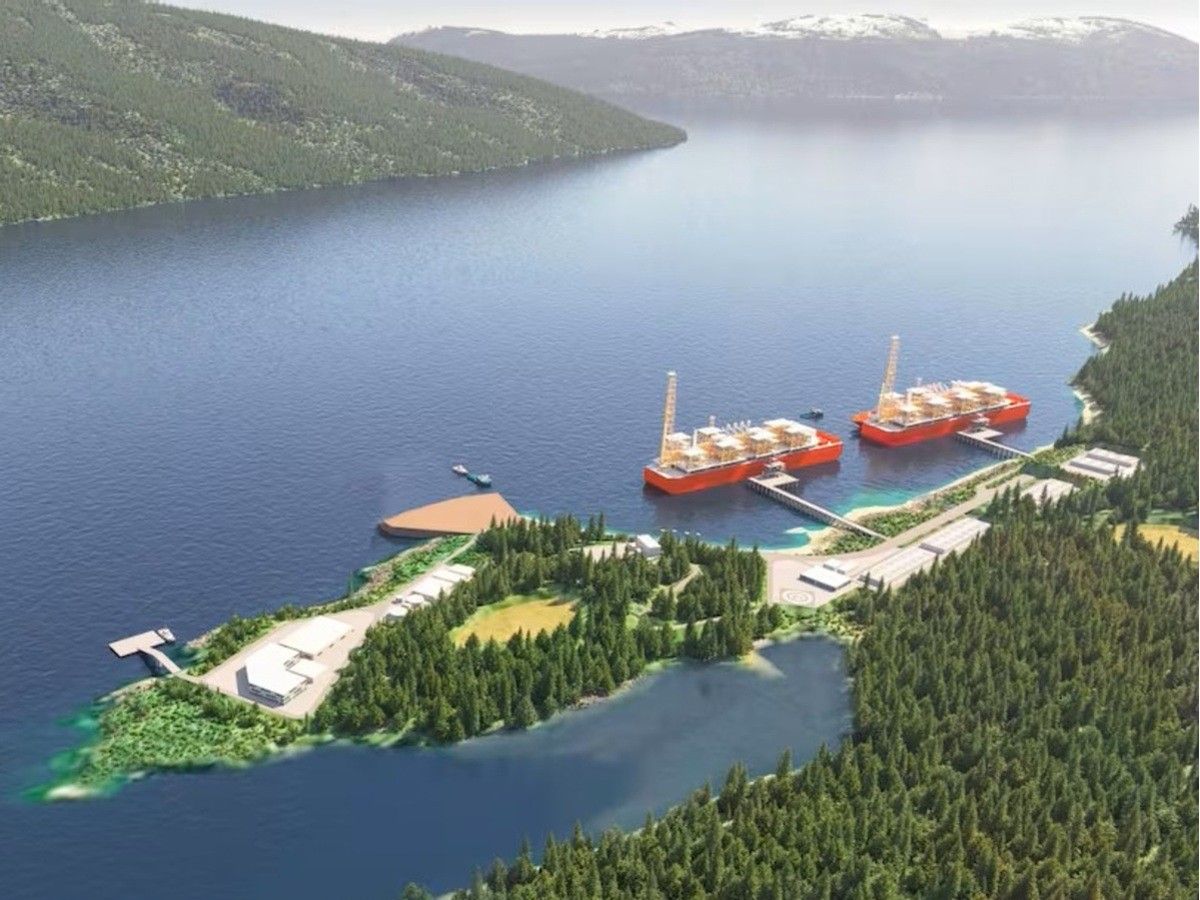
Nisga’a First Nation-backed Ksi Lisims LNG is closing in on making a final investment decision this year. On Tuesday, it signed benefit agreements with three First Nations as part of the work the project needs to complete as it moves toward that decision. Ksi Lisims still faces court challenges from another First Nation, but federal Natural Resources Minister Tim Hodgson heralded those agreements as “a testament to inclusive solutions-oriented development,” during his presentation to an investment-oriented audience at the Global Energy Show in Calgary.
The deals were unveiled a day after Ksi Lisims announced it had enlisted a second German-based gas utility as a potential customer in a little more than a week, and the latest customer has a wider distribution system that includes Sweden and the U.K. Hodgson delivered a wide-ranging speech that touched on all points of Prime Minister Mark Carney’s strategy to turn Canada into a “conventional energy superpower,” and highlighted Ksi Lisims as one of the next steps in that ambition. “It’s a $30-billion-plus, Indigenous led project, with emissions 94 per cent below the global average,” Hodgson said.
And with Ksi Lisims LNG in the spotlight in Calgary, CEO Davis Thames characterized its collaborations with First Nations as “the core of this project since its inception and a major part of what we see as making Ksi Lisims LNG a successful initiative.” Ksi Lisims’ benefit agreements are with the Metlakatla, Lax Kw’alaams and Gitxaala First Nations, which all have traditional territories around the project’s site northeast of Prince Rupert on Pearse Island, which is on Nisga’a First Nations territory. Details weren’t spelled out in their corresponding announcements, but the deals include financial provisions, business and employment opportunities, as well as support for climate initiatives. The agreement with Lax Kw’alaams will also see the First Nation withdraw its application seeking a judicial review of Ksi Lisims’ environmental approval.
Nisga’a First Nation Chief Eva Clayton said in a statement that the agreement “marks a step forward in our relationship with the Lax Kw’alaams” based on mutual respect and prosperity. “Our vision for Ksi Lisims LNG has always been about creating long-term prosperity for all communities across northwest B.C.,” Clayton said. Ksi Lisims, along with the associated Prince Rupert Gas Transmission pipeline, which is set to stretch 750 kilometres from northeastern B.C.
to its floating processing plant and terminal, is a partnership among Houston, Tex.-based Western LNG, the Nisga’a and a consortium of Canadian gas producers under the name Rockies LNG Partnership. B.C. Energy Minister Adrian Dix, who was also at the Calgary conference Tuesday, held out the First Nations deal and step toward another sales agreement as evidence that “B.C.
is the place to invest in.” Dix said that the potential sale, a letter of interest that Ksi Lisims signed with the German utility firm Uniper, whose customer base includes Sweden, the Netherlands and the U.K., demonstrates how important energy security has become for European nations. Dix added that in this context “Canada and British Columbia represents an opportunity (for) stability.” In a statement, Uniper CEO Michael Lewis highlighted Canada’s “stability and reliable regulatory frameworks,” as attractions for pursuing discussions with Ksi Lisims, which, if confirmed, would have the utility buy up to two million tonnes a year of LNG from the project, which aims to produce 12 million tonnes a year of the super-chilled fuel. While Hodgson talked about Canadian LNG expanding its markets to Europe, analysts have suggested it’s more likely that the German utilities would swap contracts with customers in Asia that are buying LNG from sources closer to Europe.
Lewis said Uniper sees “potential in projects like Ksi Lisims to further enhance the resilience and flexibility of our supply portfolio.” Ksi Lisims has signed firm contracts with a subsidiary of energy giant Shell and Total Energies to buy up to four million tonnes of its project’s output. If the letter with Uniper, and a similar deal with utility Securing Energy for Europe for one million tonnes per year signed May 27, result in firm commitments, that would bring the total to seven million tonnes, almost 60 per cent of its proposed output. That puts the project closer to the 70 to 80 per cent threshold that Ksi Lisims would like to secure before making a decision, according to previous statements from the company.
However, Dix pointed to the potential for Ksi Lisims to raise Canada’s standing as a global LNG exporter as a symbol of the province’s contribution to Carney’s “energy superpower” ambitions, at the same time Ottawa and Alberta are leaning on B.C. over a desired new oil pipeline to the West Coast Polling last fall showed a majority of British Columbians supported the idea of a new oil pipeline to the coast, but on Tuesday, Dix said he didn’t think his government’s opposition to lifting Ottawa’s moratorium on oil-tanker traffic off the North Coast was “out of step” with public opinion. “On the contrary, you see day after day, week after week, project after project, B.C.
delivering on real projects,” Dix said. That includes working on improvements to expand the capacity of the existing, twinned Trans Mountain pipeline facilities from 980,000 barrels per day to 1.2 million barrels per day, he said. “We’ve been working with Alberta on real issues and real projects,” Dix said, suggesting that the “debate is of greater interest to the media.” With files from Steven Wilhelm, Postmedia News depenner@postmedia.com Related New signs emerging that LNG Canada 2 investment decision in works How a German buyer could broker its B.C.
LNG for fuel closer to home


