

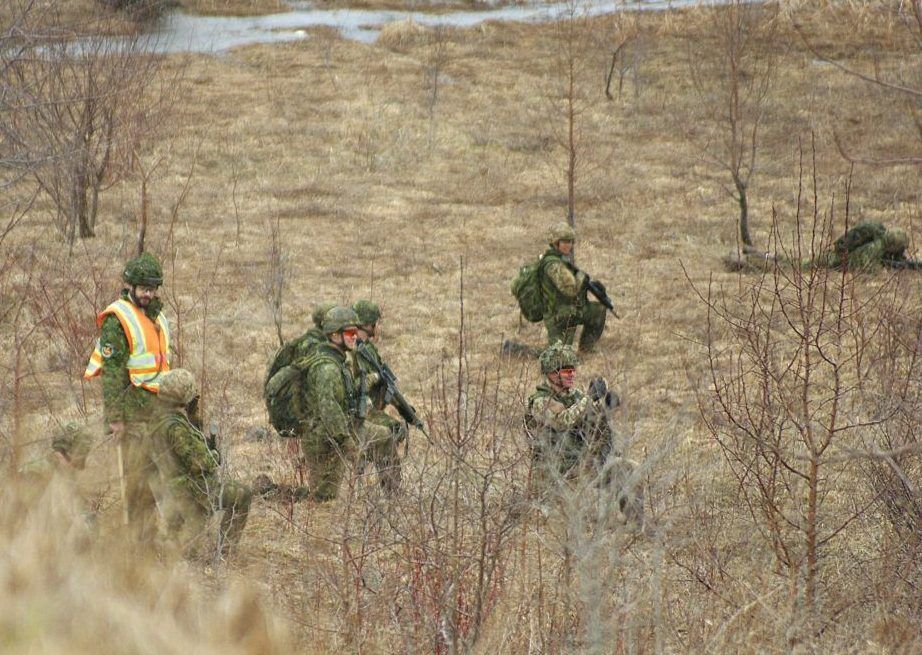
Article content The rain that had been falling steady for most of the previous 24 hours was replaced by fog as about 40 infantry trainees gathered at the edge of a ridge overlooking a training range at the Army Training Centre – Central in Meaford. They were there along with their officers and safety staff to take part in a live-fire platoon attack, the final exercise in their three months of rigorous training that will culminate with their graduation on Friday. Recommended Videos And by the time their exercise began, the fog too had lifted giving them a clear sightline to the enemy positions on the far slope of the valley hundreds of yards away.
The Sun Times was invited to observe the exercise alongside about 20 other civilians from a concrete pad where the command post tent was located. Known as Caen pad it is named after the Battle for the Caen that took place in France’s Normandy region during the Second World War in the summer of 1944. The vantage point provided a sweeping view over the valley where the exercise was being held, and gave all those attending a glimpse the training of an infantry soldier at the base in Meaford.
Lt.-Col. Joe Tobin, commanding officer of the base, said the exercise was an opportunity to open up the base and show a bit of what is done there to members of the public. On Monday representatives from Canadian Base Operators, officials with the office of the Assistant Deputy Minister (Infrastructure and Environment) of National Defence, TC Energy, the Municipality of Meaford.
“It is a big educational day to see what is going on,” Tobin said. The cohort of students taking part on Monday would have joined the Canadian Armed Forces around last summer and went through basic training before showing up in Meaford in October. They then completed the Canadian Army Soldier First Course there, graduating at the end of November.
After undergoing six days of cold weather operator training in January, they are now finishing up 53 days of Infantry Private trades training, the first qualification in the infantry for them, Tobin explained. On Friday they will graduate with a parade and given their cap badges and assigned to either the Princess Patricia’s Canadian Light Infantry or the Royal Canadian Regiment as they prepare for operations abroad. “It is a pretty big deal for them and we are really excited,” Tobin said.
The students taking part were from as far west as British Columbia, as far east as Newfoundland, and even one student from Northwest Territories. “We really are from coast to coast to coast,” Tobin said. The Canadian government has committed to growing the Canadian Armed Forces, recently announcing that it has achieved the NATO target of spending two per cent of annual GDP on defence.
Canada plans to deliver half a trillion dollars in defence investment over the next decade on a path to meeting a new NATO defence investment pledge of five per cent of GDP by 2035. At Meaford, the base has recently been redesignated the Army Training Centre – Central, while its command authority has been transferred from the 4th Canadian Division to the Canadian Army Doctrine and Training Centre, part of a major modernization and restructuring of the Canadian Army. In recent years the base has had infrastructure investments like culvert replacements and building upgrades with more planned in the future.
There is also the potential for the construction of about 60 homes at the base where the families of personnel can live. They are seeing higher numbers of staff, students and support personnel there, with increased courses expected to lead to about 1,000 people on site by summer. Along with the CAS FC training courses, there is expected to be an influx of candidates and instructors taking part in Reserve Summer Training on the base.
Tobin expects more and more training attacks like the one conducted on Monday to be held at the base, and hopes for more opportunities where members of the public can be invited there to experience it. “This is our bread and butter so we should be seeing this type of attack going on here on a regular basis,” Tobin said. After a short bus ride from the base’s Centurion Sr.
Ranks Mess to the Caen Pad, the group of observers were welcomed by Maj. Kurt Marion, Officer Commanding Charlie Company, the commander for the company executing the attack. Marion provided a summary of the exercise from the command post tent before it began.
The soldiers assembled from their attack position on a slope next to the Caen pad, while a drone buzzed overhead. The objective of the operation was to defeat an insurgent force in order to create defensive positions for a country attempting to reclaim territory it had lost. Following artillery fire, simulated by clouds of smoke to the north and east, the platoon began its advance on the objective in the distance, which included popup targets surrounded by sandbags and a large white target board simulating an insurgent vehicle.
As they moved, the soldiers fired on the enemy positions using C7 service rifle, C6 and C9 machine guns, 84-millimetre recoilless rifles, and M203 grenade launchers. After completing their objective the participants consolidated beyond it before making their way back to where it all started. Maj.
Mitchell Price, Officer Commanding Bravo Company, who accompanied the trainees on the exercise, said he did the training himself as a reservist and the attack was the culmination of a lot of hard work. “It is a lot of hard work focused on teamwork and building team cohesion, but also putting them through the paces to make sure they are physically and mentally ready for when they show up to an infantry battalion, because the way things are right now they could get deployed within a few months from when they get to battalion,” Price said. “We want to make sure the quality of soldier that we send to them is ready for that task.” Price said everyone who participated on Monday did great.
He described the muddy and wet conditions they performed the attack in as “par for the course.” “That is normal, that is what we are expected to operate in,” said Price. “The rough weather like that is just good training that can better prepare these soldiers for what it is like out there, because it is not always sunshine and beautiful weather when we have to do the job.” Price said training soldiers is very rewarding and something he loves to do. He said the live-fire platoon attack is not a requirement of their course, but has been added to it because of its value in teaching the students about safety both in training and real-life situations.
“To be able to get them through training like this, like a live-fire platoon attack, before they go to a regular force infantry battalion, is great extra training that they can have on their belts when they get there,” Price said.


