

L&T Finance Q1 FY27 slides: AI-driven growth, earnings beat targets
Oil prices surge 5% after Iran declares Strait of Hormuz closed Introduction & Market Context L&T Finance Limited (NSE:L&TFH) presented its Q1 FY27 investor slides on July 13, 2026, showcasing robust financial performance that exceeded analyst expectations and demonstrated tangible results from its technology-first strategy. The non-banking financial company, classified as an Upper Layer NBFC and part of the illustrious L&T Group, reported earnings per share of $3.50 versus a forecast of $3.45, while revenue reached $32.73 billion against expectations of $31.46 billion. The company’s stock rose 1.9% to $327.35 in after-hours trading, positioning shares near the top of their 52-week range of $194.40 to $338.60.
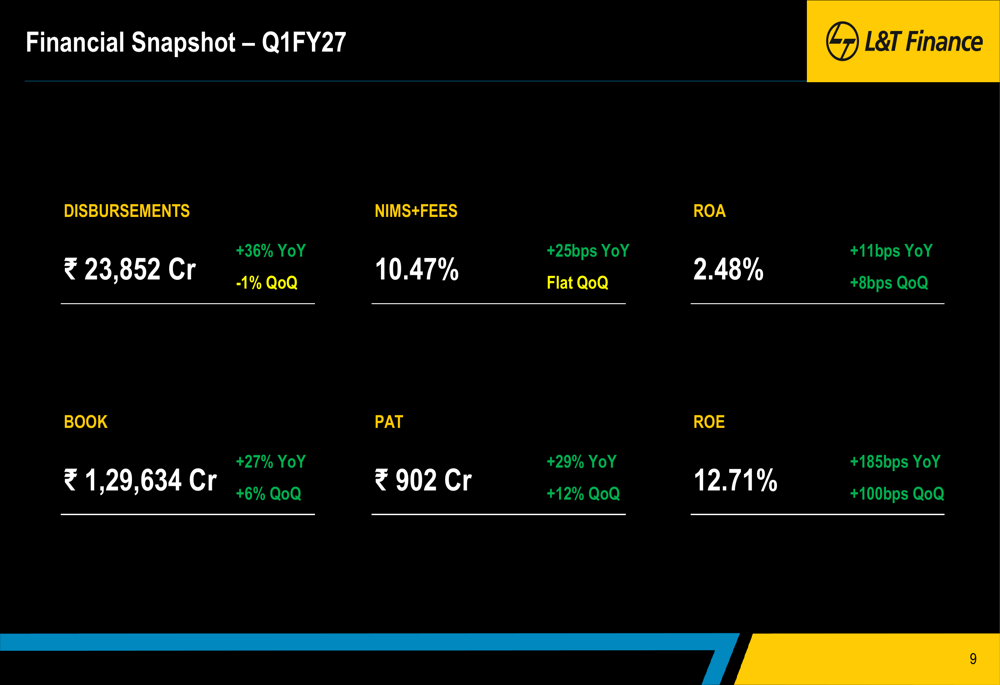
The positive market reaction reflected investor confidence in L&T Finance’s balanced approach to growth and risk management, as well as its significant investments in artificial intelligence and deep technology infrastructure. Quarterly Performance Highlights L&T Finance delivered strong results across key metrics in Q1 FY27, as illustrated in the following financial snapshot: The consolidated book reached ₹1,29,634 crores, representing 27% year-over-year growth and 6% quarter-over-quarter expansion. Disbursements totaled ₹23,852 crores, up 36% year-over-year despite management’s deliberate decision to forgo approximately ₹1,000-1,200 crores in potential disbursements to maintain credit quality standards.
Profitability metrics showed significant improvement, with profit after tax climbing 29% year-over-year to ₹902 crores—the company’s highest quarterly consolidated PAT to date. Return on assets reached 2.48%, up 11 basis points year-over-year and 8 basis points quarter-over-quarter, while return on equity surged to 12.71%, an impressive 185 basis points improvement from the prior year period. The company maintained its net interest margin plus fees at 10.47%, flat sequentially but up 25 basis points year-over-year, demonstrating pricing discipline in a competitive market.
Operating expenses as a percentage of book declined to 4.03% from 4.21% a year earlier, reflecting improved operational efficiency. Lakshya 2031 Strategic Goals: Progress Assessment L&T Finance unveiled its Lakshya 2031 strategic plan in April 2026, setting ambitious targets for book growth, credit cost, return on assets, and return on equity. The following table tracks progress against these goals: The company has already achieved its book growth target of 20%+, delivering 27% growth in Q1 FY27.
However, three key metrics remain works in progress. Credit cost stood at 2.54%, above the target of less than 2%, though management provided guidance that this should improve to 2.0-2.2% by Q4 FY27. Return on assets of 2.48% and return on equity of 12.71% both showed sequential improvement but remained below the targeted ranges of 3.0-3.2% and 16-18%, respectively.
The detailed progression of these metrics demonstrates steady improvement, as shown in the following performance tracker: Managing Director and CEO Sudipta Roy emphasized the company’s disciplined approach: "We could have grown even faster. However, given the volatility in the economy, we chose prudence over aggressive expansion." This philosophy reflects the company’s stated operating credo to be a "Risk-first, Tech-first AI-native Retail Financial Services Institution."
Technology as Strategic Differentiator L&T Finance’s presentation devoted substantial attention to its proprietary technology stack, positioning artificial intelligence as the operating system for customer lifecycle management. The company employs over 1,000 tech and data scientists in-house, representing what management calls "The Tech Multiplier." The centerpiece of this strategy is CYCLOPS, described as an "omni-product, omni-customer, next-generation underwriting engine running on a Gen-3 architecture."
The system’s capabilities and deployment status are detailed below: CYCLOPS has demonstrated measurable impact in the two-wheeler finance segment, where it has been operational since Q4 FY25. The following comparison illustrates the dramatic improvements in sourcing quality and delinquency metrics: The pre-CYCLOPS versus post-CYCLOPS comparison reveals striking improvements: the prime customer mix increased from 52% to 90%, account aggregator penetration jumped from 18% to 72%, and critical delinquency indicators improved substantially. Gross non-starters declined from 13% to 8%, net non-starters plummeted from 3.7% to 0.2%, and bounce rates fell from 22% to 12%.
Complementing CYCLOPS is NOSTRADAMUS, the company’s portfolio intelligence and augmented decisioning platform that monitors customer-level risk after disbursement: The company has also deployed multiple AI co-pilots to democratize decision-making across functions, as illustrated in this overview: The HELIOS co-pilot for SME, home loan, and personal loan underwriting has processed approximately 39,000 files, reducing turnaround time by 16-22 hours. The ORION co-pilot for portfolio management has handled over 3,000 business queries, while ShigraM has processed more than 4,000 files across 11 vernacular languages for mortgage legal process automation. Roy articulated the company’s technology ambition: "Our aspiration is to build India’s leading AI-native retail financial services institution."
He noted that Project Cyclops has already underwritten more than ₹12,000 crores in two-wheeler loans and continues to outperform industry risk benchmarks. Detailed Financial Analysis The company’s financial performance reflected balanced growth across multiple business segments. The following chart breaks down disbursement growth by business line:
Urban finance led disbursement growth with a 57% year-over-year increase to ₹10,787 crores, driven primarily by personal loans, which surged 126% year-over-year. Two-wheeler finance grew 41%, home loans increased 18%, and loan against property rose 31%. Rural business finance disbursements grew 24% to ₹6,961 crores, while gold finance increased 26% to ₹1,928 crores despite a 31% sequential decline.
Book growth by segment showed similar trends: Gold finance demonstrated exceptional growth with a 182% year-over-year increase to ₹3,829 crores and 35% quarter-over-quarter expansion, reflecting the company’s aggressive branch expansion strategy in this segment. Urban finance book grew 32% year-over-year to ₹63,615 crores, with personal loans leading at 80% growth. Rural business finance and farmer finance books expanded 22% and 11% respectively.
The comprehensive historical financial performance table provides context for the company’s trajectory: This data reveals the company’s transformation from 54% retailization in Q1 FY23 to 98% in Q1 FY27, accompanied by significant margin expansion. Net interest margin grew from 6.54% to 8.54%, while net interest margin plus fees increased from 8.23% to 10.47%. Return on assets improved from 1.02% to 2.48%, and the retail book expanded from ₹47,794 crores to ₹1,27,535 crores.
Chief Financial Officer Sachinn Joshi addressed margin dynamics on the earnings call, noting that while net interest margin declined 24 basis points due to higher funding costs, the NIM plus fees metric "has actually remained at exactly the same level" at 10.47%, as fee and other income growth offset the pressure. Management guided to a cost of funds range of 7.35% to 7.40% for FY27, up from the current 7.20% in Q1. Asset Quality: Industry-Leading Performance L&T Finance’s presentation emphasized its superior asset quality relative to industry benchmarks across multiple product categories.
The company’s 0 Days Past Due (DPD) performance in rural group loans and microfinance significantly outpaces the sector: The indexed industry delinquency comparison shows L&T Finance’s rural group loans and microfinance portfolio at just 21% of the industry average, reflecting stringent sourcing norms and monitoring systems. The company’s on-due-date collection efficiency has remained consistently above 98.7%. Similar outperformance extends across other product categories, as shown in this comparative analysis: For rural group loans and microfinance, L&T Finance achieved 96.5% 0 DPD versus 77.9% for the industry.
In farm equipment finance, the company recorded 87.8% versus 83.4% industry average, and in two-wheeler finance, 91.7% versus 84.3% industry benchmark. The overall asset quality trends demonstrate stability and improvement: For the retail portfolio, gross stage 3 assets declined from 2.93% in Q1 FY26 to 2.48% in Q1 FY27, while net stage 3 assets decreased from 0.83% to 0.77%. The provision coverage ratio remained robust at 70%.
On a consolidated basis, gross stage 3 assets improved from 3.31% to 2.86%, and net stage 3 assets from 0.99% to 0.90%. Management attributed this performance to stringent portfolio policies, including requirements that applicants have 0 DPD history, strict association norms limiting customers to a maximum of three lenders including L&T Finance, and total joint liability group indebtedness caps of ₹2 lakhs. The company also maintains a 700-member risk control unit with pan-India presence that reports independently to the Chief Risk Officer.
Strategic Initiatives and Market Positioning L&T Finance’s market position is built on extensive reach and diversified funding. The company’s pedigree and position overview highlights its scale: With a book exceeding ₹1,29,000 crores, a customer base of 2.9 crores+, and 2,800+ branches reaching approximately 2,00,000 villages and 450+ cities and towns, L&T Finance has established a granular retail franchise. The company maintains AAA ratings from domestic agencies (CRISIL, ICRA, CARE, India Ratings) and investment-grade international ratings of BBB/BBB- from S&P and Fitch, at par with India’s sovereign rating.
The company has made significant progress in digital transformation, as evidenced by the performance of its PLANET customer app: Launched in March 2022, the PLANET app has achieved 2.5 crore downloads (6.3x growth from Q1 FY24), processes ₹1,942 crores in collections (14.8x growth), handles 93% of servicing transactions (8.8x growth), and facilitates ₹5,500 crores in business (4.7x growth). The app maintains a 4.8-star rating and offers comprehensive servicing features, direct-to-consumer loan journeys, and engagement tools.
The company is investing heavily in private cloud infrastructure to support its AI initiatives and reduce long-term costs. Management indicated that open-
Source and reference
source private cloud infrastructure is 70% cheaper than hyperscale clouds on a five-year total cost of ownership basis. The private cloud project is 70% complete, with GPU augmentation and workload migration from public to private cloud scheduled for completion in Q3-Q4 2026. Forward-Looking Statements and Challenges Management reiterated its long-term Lakshya 2031 strategy targeting 20%+ compound annual book growth, credit cost below 2%, return on assets of 3.0-3.2%, and return on equity of 16-18%. For FY27 specifically, the company expects NIM plus fees to remain in a 10% to 10.5% corridor and credit cost to improve to 2.0-2.2% by Q4 FY27. Several strategic initiatives are expected to support future growth. Project Cyclops will expand into rural business finance and mortgages during FY27. Project Nostradamus will roll out further across businesses. Project Hercules, an AI-based...
Read original source- Published
- Jul 13, 2026
- Updated
- Jul 13, 2026
- Source
- Investing Canada
- Category
- Business
- Read time
- 9 min
Key facts
Why this matters locally
This business story matters locally because it may affect readers, businesses, commuters, families, or public services in British Columbia.
Local impact
BC Post links this item to British Columbia coverage so readers can follow related city updates, weather, traffic, events, and category news in one place.
Timeline
Source and credit
BC Post may summarize, organize, and add local context for reader clarity. Original reporting remains with the listed publisher.
Related Articles
View all Business
AI Market Trends: Q2 2026 Review and Forecast
Business
AI Market Trends: Q2 2026 Review and Forecast
 Business
Starchuk seeking judicial review of Surrey arena land-swap
Business
Starchuk seeking judicial review of Surrey arena land-swap
 Business
B.C.'s Massey Tunnel replacement doubles in cost to estimated $8.5 billion
Business
B.C.'s Massey Tunnel replacement doubles in cost to estimated $8.5 billion
 Business
Earth Angel Worldwide Expands Its Mission Through Music, Education and Environmental Stewardship
Business
Earth Angel Worldwide Expands Its Mission Through Music, Education and Environmental Stewardship
More Local Coverage
Latest news Top
‘Entire city’ asked to help search for missing 11-year-old Parker: Calgary police
Top
‘Entire city’ asked to help search for missing 11-year-old Parker: Calgary police
 Politics
Powerful pro-life ad featuring boxing legend to air during final World Cup matches
Politics
Powerful pro-life ad featuring boxing legend to air during final World Cup matches
 Politics
Traditional Catholic response to Cupich’s suicide distortion
Politics
Traditional Catholic response to Cupich’s suicide distortion