

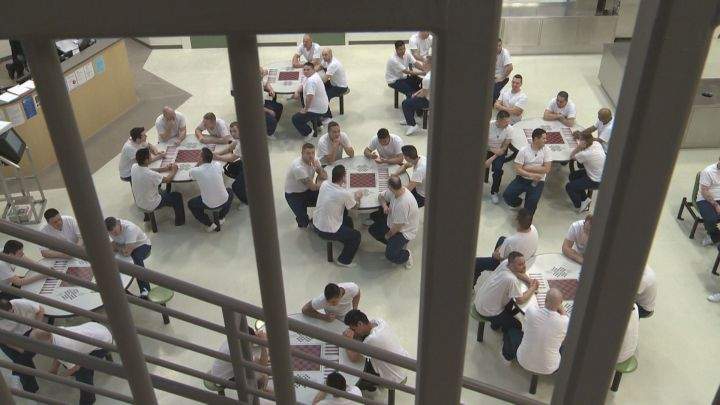
On average, 30 per cent of adults leaving an Alberta jail re-offend within months — but of the 400 FASD program participants who've enrolled since 2025, only 13 per cent have.
At the age of 40, Katlin Sharko was stuck in a loop he desperately wanted to escape: commit a crime, get arrested, do time, get released, struggle in the community, reoffend. “I was in the Edmonton remand centre and they were putting on a seminar for FAS (fetal alcohol syndrome) or people with FAS,” Sharko recalled. “I went and sat in with a couple buddies.”
He was handed pamphlets when the seminar finished. “I took the sheets and reviewed them in my cell and saw how it related to me.” Fetal Alcohol Spectrum Disorder, or FASD, is a lifelong neurodevelopmental disability caused by a fetus being exposed to alcohol in the womb.
Fetal alcohol syndrome is on the severe end of the disorder, according to the Mayo Clinic. It impacts the brain and body differently for every person, so those with FASD experience unique combinations of strengths and daily challenges — but in general, creates a mix of issues with how the body develops; thinking, learning and behavior; and functioning and coping in daily life. Sharko said all of the classic symptoms were things he experienced.
“Making bad friends, poor money management, not on time, hard to keep jobs. I don’t like large crowds, bright lights can bother me.” Since his mother had already died, Sharko called his father to ask whether she had possibly drank while pregnant.
His dad confirmed that likely happened and encouraged Sharko to seek out help. So he contacted the Willow Winds Support Network in Edmonton, which provides supports for people impacted by FASD, enrolling in a program called Transitional Mentorship. Willow Winds set Sharko up with a doctor and psychologist for an assessment and he was diagnosed with FASD, depression and Attention-Deficit/Hyperactivity Disorder (ADHD.)
Get weekly health news Sharko was assigned a transition worker — an expert in FASD, who built up a relationship with him in custody — and prepared him for life after being released. Julie Nanson-Ashton, executive director of the Central Alberta FASD Network, said workers assist in a variety of ways. “Housing, income source, food security, substance use assistance, mental health assistance.”
The workers pick clients up from the correctional facility when they’re released, show them their new home, set up appointments with doctors, therapists or banks, drive them to meeting, and generally try to bridge a gap that advocates say often results in people with FASD reoffending. “If we miss the individual when they leave that door, then what choice do they have? They’re walking into homelessness, they’re looking at re-offending, they are looking at re-engaging with substance use, and then their mental health deteriorates, right?
Whereas they’ve got some hope,” Nanson-Ashton explained. She said many offenders with FASD struggle with supports, having burned a lot of bridges in the past. “They make decisions that are rash, impulsive, and they don’t understand what the outcomes are going to be.
“They’re also easily persuaded by others to commit crimes.” - Heat, staffing shortages push Montreal emergency rooms past 200% capacity - 3 Winnipeg care homes face air conditioning outages during summer heat wave - What to do if you lose power or air conditioning in a heat wave blackout - U.S. FDA approves new breast cancer drug that could slow disease significantly Michael Stansberry, associate director of programs with Alberta Correctional Services, said because FASD is unique to each person, the outcomes of program participation vary. “Success is connecting to long term supports.
Success is family reunification. Success is getting a job. “Success is staying out of trouble.”
But overall, the province feels the Transition Mentorship program is working. “It has been absolutely amazing, the reduction in recidivism that has occurred as a result of this,” Nanson-Ashton said. On average, 30 per cent of adults leaving a provincial institution are re-convicted of another crime within three months — but of the 400 program participants who’ve enrolled since 2025, only 13 per cent have reoffended.
“We know that there are costs associated with supporting people in the community, but those costs are miniscule compared to the public costs of housing somebody, the costs of the criminal justice system, police costs,” Stansberry said. It’s expanded it to all 10 provincial correctional institutions, including young offender facilities. As for Starko, it’s been eight months since he’s been released from custody.
He’s rebuilding his relationship with his son and continues to work on his sobriety. He calls the program life-changing. “They helped me immensely.
I’m very grateful. Things have been going really good for me.”
- Published
- Jul 14, 2026
- Updated
- Jul 14, 2026
- Source
- Global News
- Category
- Crime
- Read time
- 3 min
Key facts
Why this matters locally
This crime story matters locally because it may affect readers, businesses, commuters, families, or public services in British Columbia.
Local impact
BC Post links this item to British Columbia coverage so readers can follow related city updates, weather, traffic, events, and category news in one place.
Timeline
Source and credit
BC Post may summarize, organize, and add local context for reader clarity. Original reporting remains with the listed publisher.
Related Articles
View all Crime
Video shows rescue of lone survivor from deadly B.C. helicopter crash
Crime
Video shows rescue of lone survivor from deadly B.C. helicopter crash
 Crime
Family launches fundraiser for woman struck by truck in Mission
Crime
Family launches fundraiser for woman struck by truck in Mission
 Crime
A dozen cats are missing after New Westminster apartment fire that displaced roughly 100 residents
Crime
A dozen cats are missing after New Westminster apartment fire that displaced roughly 100 residents
 Crime
‘N’ driver involved in Abbotsford rollover crash, police say
Crime
‘N’ driver involved in Abbotsford rollover crash, police say
 Crime
Langley woman pleads for break on $49K fines after felling 11 trees
Crime
Langley woman pleads for break on $49K fines after felling 11 trees
 Crime
New Langley Township fire hall opens with ‘push in’ ceremony
Crime
New Langley Township fire hall opens with ‘push in’ ceremony
More Local Coverage
Latest news Business
AI Market Trends: Q2 2026 Review and Forecast
Business
AI Market Trends: Q2 2026 Review and Forecast
 Politics
Powerful pro-life ad featuring boxing legend to air during final World Cup matches
Politics
Powerful pro-life ad featuring boxing legend to air during final World Cup matches
 Top
‘Entire city’ asked to help search for missing 11-year-old Parker: Calgary police
Top
‘Entire city’ asked to help search for missing 11-year-old Parker: Calgary police