

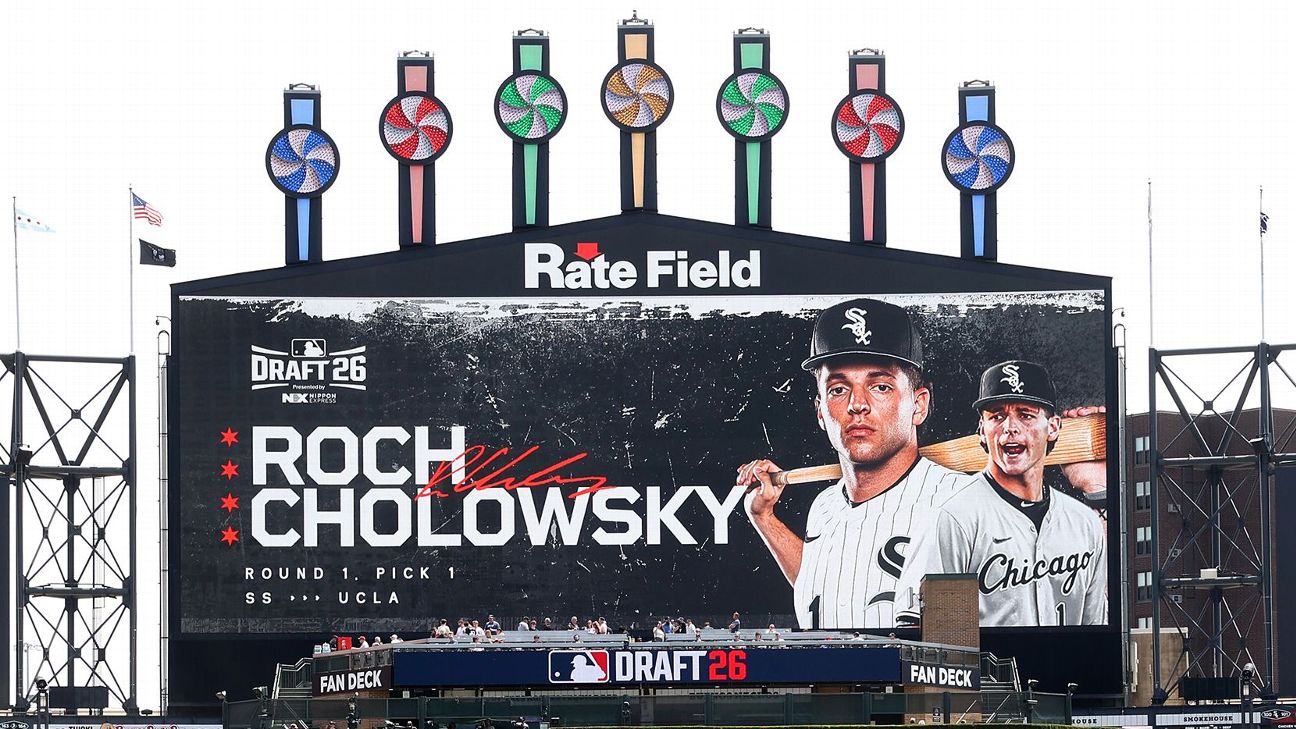
Roch Cholowsky or Grady Emerson? Here's how Chicago's No. 1 pick decision played out hours before the 2026 draft began.
CHICAGO -- It was 20 hours before the Chicago White Sox would be officially on the clock to start the 2026 MLB draft, and they still weren't fully decided on who they were going to take with the No. 1 pick. At 4 p.m. local time Friday in the bowels of Rate Field, where the first-place White Sox would host the Athletics later that evening, more than two dozen team personnel filed into the team's theater -- a three-level news conference room that doubles as a meeting area and was serving as their draft war room on this day.
The White Sox had owned the No. 1 pick since winning the draft lottery during December's winter meetings. But even after months of scouting trips and countless hours pouring over video and metrics, staff members weren't completely convinced of their direction. They had whittled their choices down from hundreds of draft-eligible players to two shortstops: 21-year-old UCLA junior Roch Cholowsky and 18-year-old Texas high school senior Grady Emerson.
General manager Chris Getz appeared in front of personnel from every department within the organization and started the final meeting. "I can't say we've got complete clarity quite yet," he said to the group. "Certainly, no harm in going through these guys again."
And thus began a 40-minute debate -- 20 minutes on Cholowsky and 20 minutes on Emerson -- wherein each department weighed in on the pros and cons of each player as highlights of both played on an overhead projection screen. ESPN was granted access to the meeting without any restrictions -- a rare look behind the scenes as the main decision-makers contemplated their franchise-altering choice. Getz was the ringmaster throughout, steering the conversation to each department as personnel shared what they've learned about each player.
Each group was important and heard. Each came with a different perspective -- all in the name of collaboration. While Getz would ultimately make the final call, it became clearer with every voice that this was a group decision.
And in Chicago's case, the hardest part was that neither player was a bad choice. "Regardless of where we go, just f---ing make it happen," Getz said. "They're both good players.
We all acknowledge that they're going to be really good major league players. And we control a lot of this too, right? If we believe that these guys are going to be good major league players, they're going to be good major league players."
The Cholowsky discussion To begin, Getz asked vice president of amateur scouting Mike Shirley for his take on the right-handed-hitting Cholowsky and what he could bring to the organization. Shirley: "What did Alex Bregman do for the Astros? Didn't that push something forward?
He helped them build out what they did. These college players at the top of the scale are different." Like Getz, Shirley acknowledged "it's close" between the two prospects, urging those in the room to share a new take on either player if they had one.
Shirley then handed off to West Coast supervisor Scott Thomas. Thomas: "The totality of the package. The tools, the instincts, there's not a whole lot of holes you can really look at with him.
"Just keep going back to the makeup and the ability to make adjustments. I think this guy is an every-day contributor on a championship club. I think this guy fits in extremely well with what's going on here in our organization."
Cholowsky's ability to make adjustments came up often, as he isn't a finished product at the plate. Though his junior year at UCLA was good -- he slashed .320/.452/.636 (1.088 OPS)
-- it was actually a slight step back from his sophomore season. He "held serve," as Shirley had put it earlier in the week, while Emerson was closing the gap. Shirley: "We took the plane off the ground and we all felt really good about this, right?
And we got to cruising altitude and everybody started to feel really good. They did. But then all of a sudden, there's some turbulence on this thing.
We started getting bumpy." Thomas: "The way he was being pitched to, I wish he would have made more of an adjustment knowing that he was getting pitched hard in, soft away. I do think he did his part throughout the entirety of the spring in regards to making those adjustments.
But knowing that he's never worked with a hitting coach, there's things to unlock here." He then emphasized Cholowsky's defensive versatility, noting his ability to play second base, shortstop or third base without any concerns. Getz then asked director of hitting Ryan Fuller if there was a "pathway" to solving any issues at the plate.
Fuller: "I really see this as two different players. Before two strikes and with two strikes. Half of his ABs came from that really compromised position [behind in the count/two strikes] where you can nitpick a lot.
Those produced the softest contact. His hard hit rate fell off 16% with two strikes, pop-up rate [went up] and he was hitting .198. "Before two strikes [were] my favorite swings.
He had a 1.400 OPS pre-two strikes. So, the more we could have that show up, I think that's going to be even more special rather than hitting from a compromised position half the time." Fuller and Getz noted mechanical work needed on Cholowsky's lead arm during his swing -- "softening" the arm bar, according to Getz.
And the group took note of some potential untapped power, recognizing his 12% strikeout rate would rise -- along with his home run rate. Getz: "Let's say there was a give upwards to 18, even towards 20%. What does that mean from a production standpoint?
That's an additional home run a week. Then what does this whole thing look like?" The group debated Cholowsky's two-strike approach some more, chalking most of it up to playing big-time college baseball.
No matter his issues, the room agreed, the White Sox would be getting someone willing to be coached. Fuller: "I told him, 'What if I told you we hate your arm bar and your two-strike approach? He was just like, 'Yeah.
Yeah, my dad told me I'm done [with that]. Two-strike approach.
Just, like, put the ball in play, be a good teammate. I'm ready to do that.' "He was really juiced up to see the plan that we would have in place for him."
Sitting near the center of the room, possessing a deep, recognizable voice, was special assistant to player development Phil Nevin. The former No. 1 draft pick also was a vital voice, lending MLB playing and coaching credentials to a room full of scouts and analysts. Getz asked him for his take.
Nevin: "The person is off the charts for me. Zero concerns. In fact, I go the other way.
For a while you think, 'Is this real? Is this real?' And then the more you talk to him, it's real.
This is a real dude. It's a real leader in that atmosphere. "When you draft a college player 1-1, you're kind of almost expecting like this time next year when we're sitting in this room, we're walking outside and watching Roch play.
And so what does that leadership mean when you put him in that room next year? He doesn't walk in and become a leader right away. That's earned.
I don't care who you are and where you come from. Does he fit in that room? Absolutely.
I think he already fit in that room two weeks ago and he loves being part of that." The
Source and reference
reference was to a secret visit by Cholowsky in June. It could not have been scripted any better as the White Sox beat the visiting Atlanta Braves in walk-off fashion, with rookie Braden Montgomery hitting an extra-inning home run in his major league debut. Nevin: "I think we're talking about two very similar personalities when you get to know the insides of both of these players. One's three years younger; one's three years older. And that's it." After that subjective analysis, Getz turned to a more objective voice by asking Matt Grabowski, the team's director of acquisitions (essentially research and development), for his input. Grabowski compared Cholowsky to Los Angeles Angels shortstop Zach Neto, noting that Cholowsky was a tick ahead of Neto at that point in his career, with room to improve. Grabowski: "I think what gives us more comfort is there's a clear path to improving the...
Read original source- Published
- Jul 15, 2026
- Updated
- Jul 15, 2026
- Source
- Entertainment And Sports Programming Network
- Category
- Sports
- Read time
- 17 min
Key facts
Why this matters locally
This sports story matters locally because it may affect readers, businesses, commuters, families, or public services in British Columbia.
Local impact
BC Post links this item to British Columbia coverage so readers can follow related city updates, weather, traffic, events, and category news in one place.
Timeline
Source and credit
BC Post may summarize, organize, and add local context for reader clarity. Original reporting remains with the listed publisher.
Related Articles
View all Sports
Thoughts turn to legacy as full-time whistle nears for Vancouver's World Cup
Sports
Thoughts turn to legacy as full-time whistle nears for Vancouver's World Cup
 Sports
Huge parade of naked cyclists promote 'less gas, more ass' in Vancouver
Sports
Huge parade of naked cyclists promote 'less gas, more ass' in Vancouver
 Sports
Swiss breakout star Manzambi and 2 others leave training ahead of World Cup clash with Colombia
Sports
Swiss breakout star Manzambi and 2 others leave training ahead of World Cup clash with Colombia
 Sports
World Cup what to know: Argentina’s Lionel Messi faces Egypt’s Mohamed Salah for spot in quarters
Sports
World Cup what to know: Argentina’s Lionel Messi faces Egypt’s Mohamed Salah for spot in quarters
 Sports
Annual Windsor bike show fuels support for 5 Windsor-Essex food banks
Sports
Annual Windsor bike show fuels support for 5 Windsor-Essex food banks
 Sports
Sidney teen to represent Canada at world paddling championships
Sports
Sidney teen to represent Canada at world paddling championships
More Local Coverage
Latest news Business
AI Market Trends: Q2 2026 Review and Forecast
Business
AI Market Trends: Q2 2026 Review and Forecast
 Politics
Powerful pro-life ad featuring boxing legend to air during final World Cup matches
Politics
Powerful pro-life ad featuring boxing legend to air during final World Cup matches