

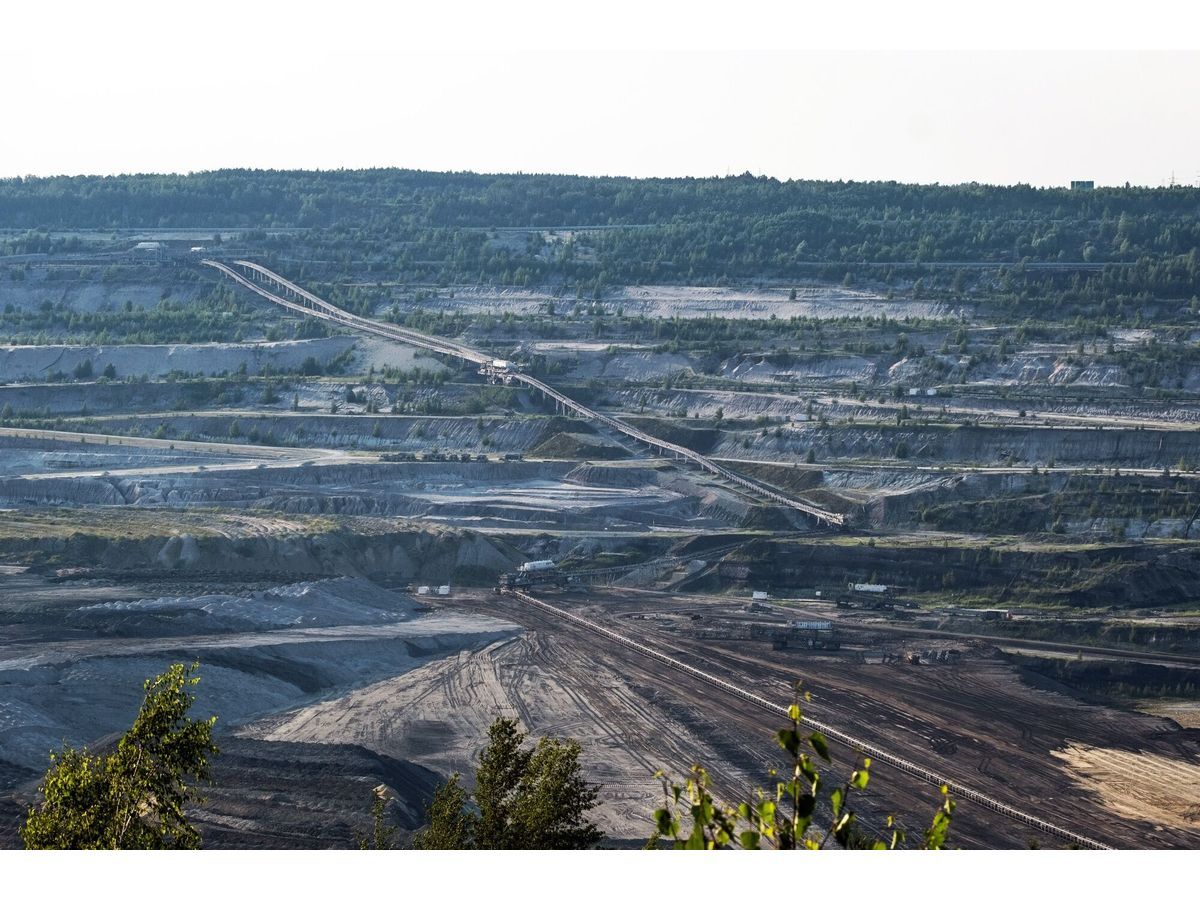
Physicist Jaroslaw Necki vividly recalls his trips to the “Sahara,” the vast open-pit mines of central Poland rich with soft lignite coal. Working in these treeless landscapes, where sand and clay stretch into the distance, he’d often forget he was in the middle of Europe. Over the years, these excursions have made the associate professor at Krakow’s Mining and Metallurgical Academy a leading global expert in methane emissions — a powerful greenhouse gas known to have a significant impact on glo
(Bloomberg) — Physicist Jaroslaw Necki vividly recalls his trips to the “Sahara,” the vast open-pit mines of central Poland rich with soft lignite coal. Working in these treeless landscapes, where sand and clay stretch into the distance, he’d often forget he was in the middle of Europe.
Over the years, these excursions have made the associate professor at Krakow’s Mining and Metallurgical Academy a leading global expert in methane emissions — a powerful greenhouse gas known to have a significant impact on global warming. Last year, Necki saw the results of the European Union’s first large-scale coal mine emissions test. The report, which was seen by Bloomberg, showed some remarkable results.
Poland’s two biggest lignite surface mines, Belchatow and Turow, recorded methane emissions levels in 2024 that were roughly one-thousandth of those shown by most independent tests in the last two decades. In the Czech Republic, methane emissions from the same kind of open-pit coal mines dropped 91% between 2022 and 2024. And in Germany, which still depends on dirty fossil fuels for about one fifth of its power production, nine out of ten lignite mines documented an overall emissions decline of 64% in 2024 from what was reported a year earlier.
In all cases, the reductions were so large that they couldn’t simply be explained by production cuts. “I don’t believe these numbers at all,” said Necki. He, as well as other experts who spoke to Bloomberg, said that the dramatic falls in reported methane emissions are the result of a small but fundamental change in the methodology for measuring them — one that was introduced as part of an plan by the EU to track and contain methane.
That tweak has allowed open-pit mine operators to essentially grade their own homework, enabling them to undercount their emissions. This could allow governments and companies to overstate their progress on reaching climate goals while underestimating the scale of action still needed. “Wrong techniques are being intentionally applied to benefit coal mines — not the environment,” Necki said.
All the mining companies contacted by Bloomberg described their methane testing as aligned with EU regulations and scientific standards. Under its Global Methane pledge, a 2021 initiative kicked off by former US President Joe Biden and EU President Ursula von der Leyen, the bloc vowed to help reduce methane emissions by 30% from 2020 levels by the end of this decade. The EU Methane Regulation is meant to be the bloc’s most powerful tool in its efforts to reach this goal.
Once the regulation is implemented next year, fossil fuel companies could eventually face fines of up to 20% of their annual turnover for failing to report emissions. As part of this plan, officials sanctioned a change to the so-called “emissions factor” — a number that’s multiplied with a mine’s annual coal output to calculate its yearly methane emissions. Prior to last year, most operators of open-pit mines, which make up three-quarters of EU coal mines, used emission factors set under national formulas to measure pollution.
Now, mine operators are being asked to establish their own emissions factors based on site-specific tests. But there are not yet any guidelines for conducting these tests. The situation is now “unclear in a number of ways,” said Silke Goldberg, Global Head of Sustainability at HSF Kramer, a law firm that advises global clients on competition legislation in Brussels.
Still, some major miners are already making use of the new option. Poland’s PGE, which operates Belchatow and Turow, introduced new emissions factors at those sites. According to their most recent tests, recorded emissions levels were more than 99% lower at the mines than earlier results.
“This is ridiculously low,” said Necki. Germany went a step further and included values provided by the mining industry in its official report to the United Nations in April. It specified a new “average implicit emission factor” that was 60% lower than the previous one.
Christian Böttcher, co-
Source and reference
author of Germany’s climate report to the United Nations, said so long as “there is no hint as to what global best practice is,” he has to use industry data. Poland’s Energy Ministry did not reply to requests for comment. The push to adopt site-specific measurement dates back at least seven years, when the UN’s Intergovernmental Panel on Climate Change released a report recommending the switch. At the time, the UN was primarily interested in improving reporting from hard coal mines in China, India, South Africa and Indonesia, which are among the world’s top polluters. In places where hard coal is mined underground, emissions can be measured quite accurately at ventilation shafts, said Ajay Kumar Singh, a leading Indian methane researcher who co-authored the IPCC report. Open-pit emissions, by contrast, are much trickier to gauge. Surface mines can show “significant variability,”...
Read original source- Published
- Jul 15, 2026
- Updated
- Jul 15, 2026
- Source
- Financial Post
- Category
- Environment
- Read time
- 8 min
Key facts
Why this matters locally
This environment story matters locally because it may affect readers, businesses, commuters, families, or public services in British Columbia.
Local impact
BC Post links this item to British Columbia coverage so readers can follow related city updates, weather, traffic, events, and category news in one place.
Timeline
Source and credit
BC Post may summarize, organize, and add local context for reader clarity. Original reporting remains with the listed publisher.
Related Articles
View all Environment
A powerful movement of healing arrives at Delta’s Discovery Centre
Environment
A powerful movement of healing arrives at Delta’s Discovery Centre
 Environment
Metro Vancouver issues air quality warning as wildfire smoke drifts in
Environment
Metro Vancouver issues air quality warning as wildfire smoke drifts in
 Environment
Vancouver forecast in 'sweet spot' but hot temperatures on the way
Environment
Vancouver forecast in 'sweet spot' but hot temperatures on the way
 Environment
Mark Carney's new climate doctrine
Environment
Mark Carney's new climate doctrine
 Environment
EU Excludes Soybean Seed from Deforestation Rules
Environment
EU Excludes Soybean Seed from Deforestation Rules
 Environment
Spanish Mountain Gold Reports 69.20 Metres of 0.74 g/t Gold and 77.85 Metres of 0.70 g/t Gold as Part of Its Feasibility Study Drill Program
Environment
Spanish Mountain Gold Reports 69.20 Metres of 0.74 g/t Gold and 77.85 Metres of 0.70 g/t Gold as Part of Its Feasibility Study Drill Program
More Local Coverage
Latest news Politics
Powerful pro-life ad featuring boxing legend to air during final World Cup matches
Politics
Powerful pro-life ad featuring boxing legend to air during final World Cup matches
 Local News
Cowichan sports shorts: rugby, hockey, biking
Local News
Cowichan sports shorts: rugby, hockey, biking