

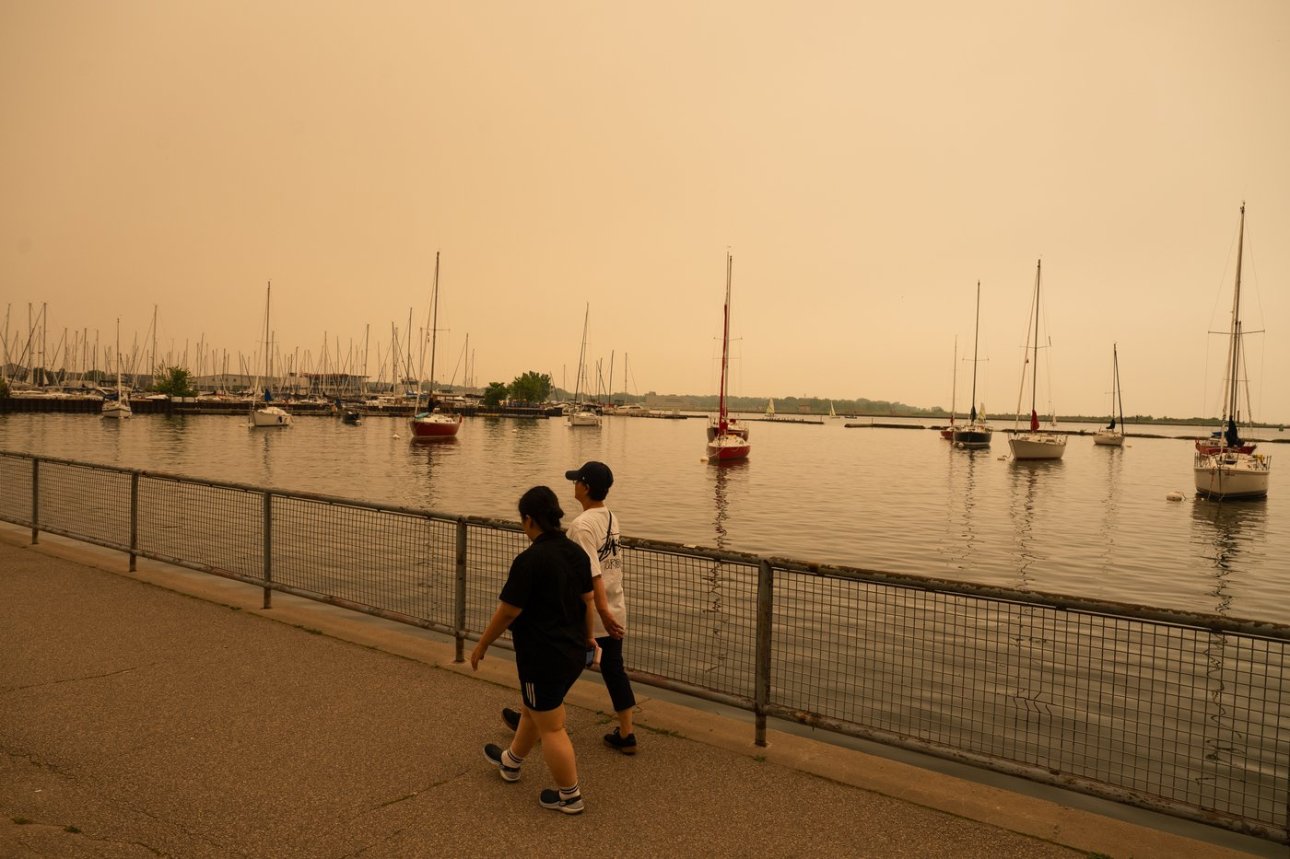
TORONTO — Many parts of Ontario, including the Greater Toronto Area, are under an Environment Canada air quality warning as smoke from wildfires in northwestern Ontario drift south. “Smoke from wildfires can have serious health consequences for those living nearby, but it can also affect the health of people living hundreds of kilometres away,” the [...]
Elevate your local knowledge Sign up for the iNFOnews newsletter today! Elevate your local knowledge Sign up for the iNFOnews newsletter today! Select Region Selecting your primary region ensures you get the stories that matter to you first.
TORONTO — Many parts of Ontario, including the Greater Toronto Area, are under an Environment Canada air quality warning as smoke from wildfires in northwestern Ontario drift south. “Smoke from wildfires can have serious health consequences for those living nearby, but it can also affect the health of people living hundreds of kilometres away,” the Canadian Lung Association says on its website. “There is no safe level of wildfire smoke.”
Here are some ways to protect yourself and your children USE THE AIR QUALITY HEALTH INDEX Environment Canada has an Air Quality Health Index (AQHI) available online, where people can check the level of pollution in their communities. You can find it at https://weather.gc.ca/airquality/pages/index_e.html A rating of 1-3 is low risk, 4-6 is moderate risk, 7-10 is high risk and over 10 is very high risk.
Many people with asthma or other chronic conditions — as well as infants, young children, pregnant people and seniors — feel the effects of smoke and other air pollution at lower levels than people who are very healthy. STAY INSIDE AS MUCH AS POSSIBLE Stay inside with the windows closed as much as possible and if you have air conditioning, make sure it’s not bringing outdoor air into the home. “Most air conditioning units do not take outdoor air into the home and are safe to use during periods of poor outdoor air quality,” the lung association says.
“If your system has a fresh air intake, set it to ‘recirculate mode’ or shut the outdoor intake damper,” it says. It’s also important to keep outside doors and fireplace dampers shut. If you don’t have air conditioning at home and the air quality outside is poor, consider going to a library, a shopping mall or a community cooling centre if you’re feeling the heat.
WEAR A MASK IF YOU NEED TO BE OUTSIDE An N95, KN95 or KF94 mask can help reduce the fine particles in wildfire smoke getting into your lungs, The Public Health Agency of Canada says on its website.
These types of masks, called respirators, are effective because they’re “designed to fit snugly around your face, covering your nose, mouth and chin” and the material can filter out fine particles, the agency says. Other masks, including cloth and medical or surgical masks don’t fit the face as snugly and the material isn’t as effective at filtering out the smoke particles, it says. If the poor air quality is happening at the same time as extreme heat, some people may feel increased heat stress while wearing a mask.
In that case, the priority is to stay cool, the public health agency says. In addition to fine particles, wildfire smoke contains various gases and even respirator masks can’t protect against those, it says. Respirator masks shouldn’t be worn by children under age two or by people who have trouble breathing while wearing them, the agency says.
MAKE SURE YOUR ASTHMA IS WELL CONTROLLED IN THE FIRST PLACE Adults and children with asthma should always have a supply of both their “controller” medications and their “reliever” medications. “Controller” medications are usually taken every day to keep inflammation in the lungs down and help to prevent asthma attacks. They usually contain an inhaled steroid.
“Reliever” medications are the inhalers that people take if they are suffering from worsened asthma, including asthma attacks. They are bronchodilators, which relax the muscles in the lungs and widen the airways. Salbutamol (brand name Ventolin) is a common inhaler medication.
SEEK MEDICAL ATTENTION WHEN NEEDED If you or your child is experiencing dizziness, chest pains, severe cough, shortness of breath, wheezing or heart palpitations, see your local health-care provider or go to the emergency department, the Lung Health Foundation advises. CONSIDER AN AIR PURIFIER FOR YOUR HOME A high-quality air purifier should have a HEPA (high efficiency particulate air) filter. Or, look for a filter with a MERV (minimum efficiency reporting value) rating of at least 13.
If you can’t afford to buy a high-quality air purifier unit, you can make one. Take a look at YouTube for instructions, but basically you’ll need a box fan, MERV 13-rated furnace filters, duct tape and some cardboard. This report by The Canadian Press was first published July 15, 2026.
Canadian Press health coverage receives support through a partnership with the Canadian Medical Association. CP is solely responsible for this content. News from © The Canadian Press, .
- Published
- Jul 15, 2026
- Updated
- Jul 15, 2026
- Source
- Infonews.ca
- Category
- Environment
- Read time
- 4 min
Key facts
Why this matters locally
This environment story matters locally because it may affect readers, businesses, commuters, families, or public services in British Columbia.
Local impact
BC Post links this item to British Columbia coverage so readers can follow related city updates, weather, traffic, events, and category news in one place.
Timeline
Source and credit
BC Post may summarize, organize, and add local context for reader clarity. Original reporting remains with the listed publisher.
Related Articles
View all Environment
A powerful movement of healing arrives at Delta’s Discovery Centre
Environment
A powerful movement of healing arrives at Delta’s Discovery Centre
 Environment
Metro Vancouver issues air quality warning as wildfire smoke drifts in
Environment
Metro Vancouver issues air quality warning as wildfire smoke drifts in
 Environment
Vancouver forecast in 'sweet spot' but hot temperatures on the way
Environment
Vancouver forecast in 'sweet spot' but hot temperatures on the way
 Environment
Mark Carney's new climate doctrine
Environment
Mark Carney's new climate doctrine
 Environment
EU Excludes Soybean Seed from Deforestation Rules
Environment
EU Excludes Soybean Seed from Deforestation Rules
 Environment
Spanish Mountain Gold Reports 69.20 Metres of 0.74 g/t Gold and 77.85 Metres of 0.70 g/t Gold as Part of Its Feasibility Study Drill Program
Environment
Spanish Mountain Gold Reports 69.20 Metres of 0.74 g/t Gold and 77.85 Metres of 0.70 g/t Gold as Part of Its Feasibility Study Drill Program
More Local Coverage
Latest news Politics
Powerful pro-life ad featuring boxing legend to air during final World Cup matches
Politics
Powerful pro-life ad featuring boxing legend to air during final World Cup matches
 Business
AI Market Trends: Q2 2026 Review and Forecast
Business
AI Market Trends: Q2 2026 Review and Forecast