

The European Central Bank will probably pause to assess inflation next week before delivering a final interest-rate hike in September, economists say.
(Bloomberg) — The European Central Bank will probably pause to assess inflation next week before delivering a final interest-rate hike in September, economists say. All respondents in a Bloomberg survey predict no change in borrowing costs next Thursday.
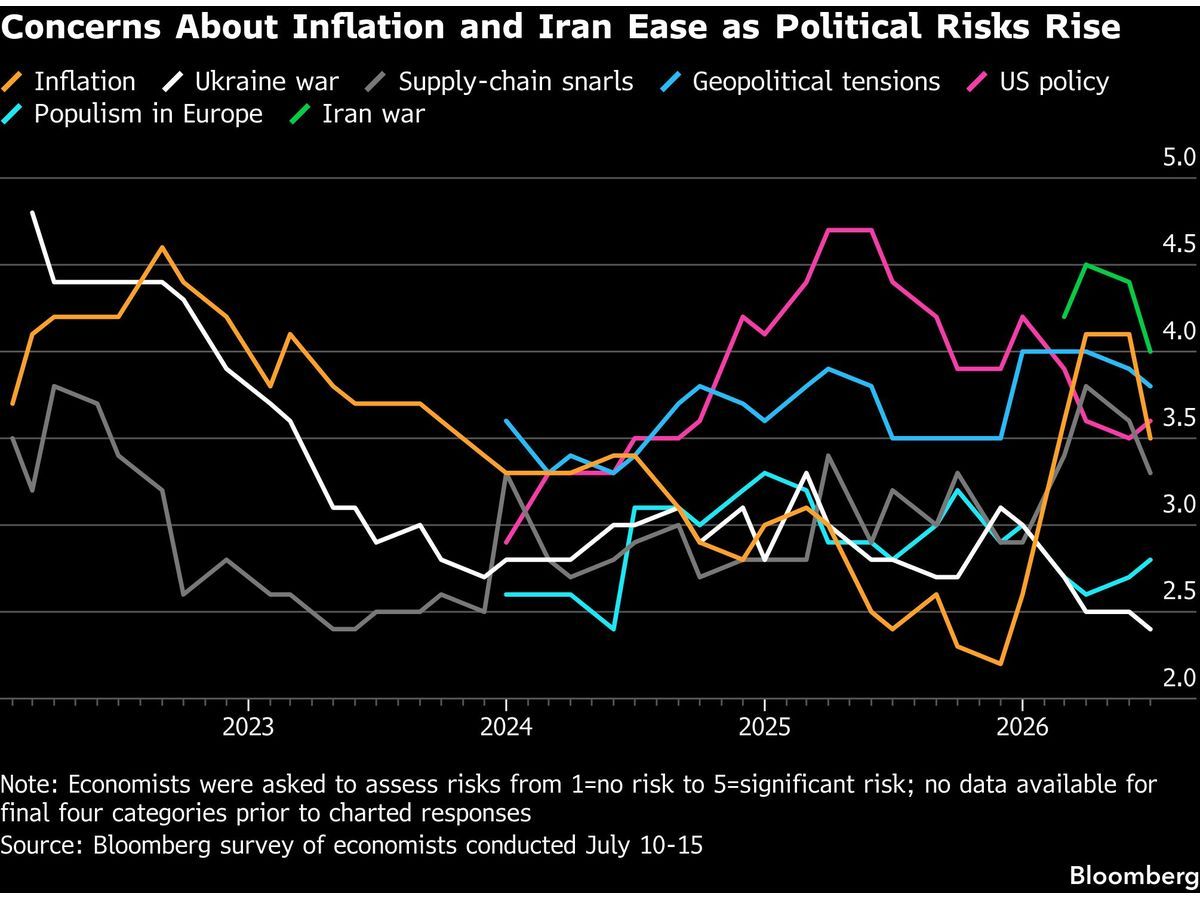
Most of them then anticipate a quarter-point increase in the deposit rate to 2.5% in September, when policymakers will have new quarterly forecasts. That level is where economists largely predict the ECB will stop tightening, after the Iran war sent oil prices surging and caused the euro zone’s worst bout of inflation since 2023. But in tune with the signals coming from the central bank itself, there’s no sense of certainty from analysts, given the fluidity of events in the Middle East that have veered in the past month from a shaky ceasefire to renewed hostilities.
“The key question now is whether renewed US-Iran tensions prove temporary,” said Dennis Shen, a lecturer at TU Berlin’s International School of Management. A contained episode would “support rates being on hold” but more disruption “could revive second-round effects and put inflation expectations under pressure.” Depending on the policy of peers, a September hike could conceivably cement the ECB’s status as the most hawkish Group of Seven central bank.
Last month it became the first of that club to raise rates in the wake of the Iran war. Policymakers’ reflections next week will ultimately set the tone for financial-market bets before a long summer break. With that in mind, Kristian Toedtmann, an economist at Dekabank, reckons Thursday’s outcome will focus on messaging.
“The supply shock is working its way through the economy,” he said. “The ECB will explain that it is monitoring the situation, it feels well positioned, and it is ready to act if needed.” There’s no evidence currently that wage dynamics risk further entrenching price pressures, officials including Austrian central-bank Governor Martin Kocher and ECB Executive Board member Piero Cipollone argued this week.
Inflation eased more than anticipated in June, along with a closely watched gauge for services. Even so, the ECB will maintain “its vigilant stance,” Bundesbank President Joachim Nagel insisted. Borrowing costs are currently at an “appropriate” level, he said on Wednesday, adding that the Governing Council will continue to take all relevant data into account at future meetings.
For economists, the key determinant to a move in the fall will be what happens in the Iran war, with associated repercussions on flows of oil and gas. What Bloomberg Economics Says... “The deceleration of euro-area inflation in June eliminated any need for urgent action. However, buoyant commodity prices keep the Governing Council on track to raise borrowing costs again in September, when it’s armed with fresh forecasts from the staff economists, for a final time in this short tightening cycle.”
—David Powell and Simona Delle Chiaie. Read the ECB PREVIEW “We do not think a September hike is a done deal,” said Chris Hare, an economist at HSBC. “If progress towards peace and improved energy supply gets back on track, we think the ECB could ultimately avoid needing to raise rates.”
Some 41% of respondents expect the central bank to already drop at least some hints next week on where rates may be headed in the coming months, even as President Christine Lagarde recently renewed her commitment to steer clear of forward guidance. Economists see risks to the ECB’s June baseline for growth and inflation this year on the downside, though broadly balanced in the medium term. Only 9% can point to evidence that inflation expectations are becoming unanchored, and most aren’t overly concerned about second-round effects.
Such an outlook could move an eventual reversal of rate hikes into view. The median estimate in the survey points to a cut in September 2027, though four economists, including Bloomberg’s, predict it as early as March.
- Published
- Jul 16, 2026
- Updated
- Jul 16, 2026
- Source
- Financial Post
- Category
- Business
- Read time
- 3 min
Key facts
Why this matters locally
This business story matters locally because it may affect readers, businesses, commuters, families, or public services in British Columbia.
Local impact
BC Post links this item to British Columbia coverage so readers can follow related city updates, weather, traffic, events, and category news in one place.
Timeline
Source and credit
BC Post may summarize, organize, and add local context for reader clarity. Original reporting remains with the listed publisher.
Related Articles
View all Business
AI Market Trends: Q2 2026 Review and Forecast
Business
AI Market Trends: Q2 2026 Review and Forecast
 Business
Starchuk seeking judicial review of Surrey arena land-swap
Business
Starchuk seeking judicial review of Surrey arena land-swap
 Business
B.C.'s Massey Tunnel replacement doubles in cost to estimated $8.5 billion
Business
B.C.'s Massey Tunnel replacement doubles in cost to estimated $8.5 billion
 Business
Earth Angel Worldwide Expands Its Mission Through Music, Education and Environmental Stewardship
Business
Earth Angel Worldwide Expands Its Mission Through Music, Education and Environmental Stewardship
 Business
Kootenay Boundary home sales climb in June as buyers gain more choice
Business
Kootenay Boundary home sales climb in June as buyers gain more choice
More Local Coverage
Latest news Politics
Powerful pro-life ad featuring boxing legend to air during final World Cup matches
Politics
Powerful pro-life ad featuring boxing legend to air during final World Cup matches
 Local News
Cowichan sports shorts: rugby, hockey, biking
Local News
Cowichan sports shorts: rugby, hockey, biking