

While the city is 'strongly encouraging' residents to evacuate, some are asking why it's not mandatory
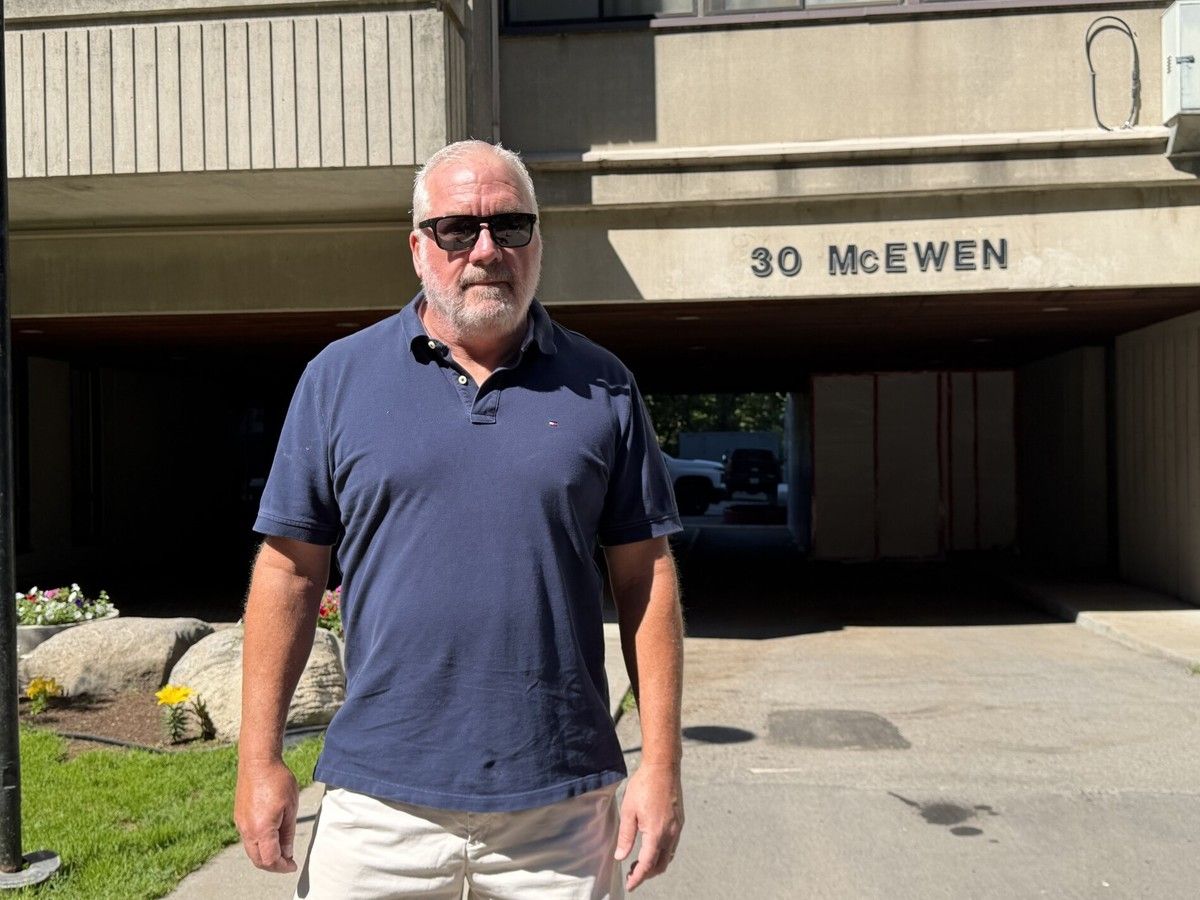
No hydro, no water and no food — that was the reality for Olivia Allan after the Canada Day rainstorm flooded thousands of basements and roads across Ottawa. Allan was among the hardest hit , as a resident of Park West at 30 McEwen Ave. The 24‐storey apartment building was left without electrical power, air conditioning or elevator service for days.
Ten days later, Olivia’s mother, Amy Allan, said conditions had barely improved. Fans blasted through the main lobby of the building on July 11, and one couldn’t miss the loud hum of the generators lighting the string of lights. Access to the building is restricted from 9 a.m. to 5 p.m. for those who had moved out after the storm , and some residents went in and out on Saturday to retrieve the belongings they had left behind.
“Olivia still chose to stay and help clean up,” Amy Allan said of her daughter, who lives on the fourth floor of the building. A July 10 letter from property owner Saickley Enterprises, obtained by the Ottawa Citizen, stated that water infiltration had caused “catastrophic damage” to the building’s hydro vault, fire systems and tenants’ storage units. The Ottawa Fire Department evacuated residents from the building late on July 1 based on priority, but most were instructed to shelter in place, according to the letter.
Although the department strongly encouraged evacuation after July 1, no mandatory order was issued. By July 3, the city “strongly encouraged” remaining residents to leave due to the extent of the damage, which would leave the building without vital services (including power and water) “for a considerable length of time.” Fire officials returned on July 4, again urging tenants to vacate.
According to the letter, residents may not be able to return before July 16, 2026, though the date is not yet official. “Once an official date has been approved by all public authorities, residents will be notified,” the letter read. Still, the evacuation remains a recommendation.
Gregory Brown said the city should issue a mandatory one. “The City can’t evacuate some people and acknowledge the building is not fit to live in, but then not issue an evacuation order, while simultaneously ‘strongly encouraging’ people to evacuate because it is not safe to try to live in the building,” said Brown, a Carleton University professor in the Department of Sociology and Anthropology. Brown said he moved his 86‐year‐old mother from the building into a nearby hotel.
“What if there is a fire? What if old people wandering around in the dark fall and hurt themselves, or worse? “Residents don’t understand that they should get out, and that’s where the government steps in and keeps them safe.”
When asked why the city had not issued a mandatory evacuation order, Ryan Perrault, general manager, Emergency and Protective Services, stated in an email: “While 30 McEwen Avenue is a privately-owned residential building and the City did not issue a mandatory evacuation order, City staff worked closely with the property owner and residents to support evacuation and recovery efforts. “Residents were strongly encouraged to temporarily relocate due to disruptions to life safety systems, including emergency lighting and elevators, and challenging living conditions within the building.” Amy Allan believes mandatory evacuations could be an option, but she worries about the trauma it could cause for older residents with disabilities.
Instead, she wants the city to focus on concrete support like food, water and temporary housing listings. “Rain is rain. It’s an act of God.
But you’d think the city would have a resource for our citizens who pay taxes, at least some concrete help. Have listings of new homes, places where they can stay in the meantime, have food, have water, have grocery carts.” The City Compassionate Grant Program of $1,000 helps, she said, but only applies to those “who have lost everything.”
She believes the criteria are unfair. Allan understands why some residents refuse to leave. “This is their whole life being turned upside down and it’s really traumatizing.
People are really upset,” she said. She said not only does the building remain contaminated, with water trapped between walls, but her daughter also lost all the food in her freezer after the power went out on July 1. Her daughter is among many without insurance.
“I’m palliative. I’m dying of heart disease. And I don’t have an income that I can go and move her to another building,” said Allan, who had wanted her daughter to move in with her after the storm.
“I’m torn,” she said. “One part of me wants to go and rescue her, and keep her here where she’s safe. And the other part of me is extremely proud of my daughter and the person she’s grown to be, helping people night and day.”
Our website is your destination for up-to-the-minute news, so make sure to bookmark our homepage and sign up for our newsletters so we can keep you informed. Related Why do Nepean neighbourhoods always seem to bear the brunt of extreme weather? This Ottawa community was hit by two tornadoes.
Now, it's in flood recovery mode
- Published
- Jul 11, 2026
- Updated
- Jul 11, 2026
- Source
- Ottawa Citizen
- Category
- Health
- Read time
- 4 min
Key facts
Why this matters locally
This health story matters locally because it may affect readers, businesses, commuters, families, or public services in British Columbia.
Local impact
BC Post links this item to British Columbia coverage so readers can follow related city updates, weather, traffic, events, and category news in one place.
Timeline
Source and credit
BC Post may summarize, organize, and add local context for reader clarity. Original reporting remains with the listed publisher.
Related Articles
View all Health
Provation Expands Global Footprint with Launch of Provation® Apex in Australia and New Zealand
Health
Provation Expands Global Footprint with Launch of Provation® Apex in Australia and New Zealand
 Health
The Surprising Cellular Benefit of the Pigment Behind Red Hair
Health
The Surprising Cellular Benefit of the Pigment Behind Red Hair
 Health
Coffee May Protect the Liver in More Ways Than Scientists Realized
Health
Coffee May Protect the Liver in More Ways Than Scientists Realized
 Health
Neuroscientists find a teamwork paradox: highly synchronized brains perform worse at complex tasks
Health
Neuroscientists find a teamwork paradox: highly synchronized brains perform worse at complex tasks
 Health
Study ties some birth control to brain tumours, but risks ‘rare’: experts
Health
Study ties some birth control to brain tumours, but risks ‘rare’: experts
More Local Coverage
Latest news Business
AI Market Trends: Q2 2026 Review and Forecast
Business
AI Market Trends: Q2 2026 Review and Forecast
 Politics
Powerful pro-life ad featuring boxing legend to air during final World Cup matches
Politics
Powerful pro-life ad featuring boxing legend to air during final World Cup matches