

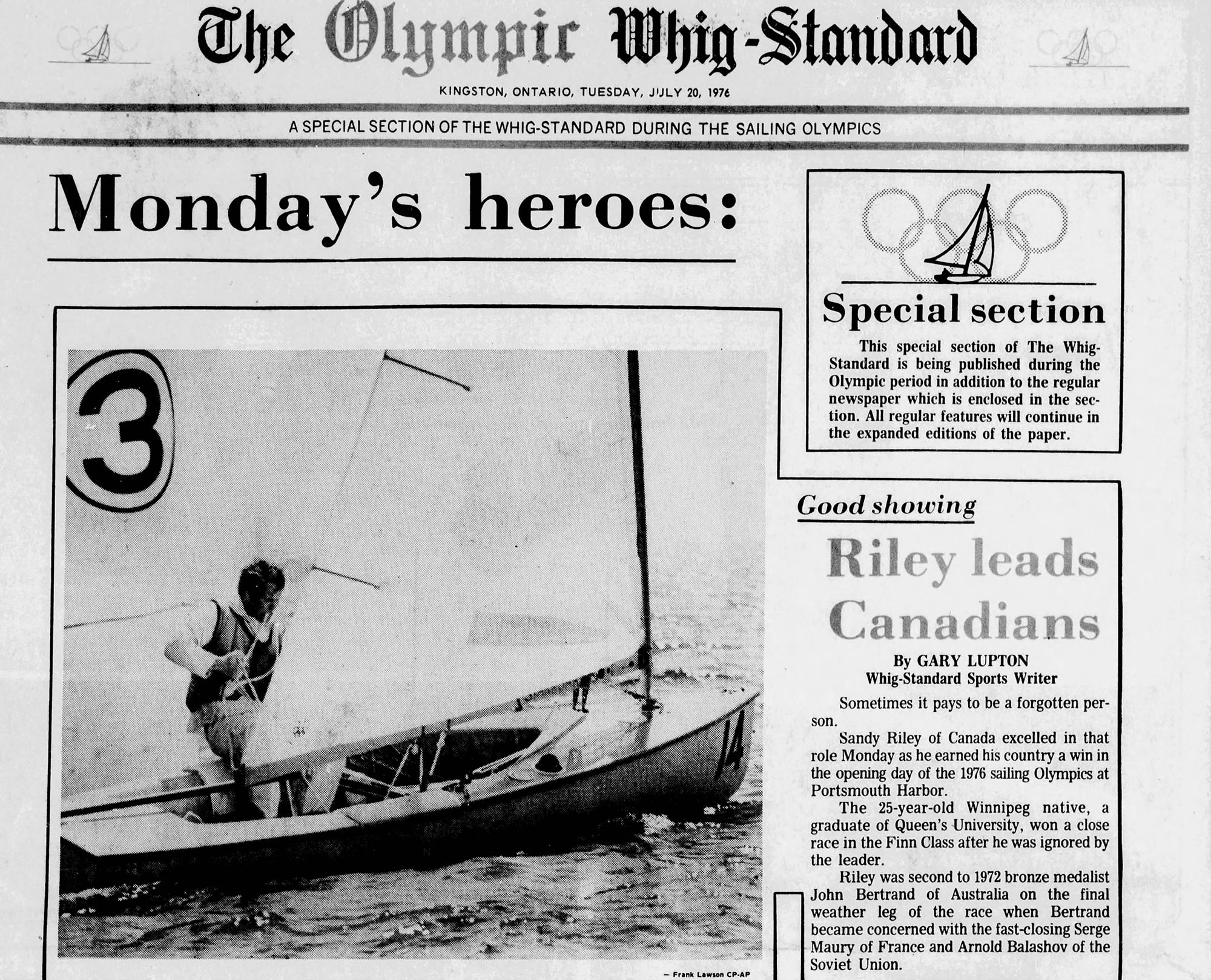
On 50th anniversary of Olympic sailing competition in Kingston, Sandy Riley relives & resails races, both glorious & devastating
Article content Sunday will mark the 50th anniversary of Sandy Riley’s best day in the Olympic sailing competition in Kingston, the opening day as it happens, but the memories rolled like waves in gathering winds. For the City of Kingston and the Canadian Yachting Association, that first day of racing had been seven years in the making, in the works since the International Olympic Committee awarded the 1976 Games to Montreal. For Riley, then a 25-year-old law student, his victory in the first race in the Finn class was a chance to shine in a setting where he had sailed for years before the Olympics landed on his horizon Twenty-eight solo sailors headed out in their heavyweight dinghies that Monday and Riley edged John Bertrand of Australia for the win.
East Germany’s Jochen Schumann finished third, just ahead Andrey Balashov of the Soviet Union in fourth. “There wasn’t a lot of media at the event and there didn’t seem to be a lot of knowledge about the event,” said Riley when contacted this spring in Winnipeg. “After the race, I talked to someone who thought by finishing first, I’d won the gold medal.”
As it would turn out, those three who chased Riley in vain that day would battle through the next six races and stand on the podium at the end of the competition: the GDR with the gold, the USSR the silver and Australia the bronze. The first day’s result ranked as an upset. In the ramp-up to the Olympic yachting competition — that’s how it appeared on the program, as “yachting” rather than “sailing” — Riley wasn’t considered one of Canada’s best hopes for a medal.
That distinction belonged to Hans Fogh, the Toronto sailor in the Flying Dutchman class, who had won a silver medal representing his native Denmark in 1960. In the Canadian Olympic-training Regatta-Kingston (CORK) in 1975, Riley had been top Canadian in the Finn class, finishing 15th. He had finished eighth in the world championships in Australia earlier in ’76 and become the first Canadian to win a U.S. championship, but he was a longshot for a medal.
Yet on the first day of the Olympic regatta, he was on top of the world and the nearest thing to a local making good. “I really understood the winds in Kingston,’ Riley said. “Everyone else was up and down and all over the place, but I was so in tune with the wind shifts.
I knew with the southwesterly winds, they might be light in the morning when you go out, but by the time the race started, they’d be honking.” A long-time resident of Winnipeg who had started sailing on the Lake of the Woods, Riley had come to Kingston in 1968 to do his bachelor of arts at Queen’s. As an undergrad, he played with the Kingston Frontenacs in the Eastern Ontario Junior B Hockey League, admittedly more enthusiastic than gifted, a hard-rock at six-foot-two and 205 pounds.
He also sailed a three-man Lightning boat out of the yacht club when the weather warmed up. In his last year at Queen’s before heading off to Toronto for law school, Riley decided to go solo and bought a Finn, a heavyweight one-man dinghy. That winter, he trained on a hiking machine set up in a space at Jock Hardy Arena.
“We trained hard,” Riley said. “I’ve described sailing the Finn as playing chess while you’re doing sit-ups and pulling weights with either arm.” The Canadian Yachting Association tapped Riley as a comer at the trials for the 1972 Olympic Games when he finished fourth in the Finns as a 21-year-old.
“The three people who beat me at the trials were in their late 30s, so the selection officials assumed they wouldn’t be sailing in the ’76 Olympics,” Riley said. “They decided to send the highest-finishing person in their 20s to Europe for regattas and the Olympics (as a reserve).” The CYA’s belief in Riley looked well founded on Day 1 of the big event.
On Day 2, the script flipped. “The second race was the one that did me in,” Riley said. Riley was third across the line in the second race, behind the winner David Howlett and the East German Schumann in second.
If the result were to stand, Riley would have held on to his lead in the overall standings. Soon after, he found out it was for naught. His result was scrubbed, and he was slotted in last place in the field — officials ruled he had left the starting line prematurely, the sailing equivalent of a false start.
“I didn’t get the gun at the starting line. I was over by a small, small amount,” he said. “It was a foggy day, and the Queen was on hand in the Royal Yacht Britannia.
There was a lot going on around us and enormous noise — just no way of communicating down at the starting line that I was over the line early.” The penalty dropped him from first place to 13th in the standings. At the end of the competition, the sailors could drop their worst finish in the seven races, so he had no margin for error going forward.
At the docks, the Canadian coach Steve Tupper broke the news to Riley and kept the media at bay. To compound the grief, officials let Riley know he’d been selected for drug testing. “It’s one of life’s little ironies,” Tupper told the in a setting where he had sailed for years before the Olympics landed on his horizon Whig-Standard.
“It just wasn’t his day.” In the third race, Riley rallied and finished eighth, but the fourth race effectively took him out of medal contention: 23rd across the line. “It was very light air that day and I just didn’t get to the right side of the course,” Riley said, heaving a sigh freighted with a half-century of what-might-have-beens.
Across the last three races, Riley would finish have a ninth-place finish, along with two in eighth place. Atypically moderate winds over the Olympic schedule hadn’t played to Riley’s strength — one day officials postponed races because of a lack of wind. Still, less than a boat length at the start of the second race in the fog denied Riley a shot at a bronze medal on the last day, a medal that went one of his best friends from the circuit, the Australian Bertand, whose defeat of Dennis Conner in the America’s Cup fueled sailing’s most intense rivalry of the ’80s.
“John had come to the U.S. to take a naval architecture degree at MIT,” said. “We travelled for years together, and I visited him years later in Australia.” Going into the 1976 Olympics, Riley understood his international sailing career was on the clock with pressing concerns and law school was just one of them — in the middle of a qualifying race at during the Olympic trials in Kingston that spring, his wife had to be rushed to hospital for the birth of a daughter.
“(International sailing) was a chapter of my life I learned so much from, but there’s a time and season for everything,” he said. “There are still days that I, nights when I wake up having resailed the entire Olympic trials or resailed the entire Olympic Games in my mind overnight.” Riley would have a long, distinguished career in law and business and served as chancellor of the University of Winnipeg from 2000 to 2009, being appointed to the Order of Canada in 2002.
Riley plans on attending events in Kingston celebrating the 50th anniversary of the Olympic sailing competition, which will be if not occasion for sailing familiar waters and winds, then resailing those seven races in 1976 once more. *** Newspapers provide the first draft of history, but not always a story in full. Often events go unseen at the time, or their effects truly unfold years and even decades after.
To mark the 50th anniversary of Kingston’s hosting the Olympic yachting regatta, the Whig-Standard will publish over the next three Saturdays a series of features about sailors whose stories only started with their pursuit of medals on Lake Ontario. In the first instalment tomorrow, two young college students were denied an opportunity to sail on the eve of their event in a controversy that threatened to bring down Montreal’s Olympics, but improbably they became a nation’s heroes.
- Published
- Jul 16, 2026
- Updated
- Jul 16, 2026
- Source
- The Kingston Whig Standard
- Category
- Canada
- Read time
- 6 min
Key facts
Why this matters locally
This canada story matters locally because it may affect readers, businesses, commuters, families, or public services in British Columbia.
Local impact
BC Post links this item to British Columbia coverage so readers can follow related city updates, weather, traffic, events, and category news in one place.
Timeline
Source and credit
BC Post may summarize, organize, and add local context for reader clarity. Original reporting remains with the listed publisher.
Related Articles
View all Canada
Port of Vancouver expansion project referred to Canada’s Major Projects Office
Canada
Port of Vancouver expansion project referred to Canada’s Major Projects Office
 Canada
Vancouver working to avoid ‘the great sigh’ following FIFA World Cup excitement
Canada
Vancouver working to avoid ‘the great sigh’ following FIFA World Cup excitement
 Canada
Vaughn Palmer: NDP was asked four years ago to rescue B.C.'s pulp mills. It didn't
Canada
Vaughn Palmer: NDP was asked four years ago to rescue B.C.'s pulp mills. It didn't