

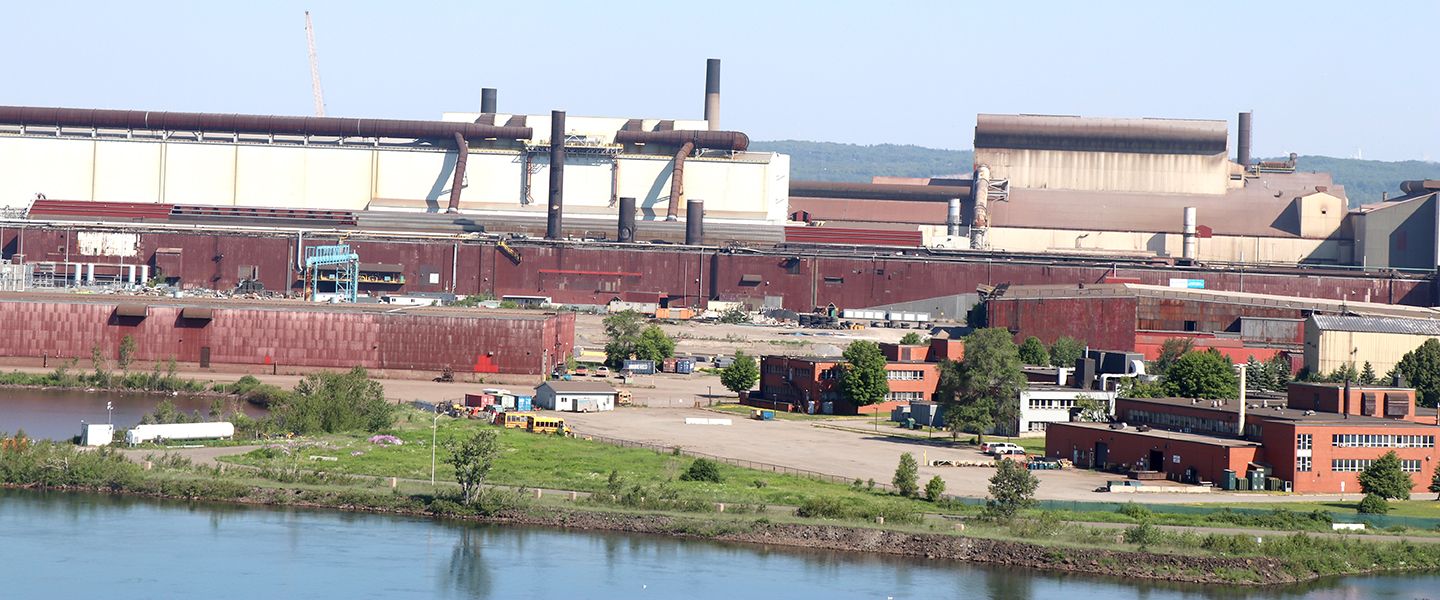
In an exclusive interview with The Sault Star, Roshel CEO Roman Shimonov said that if Roshel and Algoma Steel secure a major federal defence contract, the partnership could create hundreds of jobs, establish a Canadian centre for ballistic steel production and transform Sault Ste. Marie into a national defence manufacturing hub.
Article content Sault Ste. Marie has spent generations forging the steel that built bridges, auto parts and railways, across North America. Now, as world trade shifts, Algoma is forming new partnerships that could transform the local steel industry into something different.
Algoma Steel, along with its lead partner Roshel Defence Solutions, could give Sault Ste. Marie a new mantra — the capital of Canada’s defence industry. Recommended Videos The caveat: the Canadian defence contact for light utility vehicles that is expected to be awarded by the federal government by year-end.
“We just need one single decision and we can connect the dots that will create a better economy, a better future, for so many people and their families,” said Roman Shimonov, CEO and founder of Roshel Defence Solutions, in an exclusive interview with The Sault Star. No conditions attached. The competition has been whittled down to two companies, with Roshel being one, GM the other.
“I’m pleased to see Roshel is part of the two remaining companies bidding for the contract,” said Sault Ste. Marie MP Terry Sheehan. “I continue to meet with them and urge them to put forward more value-added opportunities, which is good for Canadians, good for my constituents.”
Shiminov and his team, along with Algoma Steel executives and local government representatives, have toured Roshel’s Brampton, Ont., headquarters and Algoma Steel’s plant, showcasing their facilities and developing a detailed plan that could quickly transform to action if Roshel receives the nod from the federal government’s defence procurement project. It was in April when Roshel Defence Solutions and Algoma Steel announced their partnership to create Its purpose is clear. RAD wants to deliver sovereign ballistic steel solutions and become a Canadian Centre of Excellence for Ballistic Steel Production.
The partnership is purpose-built to deliver sovereign ballistic steel defence solutions, including full-cycle capabilities such as metal fabrication, forming, welding and machining in Canada. The joint venture comes at a time when the Government of Canada is building its new defence strategy with a Buy-Canada policy designed to offset the impacts U.S. tariffs have had on many of Canada’s industries, especially steel and aluminum. If the federal government awards a major military procurement contract to the emerging partnership between Algoma Steel and Roshel, Shimonov says Sault Ste.
Marie could transform itself into the country’s premier hub for defence manufacturing, creating hundreds of skilled jobs while reshaping the city’s industrial identity for decades. The opportunity extends well beyond supplying steel. The partnership would see Algoma Steel provide domestically produced armour plate for Roshel’s military vehicles, strengthening Canada’s defence supply chain at a time when Ottawa has committed to increasing defence spending and reducing reliance on foreign suppliers.
For a city that has spent years trying to diversify its economy, the project could position Sault Ste. Marie at the centre of a rapidly expanding national security industry. Roshel is the largest armoured manufacturer of the armoured vehicles in the 4×4 platforms.
It has deployed 2,500 units to the Ukraine alone, as well as hundreds of units sold to allies of Canada, including the United Kingdom, Mexico, Brazil and Germany, among others. Shimonov said his company has the unique ability to use all things Canadian, and the partnership with Algoma shares a unique and complete Canadian brand. “Our partnership ensures that we are supporting and addressing all the defence programs in Canada by using Canadian steel, labour, and products developed by Roshel with raw materials supplied by Algoma,” he said.
Coupled with Algoma’s long and unique Canadian legacy, and the fact that it is the only plate manufacturer in Canada, the partnership is one that should be looked at very favourably by the federal government, Shimonov said. “The Canadian government is about to spend billions of dollars on the defence sector,” he added. “Our joint goal is to ensure these funds support Canadian taxpayers, Canadian families and Canadian companies.
Canadians can build for themselves, and we want to ensure these funds will be directed to truly Canadian companies, like ours.” Shimonov is focused on ensuring that “politics” and unachievable promises don’t come into play when the government reviews the RFPs to determine who will get the massive defence contract. “The difference with us, both Roshel and Algoma, is that we’re building and producing everything in Canada.
We pay taxes in Canada. We hire thousands of people in Canada and we’re continuing to invest in Canada.” “We don’t need to go elsewhere when we have something here that’s better, cheaper, sustainable and based on Canadian raw materials when Canadians support themselves, and others as well,” he said.
Needless to say, the job creation aspects of the project would provide relief for the 1,000 layoffs that occurred at the Sault steelmaker just six months ago as a result of the company’s conversion to EAF steel. It’s a message he’s keen on projecting to anyone who will listen, and to anyone who may have the ear of the federal government and its decision makers. The Rad Partnership This partnership is more than just about the names of two Canadian companies.
It’s a manufacturing, supply chain, and a research partnership. “We want to prioritize Canadian steel over other steel. We want to become more competitive because we’re saving on the supply chain, on the logistics and that makes so much sense,” Shimonov said.
“We want to set an example for the Canadian companies where we can create an efficient flow, an efficient sustainable supply chain, prioritize Canadian companies and use Canadian steel.” In addition, RAD is working with Indigenous communities, several academies and creating a defence hub not only to address domestic needs, but also to assist foreign programs. Shimonov said the partnership and program is not just about vehicles.
“It will allow both companies to unlock additional capabilities and create a manufacturer that will benefit programs in Canada and elsewhere as well,” he said. That, in turn, creates more contracts, more jobs and a stronger Canadian economy. Ballistic steel does not only serve defence companies.
It can also serve other industries such as agriculture, heavy machinery and oil, among others. Roshel is committed to investing hundreds of millions of dollars and generate thousands of jobs to benefit Canada – not only for defence but also to prop up machinery for those Canadian industries. RAD’s Plan
If RAD is successful in securing the contract, Roshel is prepared to invest whatever is needed to make it a success. Manufacturing space has been identified at Algoma Steel, the local labour market is available, and a workable plan is in place that can activate quickly. “We have a very strong financial position when it comes to the ability to invest and we don’t mind engaging with financial institutions that will give us even bigger access if it is required,” he said.
“The question is not about how much we invest. We can invest as much as is needed, including to create as many jobs as needed to support the contract that will unlock additional contracts for foreign countries.” He anticipates the creation of 1,000 jobs “in a matter of a few months” with hiring to begin about one month after the contract is awarded.
Those jobs would include steelworkers and a variety of specialists in welding, hydraulics, harnesses, engineering, painters, project managers and administrators, among others. “This is just to start with. Once we unlock the first award it will open up a whole bunch of other projects that are similar,” he said.
Shimonov’s visit to Sault Ste. Marie ironically comes a day before the federal government announced a strategic partnership with General Dynamics Land Systems-Canada (GDLS), resulting in a $2-billion, four-year agreement that will see 190 armoured combat supply vehicles created for the Canadian Armed Forces. It’s expected 6,000 jobs will be created.
In the background, Algoma has been working quietly with GDLS and is working on obtaining its specs and certification to provide the type of plate GDLS will need for its production in the years to come, Sheehan said. “I’m so pleased to see Algoma being nimble in what they’re doing and pleased that Algoma is at the table with the GDLS project announced (Thursday),” Sheehan said. This doesn’t leave RAD out of the mix, by any means.
Roshel’s focus is on its light utility vehicles and its Domestic Arctic Mobility Enhancement (DAME) programs. Its new light utility platform, recently debuted and geared towards the next generation, is believed to make them a contender for a government contract. The War on Ukraine The war on Ukraine has created a unique situation for Roshel.
The use of vehicles during war provide quicker access to data that often takes decades to develop. That information has been used for continuous improvement, which shortens the R&D process from decades to a matter of a few years. “The product we’re offering today to the Canadian Armed Forces is the result of thousands of vehicles deployed and were improved along the way.
It’s an ongoing process,” he said. While the war began using heavily armoured tanks costing millions of dollars, they’ve now been replaced with drones and tactical 4×4 vehicle that can do the same job. That’s resulted in Roshel producing about 16 units daily, making its manufacturing process the largest, fastest, and most cost-effective process around the world.
Roshel inked an agreement in June that creates a partnership with Daimler Truck AG, which merges Roshel’s armoured integration with Daimler’s heavy military vehicle platforms to supply NATO and allied nations. It has also secured a contract to supply 100 of its vehicles to the army in Moldova. Ironically, Roshel sells elsewhere around the globe but hasn’t sold anything to Canada, something Shimonov is desperate to change.
“Canada needs to buy from Canada,” he said. The Economic Impact Roshel has crunched the numbers in a recent market analysis. it anticipates the economic impact will reach $20 billion (Cdn) and the indirect impact within the industry about $45 billion (Cdn) over the course of five years, something that will help the economy Canada-wide.
Sault Ste. Marie’s geographic location is the ideal place for a defence hub. Situated in the centre of Canada with access to rail, water, road – and possibly a future port — transportation options are endless and will keep prices competitive.
Algoma Steel’s CEO Rajat Marwah said RAD “brings together two proven Canadian supplies to establish sovereign ballistic steel production here at home,” and strengthens sovereign industrial capabilities and the Buy Canada procurement policy. “For Algoma, that means putting our facilities and our people in service of Canada’s national security, while reinforcing the broader domestic supply chains our communities depend on. This is a strategy and a commitment to good jobs, and we’re ready to deliver,” he said.
The partnership is welcome news to Sault Ste. Marie Mayor Matthew Shoemaker. It’s one that can further help diversify the city’s economy and bring a return to steel jobs lost earlier this year as a result of Algoma Steel’s transformation to electric arc furnace steelmaking.
“This could represent a generational change to the Sault economy,” Shoemaker said. “It’s another very specific potential investment for our community and would be a very fundamental change to the Sault’s economy in a positive way.” The city has been asked to advocate to the government for the project.
“It’s easy for us as a partner community. If this project comes to fruition, to say this project is going to have the greatest benefit for the national economy and certainly a component of that is right here in Sault Ste. Marie,” Shoemaker said.
The partnership is “as Canadian as you can get” between Algoma Steel and Roshel, he added. With the community’s long history in steelmaking, Shoemaker said this diversification would build on that history and leverage steel with secondary industries. “That’s what this represents.
We leverage something that we have already got to bring in something new,” he said. Sault Ste. Marie already possesses many of the ingredients needed to become a cornerstone of Canada’s defence manufacturing sector: a century-old steelmaker transitioning to greener production, an experienced industrial workforce, strategic transportation links and a growing appetite in Ottawa to build military equipment with Canadian materials.
The contract could be the first step to creating that defence manufacturing hub and centre of defence excellence, he said. Whether that vision becomes reality now depends largely on the decision-makers in Ottawa. A federal contract could serve as the catalyst that elevates Sault Ste.
Marie from a traditional steel town into what could become Canada’s defence capital.
- Published
- Jul 17, 2026
- Updated
- Jul 17, 2026
- Source
- The Sault Star
- Category
- Canada
- Read time
- 9 min
Key facts
Why this matters locally
This canada story matters locally because it may affect readers, businesses, commuters, families, or public services in British Columbia.
Local impact
BC Post links this item to British Columbia coverage so readers can follow related city updates, weather, traffic, events, and category news in one place.
Timeline
Source and credit
BC Post may summarize, organize, and add local context for reader clarity. Original reporting remains with the listed publisher.
Related Articles
View all Canada
Port of Vancouver expansion project referred to Canada’s Major Projects Office
Canada
Port of Vancouver expansion project referred to Canada’s Major Projects Office
 Canada
Wildfire crews on alert as lightning arrives in parts of tinder-dry B.C.
Canada
Wildfire crews on alert as lightning arrives in parts of tinder-dry B.C.
 Canada
B.C. officials brace for increased wildfire activity from dry lightning
Canada
B.C. officials brace for increased wildfire activity from dry lightning
More Local Coverage
Latest news Local News
Cowichan sports shorts: rugby, hockey, biking
Local News
Cowichan sports shorts: rugby, hockey, biking
 Top Stories
Yukon minerals work still under review despite federal announcement
Top Stories
Yukon minerals work still under review despite federal announcement
 Top Stories
Hotel bookings during World Cup down from last year, but B.C. minister sees positives
Top Stories
Hotel bookings during World Cup down from last year, but B.C. minister sees positives