

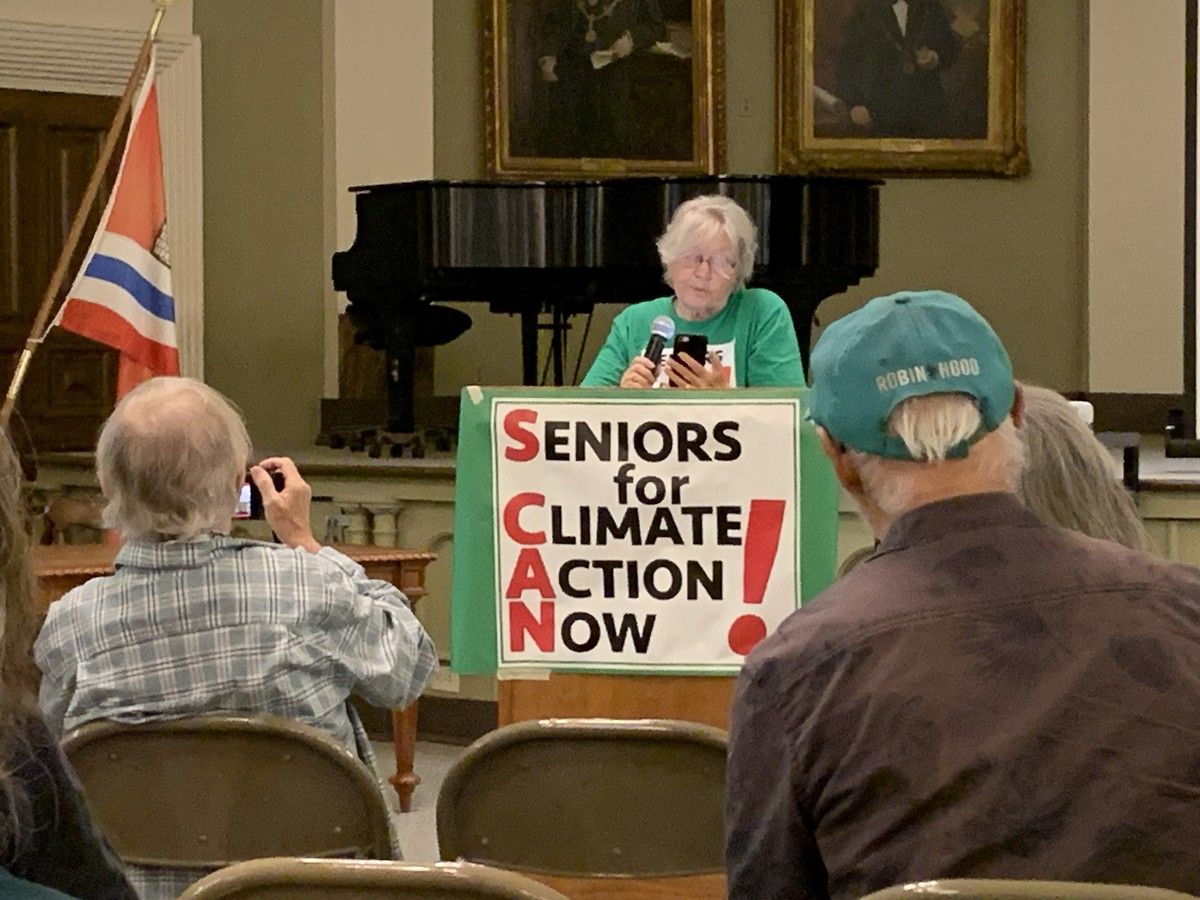
The dark irony wasn't lost on organizers that event took place as Kingston remained under a heat warning and air quality advisory.
Climate advocates, physicians, public health officials and a city councillor used Extreme Heat Awareness Day on Wednesday to press Kingston to adopt stronger protections for renters, arguing that dangerously hot apartments are becoming an increasingly urgent public health issue as heat waves grow more frequent and severe. At a press conference organized by Seniors for Climate Action Now (SCAN) at Kingston City Hall, speakers called on the city to move beyond recent pilot initiatives and enact a maximum indoor temperature bylaw covering all residential rental units. The dark irony wasn’t lost on organizers that the event took place as Kingston remained under a heat warning and air quality advisory, linked to wildfire smoke.
Several speakers cited these current and alarming conditions. “This is a day of recognition, but it’s also a day for action,” said Chris Gusen, co-chair of the Kingston Climate Justice Coalition, who moderated the event. “We are here because we need the City of Kingston to move beyond pilot programs and pass a comprehensive bylaw establishing a maximum indoor temperature for all tenants.”
The call builds on measures already taken by the municipality. In February 2025, Kingston council voted to move forward with a property standards amendment requiring landlords to maintain temperatures at or below 26 C in apartment buildings that already have centralized air conditioning, though the policy stopped short of requiring landlords to install cooling in buildings that do not already have it. The city also launched a Residential Air Conditioner Assistance Program this year, providing free air-conditioning units to eligible low-income seniors living in multi-residential buildings.
The pilot program was approved by council in April and launched in May. Advocates at Wednesday’s event welcomed those measures but argued they do not go far enough. Sydenham District Coun.
Conny Glenn said she has been working for several years to advance a maximum-temperature standard for rental housing and believes recent developments have created a new opportunity for Kingston to act. “We know that 26 degrees Celsius as an indoor temperature is what’s safe,” Glenn said. “Finally, the province has enacted its legislation as of July 1, and we have the opportunity to come back and get that bylaw done.”
Glenn credited community organizations and activists for keeping pressure on the issue. “A pilot project isn’t enough,” she said. “Now it’s the next step, and we have to continue to work on these problems together.”
She also emphasized that extreme heat and poor air quality affect a broad range of residents, not only those traditionally viewed as vulnerable. “It isn’t just seniors. It isn’t just vulnerable people with medical conditions.
It is all of us,” Glenn said, describing seeing a cyclist while on her way to the press conference who was wearing a mask due to wildfire polution. “When you walk outside and you struggle to breathe and you can feel that fire in your lungs because it’s too hot ... we’ve got a big problem,” Glenn said. Dr. Piotr Oglaza, medical officer of health and CEO of Southeast Public Health, said heat events and air-quality warnings that might once have been considered unusual are now occurring with increasing regularity.
“Unfortunately, these types of events are now recurring with almost predictable frequency,” Oglaza said. He said public health officials focus on both immediate protective measures and longer-term policy solutions. At the individual level, he urged residents to pay attention to heat warnings, monitor their own health and check on neighbours, friends and relatives who may be at elevated risk.
“Health-related illness can develop quickly,” he said. “Even short periods of exposure to high temperature could cause health problems.” Heat-related illness can include dehydration, heat exhaustion and heat stroke, he said, while poor air quality can worsen respiratory and cardiovascular conditions.
Oglaza identified older adults, infants and young children, pregnant people, people with chronic illnesses or disabilities, newcomers to Canada, outdoor workers, people experiencing homelessness and socially isolated residents as among those most vulnerable during extreme weather events. He also argued that municipalities should increasingly view climate adaptation as an urban-planning challenge. Drawing on observations from a recent trip to Poland, Oglaza pointed to investments in public transit, pedestrian-oriented spaces and mature urban tree canopies as examples of infrastructure that can reduce heat exposure while improving quality of life.
“We don’t tell people not to drive,” Oglaza said. “We make the alternatives so appealing that they will want to choose it.” Dr. Henry Swoboda, an emergency physician in Kingston and a member of the Canadian Association of Physicians for the Environment, said extreme heat should be viewed as a public-health emergency rather than a seasonal inconvenience.
“Kingston is among the Canadian communities identified as being at highest risk for prolonged heat waves,” he said. Swoboda warned that the risks extend beyond individual health impacts and can affect the entire health-care system. When large numbers of people become ill at the same time, he said, emergency departments become crowded, ambulance offload delays increase and hospital resources become strained.
“Heat waves amplify those pressures,” he said. “The tragedy is that this surge in demand is largely predictable.” Swoboda pointed to recent international examples as evidence of what can occur when communities are unprepared.
He referenced reports showing that more than 10,000 excess deaths were recorded across Europe during a late-June heat wave, with the overwhelming majority occurring among people aged 65 and older. He also cited the 2021 British Columbia heat dome, when a BC Coroners Service review found 619 people died from heat-related causes over a one-week period . Nearly all of those deaths occurred indoors, primarily among older adults and medically vulnerable residents.
“The encouraging news is that many heat-related illnesses and deaths are preventable,” Swoboda said. Among the measures he advocated were accessible cooling centres, assistance for those unable to afford air conditioning, stronger tenant protections and expanded urban tree cover. Tenant advocate Tara Kainer framed the issue as one that intersects with poverty, housing affordability and power imbalances between renters and property owners.
Speaking as a tenant and member of SCAN, she argued that low-income renters often have little ability to modify their living conditions even when they recognize problems with insulation, cooling or building design. “It’s a moral failing that people in need of a basic human right are fodder for profit,” Kainer said. She cited Statistics Canada data showing renter households have been growing faster than owner households and argued many tenants lack the financial resources needed to protect themselves during heat emergencies.
“One study investigating the 2021 heat dome in B.C. concluded that the biggest risk factor for death during extreme heat is poverty,” Kainer said. She acknowledged Kingston’s new air-conditioner assistance pilot but described it as only a partial solution. “Residential air-conditioning programs like the pilot Kingston implemented this summer are helpful, but cannot protect all tenants,” she said.
“We demand that the City of Kingston implement a maximum temperature bylaw for all residential units.” SCAN member Nancy Nicol echoed that message, describing extreme heat as one of the most dangerous consequences of climate change. “The World Health Organization cites climate change as the greatest threat to human health,” Nicol said.
She pointed to local survey data indicating many Kingston tenants experience excessive indoor heat during summer months and argued that governments have both public-health and human-rights obligations to address the issue. “We can take steps to protect people,” Nicol said. “There are four basic ways to cut the vast deaths from heat: stop the planet from burning up, cool your immediate environment, avoid the heat and protect vulnerable people.”
Nicol also criticized what she described as insufficient climate action from senior levels of government and warned that extreme weather events, including heat waves, wildfires and floods, will worsen if greenhouse gas emissions continue to rise. “Climate is not separate from people’s lives,” she said. “It impacts all our lives and our health and our cost of living.”
Following the event, Nicol said advocacy by SCAN members helped secure both the city’s air-conditioner pilot project and its initial steps toward regulating indoor temperatures. “One concrete headway in Kingston was the pilot project for air conditioning,” she said. “I don’t think that would have happened without the work that Tara Kainer, and SCAN, was doing.”
Still, she acknowledged that such measures amount to a limited response to a much larger challenge. “It is a Band-Aid solution,” Nicol said. “But it is essential, because it is going to save some lives, and it’s going to keep some people protected.”
She said many climate advocates have become frustrated by what they see as a gap between governments’ climate commitments and their actions, but added that maintaining hope remains essential. “I’m a very strong believer in hope. You have to be if you’re going to stay in a battle like this in the long term,” she said.
For advocates gathered Wednesday, the broader goal remains persuading Kingston council to adopt a citywide maximum-temperature standard that would protect renters regardless of whether their buildings already have air conditioning. Organizers urged residents to contact councillors, sign petitions and keep the issue in the public eye ahead of Kingston’s municipal election campaign. “Every heat death is preventable,” Gusen said.
“Our municipal government has the power to act.” Bihall@postmedia.com
- Published
- Jul 15, 2026
- Updated
- Jul 15, 2026
- Source
- The Kingston Whig Standard
- Category
- Community
- Read time
- 7 min
Key facts
Why this matters locally
This community story matters locally because it may affect readers, businesses, commuters, families, or public services in British Columbia.
Local impact
BC Post links this item to British Columbia coverage so readers can follow related city updates, weather, traffic, events, and category news in one place.
Timeline
Source and credit
BC Post may summarize, organize, and add local context for reader clarity. Original reporting remains with the listed publisher.
Related Articles
View all Community
Where the rules don’t apply: Fortis and the Christina Lake data centre controversy
Community
Where the rules don’t apply: Fortis and the Christina Lake data centre controversy
 Community
Grey Matters Takes Delivery of the First Brain Dedicated PET Scanning System for its Flagship NovaScan Neuroimaging Clinic in Florida
Community
Grey Matters Takes Delivery of the First Brain Dedicated PET Scanning System for its Flagship NovaScan Neuroimaging Clinic in Florida
 Community
For Our Kids
Community
For Our Kids
 Community
Ladner father, daughter are FIFA Unsung Heroes
Community
Ladner father, daughter are FIFA Unsung Heroes
 Community
Lexston Guyana Inc. Enters Into Letter Of Intent To Acquire Strategic Guyana Mineral Claims
Community
Lexston Guyana Inc. Enters Into Letter Of Intent To Acquire Strategic Guyana Mineral Claims
More Local Coverage
Latest news Business
AI Market Trends: Q2 2026 Review and Forecast
Business
AI Market Trends: Q2 2026 Review and Forecast
 Politics
Powerful pro-life ad featuring boxing legend to air during final World Cup matches
Politics
Powerful pro-life ad featuring boxing legend to air during final World Cup matches