

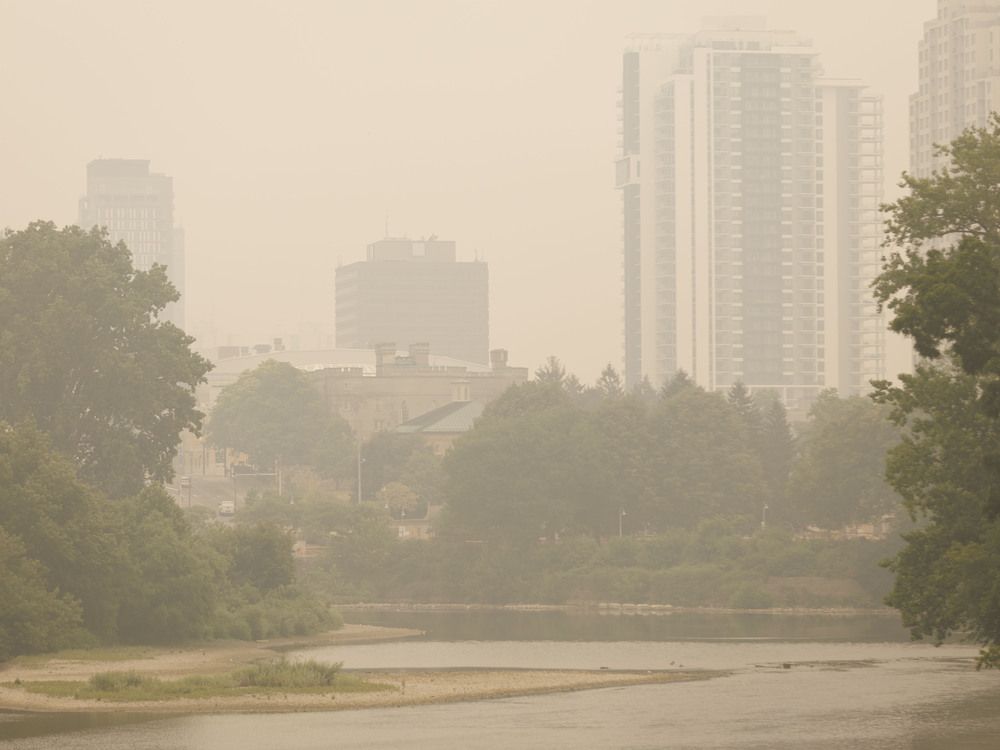
From health advice to event cancellations, here’s what Londoners need to know.
London is under an air quality warning due to wildfire smoke for a second straight day. But how bad is it? How widespread is the smoke?
And what are health experts saying? LFP’s Ryan Goodison has the answers. HOW BAD IS THE SMOKE?
As of Thursday morning, Environment Canada has issued an orange-level air quality warning – the second-highest level in its three-colour system – indicating conditions likely to cause significant health impacts. Smoke from wildfires in northwestern Ontario rolled in midday Wednesday, prompting the warning. The national weather agency says during heavy smoke conditions, everyone’s health is at risk regardless of age or health status.
It recommends limiting time outdoors and rescheduling events and activities. “You may experience mild and common symptoms such as eye, nose and throat irritation, headaches or a mild cough,” the agency wrote in its warning. Less common symptoms can include wheezing, chest pain or a severe cough.
The agency says people more likely to be affected by wildfire smoke include those aged 65 and older, infants, pregnant women, those with an existing illness and people who work outdoors. Ontario’s Air Quality Health Index rated London at 10+, the highest level on the scale and representing a very high health risk. For at-risk populations, such as children and older adults, the province recommends avoiding strenuous outdoor activities and physical exertion.
For the general population, it recommends rescheduling outdoor activities, especially if symptoms such as coughing or throat irritation develop. HOW WIDESPREAD IS THE SMOKE? A map from Environment Canada shows large parts of Ontario are under orange-level air quality warnings.
The warnings extend from Northwestern Ontario, including Thunder Bay, across Southwestern Ontario, including London, Windsor and Woodstock. Toronto and communities across the Greater Toronto Area are also under similar warnings. The province’s Air Quality Health Index shows most communities in the affected area are at 10+, representing a very high risk.
Sgt. Ed Sanchuk of the OPP’s West Region posted to social media Thursday morning reminding people not to rely solely on daytime running lights, as they may not activate rear lights. “With smoke from the northern forest fires affecting visibility across many areas, motorists are reminded to turn on their headlights whenever driving in smoky, hazy or reduced-visibility conditions,” Sanchuk said.
He also urged motorists to increase their following distance and reduce their speed when visibility is limited. “A simple action, such as turning on your headlights, can make a significant difference in keeping everyone safe on our roads,” he said. WHAT ARE HEALTH EXPERTS SAYING?
Alex Summers, medical officer of health for the Middlesex-London Health Unit, told The Free Press on Thursday morning the biggest concern is the short-term health impacts, including eye, nose and throat irritation. “These can progress, less commonly, to things like shortness of breath or chest pain, and that’s why we really want folks to be aware of their symptoms, particularly if they’re at higher risk,” he said. “The chronic or long-term impacts are likely minimal given the short duration of exposure, but if accumulated over a longer period of time, we would worry about long-term impacts.
We anticipate this will be largely a short-term event.” Summers said a well-fitted, properly worn respirator such as an N95 mask is something people should consider if they’re outdoors because it can reduce exposure to the fine particles in wildfire smoke. Even with a mask, however, some risk remains, which is why the health unit continues to advise people to reduce strenuous outdoor activity and spend more time indoors.
“I would also recommend that folks check in on those who are in your care or living nearby to make sure that they are doing well, particularly those that are at higher risk,” he said. Summers also encouraged people to stay cool, drink plenty of water and take breaks. Residents should continue monitoring air quality through Environment Canada or the health unit’s website.
WHAT’S CLOSED OR CANCELLED? At 5:15 p.m. Wednesday, the City of London announced all outdoor programming was cancelled until further notice because of poor air quality. Soccer fields, baseball diamonds and cricket pitches operated by the city, as well as outdoor pools, wading pools and Storybook Gardens, are closed.
Roller skating at Rotary Square and Rhythm Kickboxing on Dundas Place are also cancelled, the city said. The city said it will provide an update Thursday afternoon on the status of outdoor programming. Despite the air quality warning, the first night of London’s Rock the Park music festival continued Wednesday, with thousands of fans attending.
There is no word yet on what the festival is planning for Thursday night. In Middlesex County, a burn ban took effect Wednesday, according to the Municipality of Strathroy-Caradoc’s website. The municipality said all open-air burning is prohibited during the ban, except for small recreational fires that comply with its open-air burning bylaw.
Recreational fires are permitted between 4 p.m. and midnight only. Only commercially produced charcoal or clean, dry seasoned wood may be burned, and fires must be at least three metres (10 feet) from combustible structures or materials. With files from Free Press reporter Allison Young
- Published
- Jul 16, 2026
- Updated
- Jul 16, 2026
- Source
- Lfpress
- Category
- Environment
- Read time
- 4 min
Key facts
Why this matters locally
This environment story matters locally because it may affect readers, businesses, commuters, families, or public services in British Columbia.
Local impact
BC Post links this item to British Columbia coverage so readers can follow related city updates, weather, traffic, events, and category news in one place.
Timeline
Source and credit
BC Post may summarize, organize, and add local context for reader clarity. Original reporting remains with the listed publisher.
Related Articles
View all Environment
A powerful movement of healing arrives at Delta’s Discovery Centre
Environment
A powerful movement of healing arrives at Delta’s Discovery Centre
 Environment
Metro Vancouver issues air quality warning as wildfire smoke drifts in
Environment
Metro Vancouver issues air quality warning as wildfire smoke drifts in
 Environment
Vancouver forecast in 'sweet spot' but hot temperatures on the way
Environment
Vancouver forecast in 'sweet spot' but hot temperatures on the way
 Environment
Mark Carney's new climate doctrine
Environment
Mark Carney's new climate doctrine
 Environment
EU Excludes Soybean Seed from Deforestation Rules
Environment
EU Excludes Soybean Seed from Deforestation Rules
 Environment
Spanish Mountain Gold Reports 69.20 Metres of 0.74 g/t Gold and 77.85 Metres of 0.70 g/t Gold as Part of Its Feasibility Study Drill Program
Environment
Spanish Mountain Gold Reports 69.20 Metres of 0.74 g/t Gold and 77.85 Metres of 0.70 g/t Gold as Part of Its Feasibility Study Drill Program
More Local Coverage
Latest news Politics
Powerful pro-life ad featuring boxing legend to air during final World Cup matches
Politics
Powerful pro-life ad featuring boxing legend to air during final World Cup matches
 Business
AI Market Trends: Q2 2026 Review and Forecast
Business
AI Market Trends: Q2 2026 Review and Forecast