

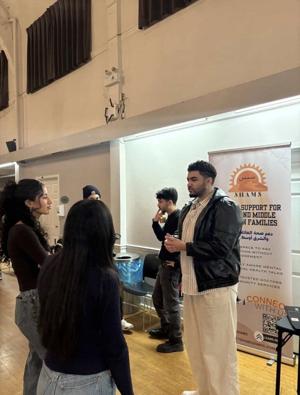
Accessing culturally relevant mental health care is a challenge for many in Canada’s Middle Eastern and North African (MENA) communities.
Accessing culturally relevant mental health care is a challenge for many in Canada’s Middle Eastern and North African (MENA) communities. A July 18 convention hosted by Project SHAMS at the University of Toronto Mississauga aims to raise awareness of the issue and connect community members with health-care professionals and resources that are familiar with their language, traditions and lived experiences. The event is free to attend.
The Mississauga-based community organization strives to create more inclusive mental health care for MENA residents and increase access to culturally relevant support. In Peel Region, officials acknowledge that reducing barriers and improving equity is a part of their work on mental health. ARTICLE CONTINUES BELOW In 2023, regional council announced the launch of the Connection, Acceptance, Resource, Empowerment (CARE) Program, a funding initiative to support community agencies that provide mental health support to vulnerable groups.
However, there are no MENA-specific groups among CARE’s partner organizations, despite there being 50,000 residents in the region who identify as Arab, more than 16,000 who identify as West Asian, and Peel being an overall highly diverse population. While Arab Canadians are only one part of the broader MENA population, studies examining mental health among MENA communities in Canada are limited. A 2024 McMaster University CAN-HEAL study of 60 Arab immigrants to Canada found that 55 per cent reported being in poor mental health and 87 per cent said it had worsened since moving to Canada.
Participants in the study suggested that their ability to receive effective mental health care would be improved if there were health-care providers that were understanding of their cultural norms and values, religious beliefs, language, their experiences with immigration and forced migration, as well as experiences with racism and xenophobia. The study recommended the provision of culturally tailored mental health care, with services designed to reflect the needs of Arab-Canadian community members. Noor Al Assadi, a Palestinian-Lebanese developmental psychologist, said when a patient’s mother tongue is not English, they may struggle to fully express themselves and health-care providers may have difficulty understanding what they are experiencing.
Beyond language, Al Assadi said cultural nuances can also affect communication. The MENA community encompasses a range of dialects and accents, with words and expressions often carrying different meanings depending on cultural context. Al Assadi said there are few developmental psychologists who speak Arabic and understand the cultural backgrounds of MENA clients.
“We’re less than 10 (developmental psychologists in Ontario) that speak and read Arabic and understand our culture,” said Al Assadi. Mahmoud Noweir founded Project SHAMS after witnessing similar issues. “When I first moved here 10 years ago ...
I went with my mom to clinical appointments ... My mom didn’t really know how to express herself the best, so I had to be a translator, an emotional support ... at the age of 18,” he said. “As I grew older, I saw gaps that many Middle Eastern and minority families face when they’re trying to access health care in Canada, whether it was mental health stigma, language barriers, or not knowing where to find trusted information,” said Noweir.
“I just wanted to create something that could bring health-care professionals and communities together in a way that felt like welcoming, practical, and culturally relevant,” Noweir added. In Noweir’s view, a major aspect of culturally relevant health care is not just expanding the services available, but also broadening representation in mental health research. “Studies on Middle Eastern and North African mental health are very limited ...
When Middle Eastern Arab communities are under-represented in health studies, a system may rely on research that does not fully reflect their genetics, their culture, their diet, their immigration experiences, or even barriers to care,” said Noweir. “If people don’t feel like they’re understood, respected, or represented, they may delay asking for help or (avoid care) altogether,” Noweir added. Project SHAMS aims to tackle this issue by recruiting MENA participants for Canadian studies on mental health, conducting community-based research, and partnering with researchers in Canada that focus on health equity, immigration politics, adolescent health, and more.
Noweir is calling on municipalities across Canada to partner with grassroots non-profit organizations that provide culturally relevant mental health services and resources to Middle Eastern and North African communities, saying stronger local partnerships are critical as demand for culturally responsive care continues to grow.
- Published
- Jul 15, 2026
- Updated
- Jul 15, 2026
- Source
- The Record
- Category
- Health
- Read time
- 3 min
Key facts
Why this matters locally
This health story matters locally because it may affect readers, businesses, commuters, families, or public services in British Columbia.
Local impact
BC Post links this item to British Columbia coverage so readers can follow related city updates, weather, traffic, events, and category news in one place.
Timeline
Source and credit
BC Post may summarize, organize, and add local context for reader clarity. Original reporting remains with the listed publisher.
Related Articles
View all Health
Provation Expands Global Footprint with Launch of Provation® Apex in Australia and New Zealand
Health
Provation Expands Global Footprint with Launch of Provation® Apex in Australia and New Zealand
 Health
The Surprising Cellular Benefit of the Pigment Behind Red Hair
Health
The Surprising Cellular Benefit of the Pigment Behind Red Hair
 Health
Coffee May Protect the Liver in More Ways Than Scientists Realized
Health
Coffee May Protect the Liver in More Ways Than Scientists Realized
 Health
Neuroscientists find a teamwork paradox: highly synchronized brains perform worse at complex tasks
Health
Neuroscientists find a teamwork paradox: highly synchronized brains perform worse at complex tasks
 Health
Andlauer-backed group loses bid for Château Montebello
Health
Andlauer-backed group loses bid for Château Montebello
More Local Coverage
Latest news Business
AI Market Trends: Q2 2026 Review and Forecast
Business
AI Market Trends: Q2 2026 Review and Forecast
 Politics
Powerful pro-life ad featuring boxing legend to air during final World Cup matches
Politics
Powerful pro-life ad featuring boxing legend to air during final World Cup matches