

It sounds almost like an oxymoron: Sustainable data centers. After all, the facilities have driven demand for gas and coal-fired power plants, guzzled critical water in regions subject to drought and even raised temperatures in surrounding areas.
(Bloomberg) — It sounds almost like an oxymoron: Sustainable data centers. After all, the facilities have driven demand for gas and coal-fired power plants, guzzled critical water in regions subject to drought and even raised temperatures in surrounding areas.
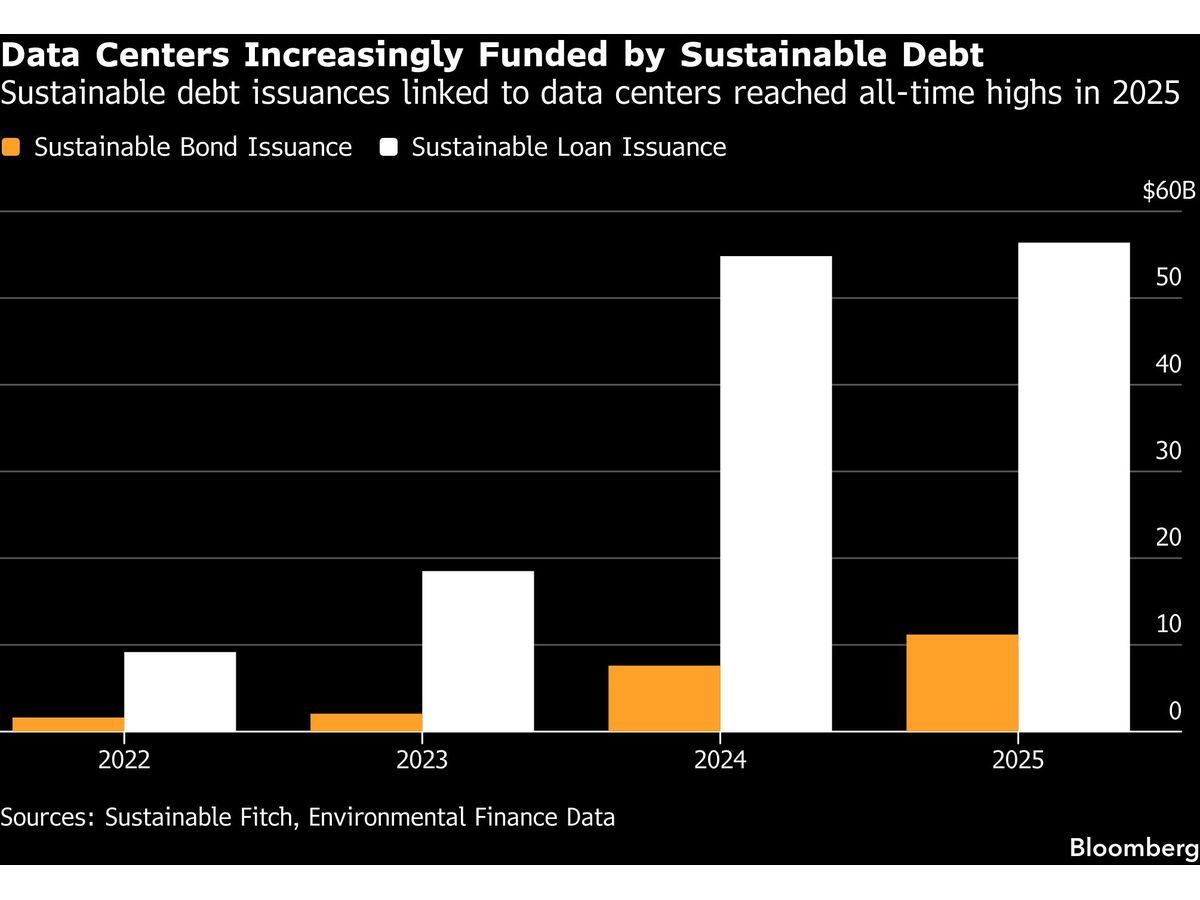
Yet with bipartisan backlash rising across America, developers looking to finance the artificial intelligence boom are increasingly issuing green bonds and loans to finance data centers they say will be energy efficient, as well as renewable energy infrastructure to power them. The strategy, say experts, is a way to quell criticism and, ideally, lower borrowing costs in the process. Since late 2022, when OpenAI triggered a boom with the release of ChatGPT, data center entities have sold $186 billion in sustainable debt, with last year representing the biggest annual total yet, a report by Sustainable Fitch said last month.
On the one hand, the trend reflects a broader reality of debt markets in the AI buildout, projected to cost as much as $7 trillion by 2030: To raise such astronomical sums, issuers have hardly left a corner of finance untouched. But green bonds in particular are getting a hard look as data center projects are, in some places, faltering as communities increasingly revolt over their perceived strain on resources. Coordinated local opposition blocked or stalled at least 48 data center projects valued at a combined $156 billion in 2025, according to research firm Data Center Watch.
New York pushed further this week, becoming the first state to issue a moratorium on new hyperscale data centers, with the governor’s office saying the move allows more time to form a regulatory framework and assess how big facilities will affect utility costs and the environment. Meanwhile, some of the industry’s major players, including QTS Realty Trust Inc, Compass Datacenters LLC and AirTrunk Operating Pty Ltd, have issued green debt this year, with proceeds meant to finance sustainability goals at data centers. Luke Stephens, AirTrunk’s treasurer, said in an interview that the company plans to take out between $4 billion and $5 billion in sustainability-linked loans in the next two to three months.
“The need for companies to have clear and articulated community and social agendas is only going one way – and that’s increasing,” he said. “Sustainable financing is a great way to evidence those commitments.” A long-held pitch of issuing green bonds is that environmentally-conscious buyers will finance projects at lower borrowing costs than the broader market – the so-called “greenium” – because they value impact over returns.
When it comes to data centers, though, onlookers say the biggest priority is avoiding the pervasive narrative around draining local resources. “It is very much a reputation and political move right now,” said Todd Cort, a sustainable finance researcher at the Yale School of Management. Georgia Backlash
The data-center backlash is evident, for example, in Georgia’s Fayette County. It’s home to QTS’ sprawling data center campus, which Microsoft Corp. has signed on as a tenant. The facility has sparked bipartisan local pushback over power and water use.
“Environmental concerns are real here on the ground,” said James Clifton, a Republican running on an anti-data center platform for a county seat. QTS borrowed $4.6 billion in the green-bond market in April to help finance the facility. Proceeds can be used for financing data centers that meet certain energy efficiency thresholds and procuring renewable power, including installing solar, wind and battery infrastructure and securing renewable power purchase agreements, among other initiatives.
The company’s updated green financing framework as of last month explicitly added sustainable water management practices as well. QTS’ water use “is consistent with expectations for a project of this scale and represents less than 1% of Fayette County Water’s current production,” the company said in a statement. Once operational, the facilities will use water that “is roughly equivalent to the monthly use of less than five American households for a typical building.”
Since data centers have historically drained natural resources, rather than preserving them, some sustainably-minded investors are likely to proceed with some trepidation, said Chris Ratti, Bloomberg Intelligence senior sustainable finance analyst. “Investor scrutiny of data centers’ sustainability credentials will likely intensify as power and water use rises,” Ratti said in a recent report. “Yet renewable-power sourcing, efficiency gains and green-building design should keep green-labeled debt open for developers.”
Given the scope of the investment coming for the AI buildout, ESG-focused funds are also likely to want to encourage environmentally-conscious targets by offering funding through green debt. “They’re asking for a lot of money over the next several years,” said Anuj Gulati, Calvert Research and Management’s global head of fixed income ESG strategy and research. “And we have a say in this, at least.”
For now, green bonds are offering some savings relative to conventional debt markets, which have shown signs of fatigue as of late – but possibly not enough for developers to drastically change their plans. Compass Datacenters saw borrowing costs lowered by “a few” basis points on its green debt, said Jonathan Schildkraut, its chief investment officer. But given the proceeds were sustainability-minded anyway, it was no burden to go that route instead of tapping other markets.
“We don’t go and do green things to get sustainable-linked credit,” he said. “If there are things that we do and there are available reductions in our interest costs as a result, we take advantage of it.”
- Published
- Jul 15, 2026
- Updated
- Jul 15, 2026
- Source
- Financial Post
- Category
- Environment
- Read time
- 4 min
Key facts
Why this matters locally
This environment story matters locally because it may affect readers, businesses, commuters, families, or public services in British Columbia.
Local impact
BC Post links this item to British Columbia coverage so readers can follow related city updates, weather, traffic, events, and category news in one place.
Timeline
Source and credit
BC Post may summarize, organize, and add local context for reader clarity. Original reporting remains with the listed publisher.
Related Articles
View all Environment
Metro Vancouver issues air quality warning as wildfire smoke drifts in
Environment
Metro Vancouver issues air quality warning as wildfire smoke drifts in
 Environment
A powerful movement of healing arrives at Delta’s Discovery Centre
Environment
A powerful movement of healing arrives at Delta’s Discovery Centre
 Environment
Vancouver forecast in 'sweet spot' but hot temperatures on the way
Environment
Vancouver forecast in 'sweet spot' but hot temperatures on the way
 Environment
Spanish Mountain Gold Reports 69.20 Metres of 0.74 g/t Gold and 77.85 Metres of 0.70 g/t Gold as Part of Its Feasibility Study Drill Program
Environment
Spanish Mountain Gold Reports 69.20 Metres of 0.74 g/t Gold and 77.85 Metres of 0.70 g/t Gold as Part of Its Feasibility Study Drill Program
 Environment
Mark Carney's new climate doctrine
Environment
Mark Carney's new climate doctrine
 Environment
EU Excludes Soybean Seed from Deforestation Rules
Environment
EU Excludes Soybean Seed from Deforestation Rules
More Local Coverage
Latest news Politics
Powerful pro-life ad featuring boxing legend to air during final World Cup matches
Politics
Powerful pro-life ad featuring boxing legend to air during final World Cup matches
 Local News
Cowichan sports shorts: rugby, hockey, biking
Local News
Cowichan sports shorts: rugby, hockey, biking