

Public utility starts education campaign to convince people to switch over, and if that doesn't work they'll be charged more
Article content NB Power’s on a mission. The public utility has set itself a target to sign up at least half the customers who have so far refused to accept the installation of a smart meter. Most utilities in Canada and the United States have already installed them, so when NB Power began rolling them out in 2023 at a cost of $97 million, it was way behind.
But so far, about 18,000 of NB Power’s 393,000 customers have said no to smart meters, or five out of every 100. Based on the experience of other utilities in Canada and the United States, that’s about double the normal number of refusals. Philippe Landy, acting vice president of operations, tries telling people practical stories about how smart meters could help.
“When I used to be a regional manager in Moncton, probably the highest escalated call I would get wasn’t people who were mad. It was people calling and saying, ‘I messed up. I just moved to my new house.
I called NB Power late, and they can’t come for two more days to hook me up. I’ve got my kids here. What do I do?’
“With a smart meter, you don’t have to wait at all. We can turn on the power remotely.” The utility has decided to take a carrot-and-stick approach to converting the holdouts.
Starting last month, a team of six has been sending emails to customers telling them the benefits of smart meters. They also invite those people to call customer service agents, who are trained to ease their concerns, all part of what it’s calling the Meter Choices campaign. There’s also no charge for the installation of a smart meter.
If that doesn’t work, NB Power has already been granted permission from the regulator – the New Brunswick Energy and Utilities Board – to slap on an extra charge of $4.65 a month to customers’ bills, or $55.80 a year, starting in September. The board permitted NB Power to do this because the utility said it would still have to send workers to those households to read their old analog meters every two months, and it needs to cover those extra labour costs. This obviously won’t make some people happy, as it comes on top of electricity rate hikes over the last three years that have far outstripped inflation and pushed household bills up by hundreds of dollars on average.
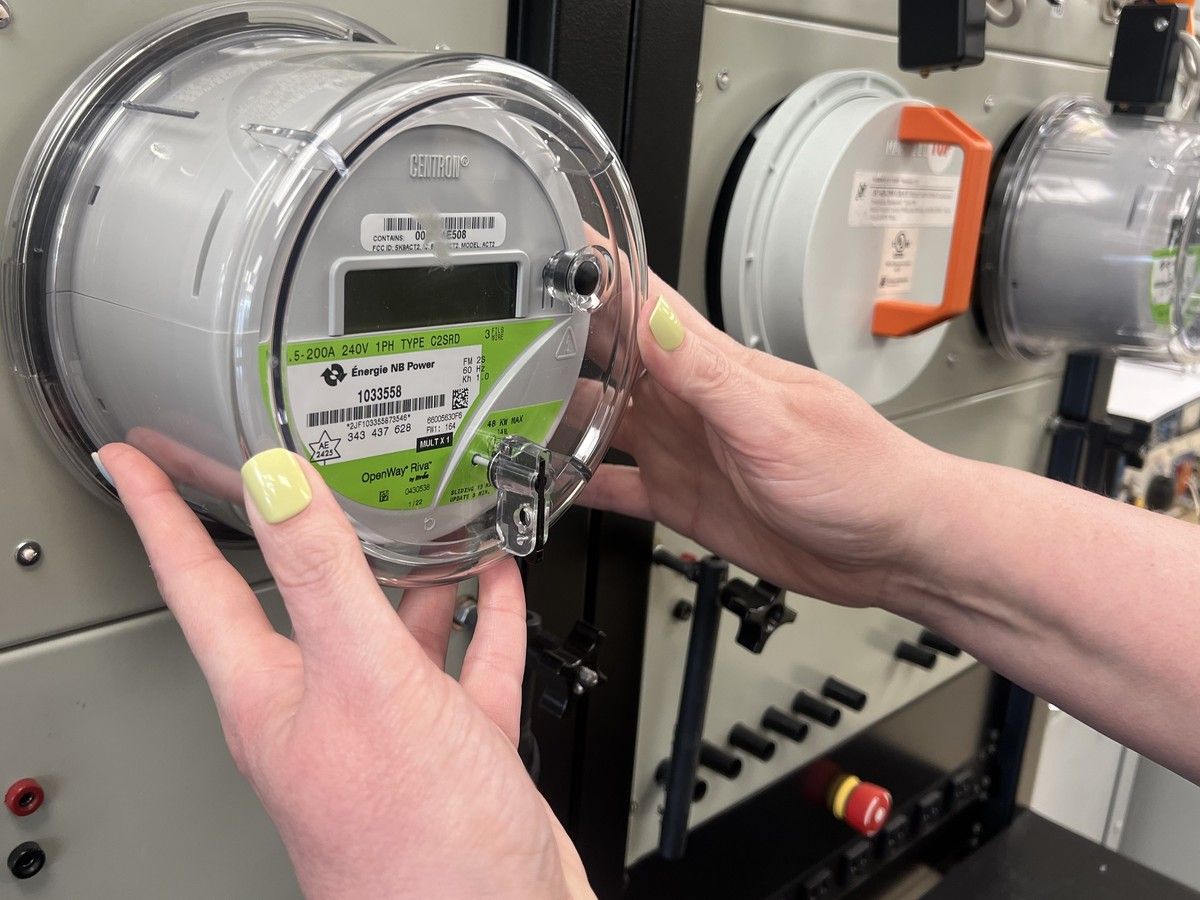
And there’s already a healthy dose of public cynicism about NB Power, given some of its troubles, such as a series of expensive breakdowns at the Point Lepreau nuclear plant. Smart meters are advanced, digital devices that record your electricity consumption in real-time. Unlike traditional analog meters, they use a secure wireless network to transmit the data directly to NB Power, eliminating the need for the utility to send workers to read household and business meters.
They give utilities a better sense of how electricity is being used and when power is interrupted. NB Power is predicting that once the system is fully operational, restoration times during outages will be quickened. NB Power workers servicing an area hit by a storm will be able to tell more easily if everyone is fully restored before taking off to another hard-hit area.
“During the ice storm of 2017 on the Acadian Peninsula, we had asked customers to leave their porch lights on so our workers would know they didn’t need service,” Landry said. “That will become a thing of the past.” The smart meters will also allow the utility to charge time-of-day pricing, if it decides to go down that route.
Customers would be charged more during peaks that are expensive to service, such as before work in the morning or right after school. On the flipside, customers could benefit from a lower rate if they set their laundry machines or dishwashers for the middle of the night. As it stands, NB Power likely won’t ask the board permission to go to time-of-day rates until at least 2028.
Landry knows they have a steep hill to climb in convincing holdouts. They’ve seen social media posts on Facebook forums such as NB Power Rants that fuel conspiracy theories and skepticism about the meters. The Crown corporation has also conducted surveys on people who are cynical about the devices.
They’ve raised three main concerns. They worry smart meters aren’t accurate for measuring electricity. Some people believe they start fires.
And still others believe that the radio frequency transmissions the meters send and receive are bad for human health. Landry says NB Power can debunk each point. “In terms of accuracy, we had an independent review of our smart meters, and we measure the devices on a regular basis.
We aren’t finding anything outside the norm.” Smart meters, the executive points out, have been in use elsewhere for upwards of 20 years. They work just as well in Nova Scotia, Quebec, Ontario, Saskatchewan and British Columbia as they do in New Brunswick.
“We are not leading edge here, not even close. There are 80 million meters in use in North America, and something like 80 per cent of households already have them. It’s not that new a technology.
Some people think we have bought used meters from somewhere. We did not. Our meters are brand spanking new, the latest version, so all the headaches that happened 20 years have been worked out.”
In terms of safety, Landry said the utility works very closely with the provincial fire marshal to ensure it doesn’t start any blazes. But he says people keep posting nonsense on social media that smart meters are causing fires. “There’s been nothing identified, no fires, caused by the meters.
One of the benefits of installing a meter is when we pull off the old analog meter, we actually provide an inspection behind the meter. Some of them have been on there for 15 or 20 years with no one ever looking behind there. Typically, that’s the responsibility of the customer, but through this process, what we’ve agreed to do is if we pull the meter and see something wrong, we fix it.”
An added safety feature, he said, is the new meters will send a signal to NB Power if there’s a high temperature emitted behind the device, something the old analog meters couldn’t do. On the health side, Landry said most people already have plenty of radio frequency emissions in their house. “Your router at your house, your cell phone is putting out way more R.F. than your meter would.
And these devices are typically sitting outside your home. You don’t put it near your ear. Put even if you did, it is not putting out as much R.F. as your phone or microwave that you use every day.”
Landry said that he respects customers’ right to decide what they want installed at their home. He just wants to make sure they are basing their decisions on correct information and not falsehoods spouted on social media. “Most households have had these installed long enough that other people who don’t have them are starting to get more comfortable with the idea of having them.
And now that a $4.65 charge is coming, they might switch over. But it’s too early to tell.”
- Published
- Jul 12, 2026
- Updated
- Jul 12, 2026
- Source
- The Tj News
- Category
- Top Stories
- Read time
- 6 min
Key facts
Why this matters locally
This top stories story matters locally because it may affect readers, businesses, commuters, families, or public services in British Columbia.
Local impact
BC Post links this item to British Columbia coverage so readers can follow related city updates, weather, traffic, events, and category news in one place.
Timeline
Source and credit
BC Post may summarize, organize, and add local context for reader clarity. Original reporting remains with the listed publisher.
Related Articles
View all Top Stories
Yukon minerals work still under review despite federal announcement
Top Stories
Yukon minerals work still under review despite federal announcement
 Top Stories
Forests minister talks saw mills, old-growth and caribou in B.C. Interior
Top Stories
Forests minister talks saw mills, old-growth and caribou in B.C. Interior
 Top Stories
Hotel bookings during World Cup down from last year, but B.C. minister sees positives
Top Stories
Hotel bookings during World Cup down from last year, but B.C. minister sees positives
 Top Stories
B.C. forests minister talks saw mills, old-growth and caribou in Revelstoke
Top Stories
B.C. forests minister talks saw mills, old-growth and caribou in Revelstoke
 Top Stories
Victoria to host BreakOut West as B.C. artists earn over 50 nominations
Top Stories
Victoria to host BreakOut West as B.C. artists earn over 50 nominations
More Local Coverage
Latest news Business
AI Market Trends: Q2 2026 Review and Forecast
Business
AI Market Trends: Q2 2026 Review and Forecast
 Politics
Powerful pro-life ad featuring boxing legend to air during final World Cup matches
Politics
Powerful pro-life ad featuring boxing legend to air during final World Cup matches
 Local News
Cowichan sports shorts: rugby, hockey, biking
Local News
Cowichan sports shorts: rugby, hockey, biking