


After the Jasper wildfire in the summer of 2024, a small group of retired wildfire experts began exploring ways to lower the risk of a major wildfire in and around Banff.
BANFF – The Banff townsite could struggle to fully evacuate during certain historically documented ‘blow-up’ wildfire conditions, according to new research. Scientists also say the tourist town remains at high risk of what is called “urban conflagration”, which is essentially a fire spreading from building to building so quickly that firefighters would struggle to stop it unless more FireSmart work is done in town. Wildfire scientist and Banff resident Marie-Pierre Rogeau said there has been noticeable improvements on the fuel mitigation front by the Town of Banff, Parks Canada and many property owners, but Banff’s “collective wildfire resilience is still low”.
“The results of this study indicate that under certain, but historically accurate conditions, the town of Banff may be hard-pressed to fully evacuate the town, and is still currently subject to near catastrophic urban conflagration,” she said. “There are still far too many problematic properties that are easy to ignite during ember showers and posing a significant risk of urban conflagration with neighbouring properties positioned downwind.” After the Jasper wildfire in summer 2024, a small group of retired wildfire experts began exploring ways to lower the risk of a major wildfire in and around Banff.
The informal study, which uses the fire growth simulation model Prometheus, assessed points of wildfire entry around town and predicted the number of burning hours until the fire front reaches the community. The study dealt only with blow-up fire weather situations when how fiercely the front of the fire is burning exceeds 10,000 kW/hr. Rogeau, who has 35 years of experience and has studied and consulted in the field of wildfire science since 1991, said this blow-up situation is when fire suppression capacities are inadequate even shortly after a fire starts, such as the case in the summer 2024 Jasper wildfire.
According to the research, there were 214 days, or an average of almost eight days per year in Banff between 1998 and 2025, that met the criteria for a blow-up fire. An informal assessment of wind flow patterns around town and the Bow Valley highlighted difficulties in understanding mountain wind dynamics and which circumstances would put both Banff and Canmore at risk over a short-time span, triggering a back-to-back evacuation. Several simulated wildfire starts at different locations around the town were tested to see how much warning residents would have to evacuate.
It considered fires starting about five and 10 kilometres away under a range of weather conditions, from more typical fire behaviour to extreme worst-case scenarios. The modelling found that under the most extreme conditions, a fire starting 10 km from town could threaten the community in less than 12 hours if driven toward town by the wind, leaving little time to evacuate. Fires starting just five km away in those same conditions could force an immediate evacuation, with some simulations suggesting not everyone would be able to get out safely.
Under less extreme conditions, residents would generally have between about 21 and 30 hours to evacuate, giving emergency officials a much better chance of moving everyone to safety. The research concluded the majority of the scenarios triggered an immediate evacuation alert and 47 of the days had the potential for a wildfire to advance six km or more in one afternoon. Another plausible example, say the scientists, showed that a wildfire starting 10 km up the Spray Valley and burning under southwest winds averaging only 15 km/hr would result in flames reaching town in under 12 hours.
Of course, stronger winds and ignitions closer to town would mean wildfire gets to town in an even shorter time. Kelvin Hirsch, a former Canadian Forest Service fire researcher, said susceptible structures and combustible material around them are rarely ignited directly by the flames from a wildfire but instead it happens via burning embers. “Under extreme wildfire conditions, embers can travel over two km ahead of the main fire front as was seen in 2023 when the McDougall Creek Fire near Kelowna B.C. created new spot fire across Lake Okanagan,” he said.
“When this happens, the fire stops being a wildfire and transitions into an urban conflagration and despite the valiant efforts of structural firefighters little can be done to prevent fire spreading from building to building.” Hirsch, who helped develop the first FireSmart manual in the late 1990s, said under extreme conditions a wildfire spreads so quickly and is "so intense that the initial attempts to contain it are not safe nor rarely effective." “For example, just 10 minutes after lightning strikes started the three fires south of Jasper, they were already rapidly spreading crown fires,” he added.
“As wildfires grow to thousands and tens of thousands of hectares, they are virtually uncontrollable regardless of the number of firefighters, air tankers, and other types of firefighting resources that are deployed." The scientists are also calling for another study examining and identifying all locations in Banff that can serve as a safe shelter-in-place, both outdoors and indoors, to be undertaken as soon as possible. Rogeau said outdoor locations need to address the number of people they could possibly shelter, keep on-site containers filled with fire blankets, masks, goggles and burn kits.
She said wildlife precautions would also need to be considered because these safe sites – such as the golf course – will also be used by wildlife fleeing the fire. “Doing the simulations, there’s very high chances there could be scenarios where people won’t be able to leave town so there’s a need for shelter-in-place, either inside or outside,” she said. “The next evacuation guide needs to include shelter-in-place locations and assign them to town evacuation zones, as well as the sequential order of evacuation zones based on the location of the fire and prevailing winds.”
In addition, Rogeau has called for a study on wind-driven pathways through town that intersect with poor FireSmart scoring properties. “If you have several properties with poor scores igniting at once from falling embers, it becomes a recipe for losing most of the town,” she said. Wildfire experts say that while local emergency respondents and wildland fire management specialists fully understand the risks and what needs to be done, progress has been slow with private property owners, including homes and commercial dwellings.
Parks Canada’s fire program has also long been under-funded and lacks staff capacity, they say. Cliff White, a retired Parks Canada wildfire expert with 47 years of experience, was Banff National Park’s vegetation and fire specialist from 1979 to 1986 and also served as Parks Canada’s first national fire management officer in Ottawa. He has created a Lens of Time Northwest website regarding ‘Burning Banff’, which is found at https://lensoftimenorthwest.com/themes/burning-banff/.
He is calling for an alternative solution to manage fuels in the Bow Valley, which he said could be administered under a Community Forest model. White said Community Forest programs are increasingly seen as an essential landscape approach to reduce wildland fire risk, adding these organizations work with local businesses and residents to manage vegetation and biomass to “create conditions favourable for safe and rapid wildfire control.” “The crisis of increasing wildfire risk to communities, and roof-to-region solutions require urgent and innovative governance, harvest licensing and economic support for ongoing biomass reduction in the intensive forest management zone around communities,” he said.
While start-up costs would be substantial, White said it requires innovative ecological management, integrating logging and thinning forests, and brushing and mowing, to be integrated with Indigenous traditional knowledge of fire to create habitat types with low fire intensities. He said community forest models are often set up as not-for-profits with an open governance structure that encourages participation by local citizens and businesses. As not-for-profits, he said they can also get grants and donations and prioritize so that funds from tree logging can be re-channelled into creating FireSmart landscapes.
“B.C. hit this straight on 20 years ago and I think we have to do this here and build capacity within the community... get partners involved and go after funding grants,” said White. The wildfire scientists say robust fire guard building along town boundaries is still insufficient, as long as there is not strong adherence to FireSmart across the community. Rogeau called for mandatory FireSmart assessments in town.
She again stressed they are not dismissing the ongoing fuel reduction work by Parks Canada, the Town of Banff and numerous Banff residents, but judge the wildfire threat to the town as “highly elevated” almost two years since Jasper’s wildfire disaster and a decade since the devastation in Fort McMurray. “We still have cedar shake roofs, coniferous trees and highly flammable material next to dwellings, which will ignite from falling embers from as far as two km or more... this town has very little chance to fare well during a high-intensity fire,” said Rogeau.
Rogeau has made presentations on her findings to Town of Banff administration and has sent a letter to mayor and council. A spokesperson for the Town of Banff was not immediately available.
- Published
- Jul 16, 2026
- Updated
- Jul 16, 2026
- Source
- Rocky Mountain Outlook
- Category
- Environment
- Read time
- 7 min
Key facts
Why this matters locally
This environment story matters locally because it may affect readers, businesses, commuters, families, or public services in British Columbia.
Local impact
BC Post links this item to British Columbia coverage so readers can follow related city updates, weather, traffic, events, and category news in one place.
Timeline
Source and credit
BC Post may summarize, organize, and add local context for reader clarity. Original reporting remains with the listed publisher.
Related Articles
View all Environment
50-hectare wildfire burns between Clearwater and 100 Mile House
Environment
50-hectare wildfire burns between Clearwater and 100 Mile House
 Environment
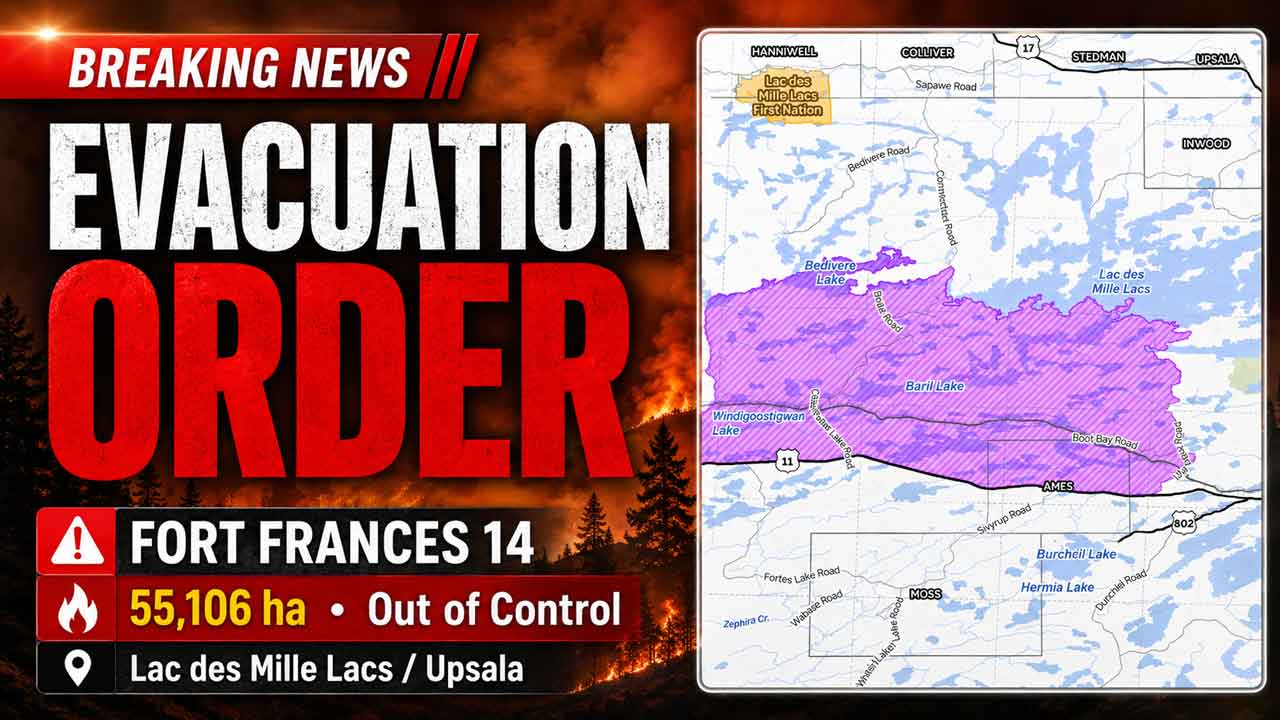
Updated Evacuation Information for Wildfire Fort Frances 14 (July 17 2026)
Environment
Updated Evacuation Information for Wildfire Fort Frances 14 (July 17 2026)
 Environment
A powerful movement of healing arrives at Delta’s Discovery Centre
Environment
A powerful movement of healing arrives at Delta’s Discovery Centre
 Environment
EU Excludes Soybean Seed from Deforestation Rules
Environment
EU Excludes Soybean Seed from Deforestation Rules
 Environment
Metro Vancouver issues air quality warning as wildfire smoke drifts in
Environment
Metro Vancouver issues air quality warning as wildfire smoke drifts in
 Environment
Vancouver forecast in 'sweet spot' but hot temperatures on the way
Environment
Vancouver forecast in 'sweet spot' but hot temperatures on the way
More Local Coverage
Latest news Business
AI Market Trends: Q2 2026 Review and Forecast
Business
AI Market Trends: Q2 2026 Review and Forecast
 Politics
Powerful pro-life ad featuring boxing legend to air during final World Cup matches
Politics
Powerful pro-life ad featuring boxing legend to air during final World Cup matches