

The UK economy unexpectedly grew in May, suggesting that consumers and businesses were more resilient than feared in the face of political turbulence and higher energy prices.
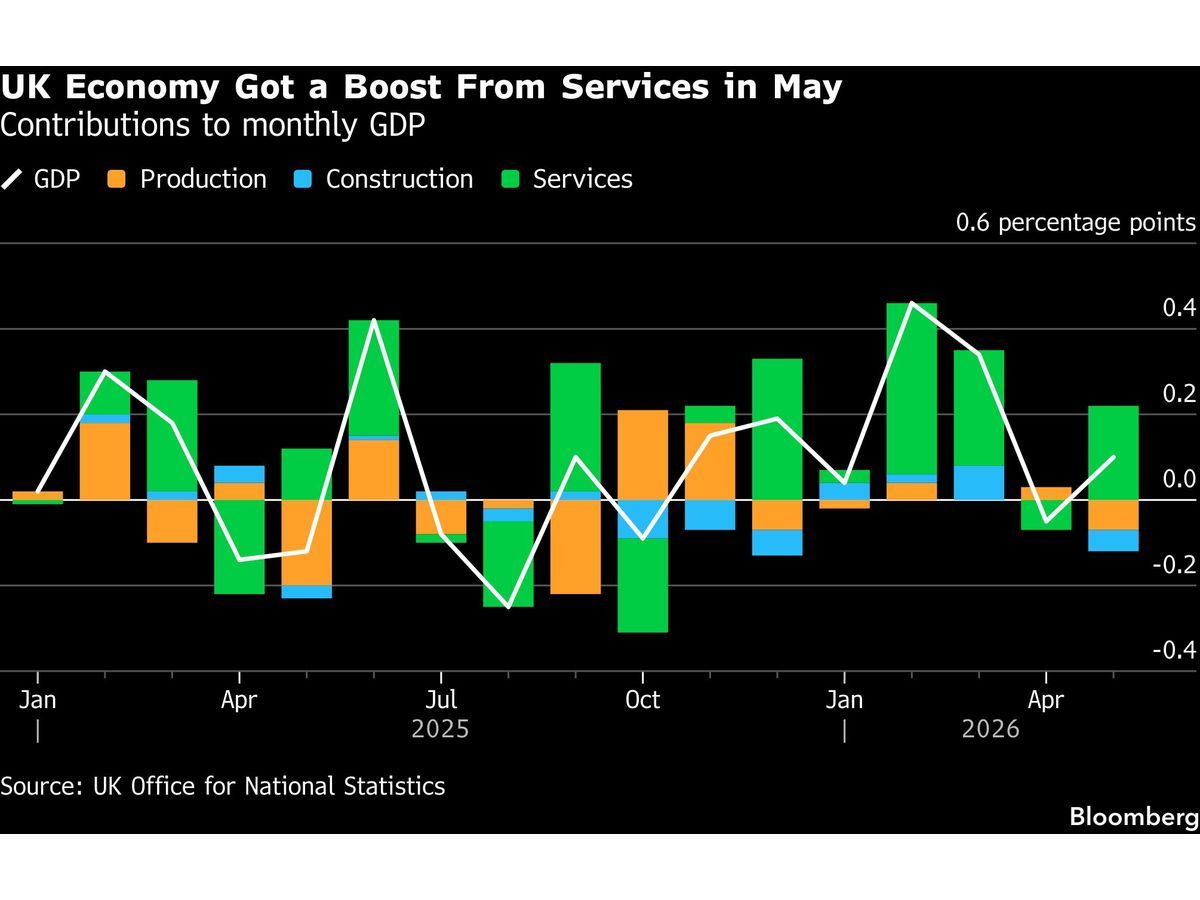
(Bloomberg) — The UK economy unexpectedly grew in May, suggesting that consumers and businesses were more resilient than feared in the face of political turbulence and higher energy prices. Gross domestic product rose 0.1% after a 0.1% decline in April, the Office for National Statistics said Thursday. Economists expected no change.
Services grew 0.3% on the month, driven by research and development in medical sciences and a strong performance for retailers, as warm weather brought consumers into the shops. Construction meanwhile fell 0.8% and industrial production declined 0.5% as a small gain for manufacturing was offset by lower energy and utilities output. The modest overall improvement came with the economy caught between political drama and an energy crisis.
Britons were beginning to factor in the prospect of another change in prime minister after Keir Starmer’s position became untenable following heavy losses in May’s local elections. At the same time, the conflict in the Middle East continued to elevated oil prices and weigh on sentiment. Activity is likely to stay muted in the next months.
The collapse of a US-Iran truce and renewed strikes has pushed up oil prices again, reviving fears of higher inflation and weaker growth. “The UK economy returned to growth in May, but renewed energy price pressures cloud outlook” says Yael Selfin, chief economist at KPMG. The ONS said consumer-facing services grew 0.5% in May, driven by a 1.2% increase in retail sales and the sport, amusement and recreation sectors.
Retail sales were helped by promotions and warm weather. A stabilizing labor market is also easing concerns about job losses and could help support consumer spending. Bank of England policymakers face a balancing act ahead of their next interest-rate decision on July 30.
While the Iran energy shock threatens to keep inflation above the BOE’s 2% target for longer, activity remains subdued. Andy Burnham, who is set to replace Starmer as prime minister on Monday, inherits an economy facing “major challenges,” the Organisation for Economic Cooperation and Development warned in a recent report. Economists expect a slowdown in the second quarter of the year after starting 2026 with the fastest growth in the Group of Seven.
However, the economy is holding up better than the BOE assumed. “We assume a prolonged period of rates on hold, but solid growth is one reason that a hike is more likely than a cut,” said Rob Wood, chief UK economist at Pantheon. (Adds details, charts)
- Published
- Jul 16, 2026
- Updated
- Jul 16, 2026
- Source
- Financial Post
- Category
- Business
- Read time
- 2 min
Key facts
Why this matters locally
This business story matters locally because it may affect readers, businesses, commuters, families, or public services in British Columbia.
Local impact
BC Post links this item to British Columbia coverage so readers can follow related city updates, weather, traffic, events, and category news in one place.
Timeline
Source and credit
BC Post may summarize, organize, and add local context for reader clarity. Original reporting remains with the listed publisher.
Related Articles
View all Business
AI Market Trends: Q2 2026 Review and Forecast
Business
AI Market Trends: Q2 2026 Review and Forecast
 Business
Starchuk seeking judicial review of Surrey arena land-swap
Business
Starchuk seeking judicial review of Surrey arena land-swap
 Business
B.C.'s Massey Tunnel replacement doubles in cost to estimated $8.5 billion
Business
B.C.'s Massey Tunnel replacement doubles in cost to estimated $8.5 billion
 Business
Earth Angel Worldwide Expands Its Mission Through Music, Education and Environmental Stewardship
Business
Earth Angel Worldwide Expands Its Mission Through Music, Education and Environmental Stewardship
More Local Coverage
Latest news Politics
Powerful pro-life ad featuring boxing legend to air during final World Cup matches
Politics
Powerful pro-life ad featuring boxing legend to air during final World Cup matches
 Local News
Cowichan sports shorts: rugby, hockey, biking
Local News
Cowichan sports shorts: rugby, hockey, biking