

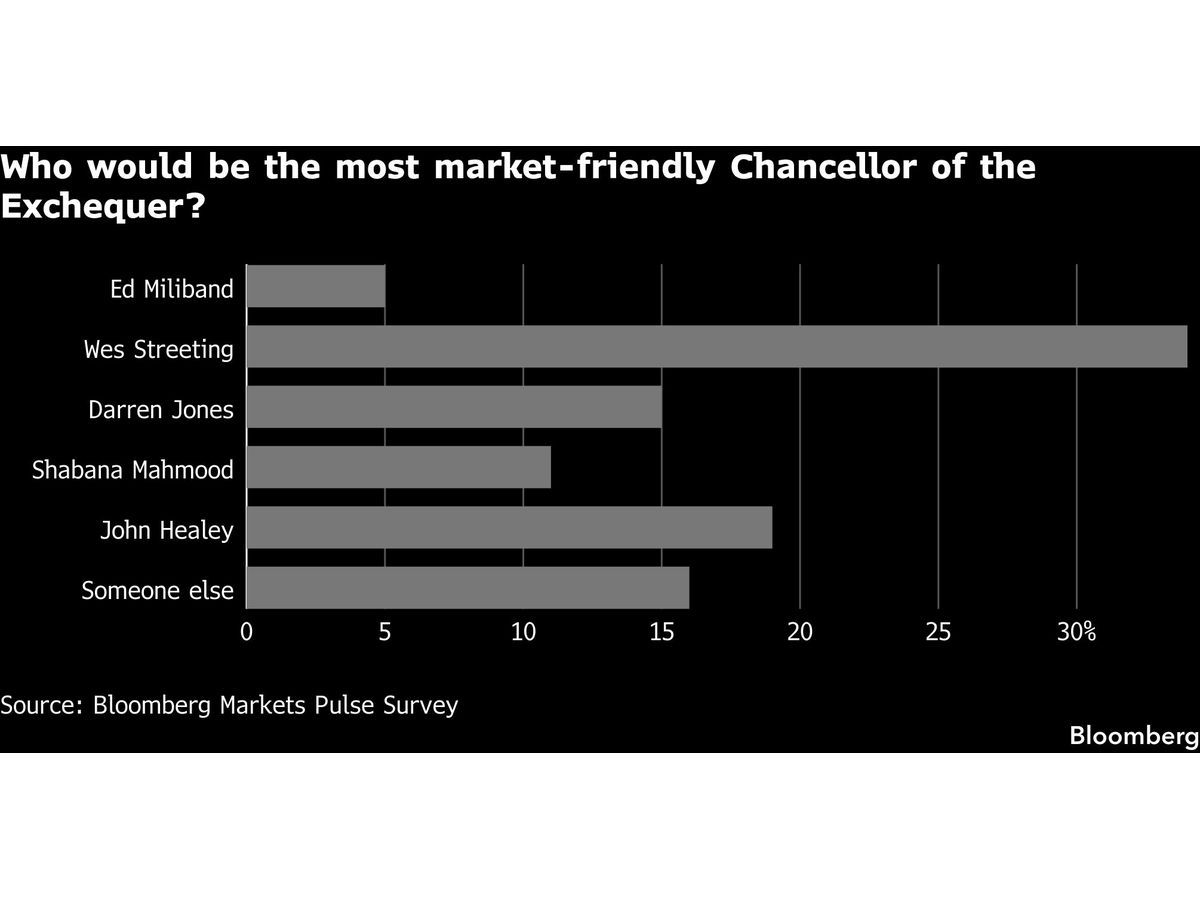
Andy Burnham has yet to announce his choice for UK Chancellor of the Exchequer, but among the presumptive next prime minister’s leading candidates, Energy Secretary Ed Miliband is seen as the least market-friendly choice, according to the latest Bloomberg Markets Live Pulse survey.
(Bloomberg) — Andy Burnham has yet to announce his choice for UK Chancellor of the Exchequer, but among the presumptive next prime minister’s leading candidates, Energy Secretary Ed Miliband is seen as the least market-friendly choice, according to the latest Bloomberg Markets Live Pulse survey. The former party leader attracted the lowest level of support, with 5% of votes. Meanwhile, ex-Health Secretary Wes Streeting is considered the best option for UK markets, according to 34% of respondents in the survey of 187 market participants conducted from July 2-13, 2026.
That gave him a clear margin over recently resigned Defence Secretary John Healey. Miliband has long been viewed as the option most likely to push a higher-spending, left-leaning agenda, and is the clear bookmakers’ favorite to succeed Rachel Reeves as Chancellor. Streeting’s more centrist views have made him the preferred candidate for investors worried by the UK’s swelling budget deficit and keen for the government to stick to its fiscal rules for borrowing and spending.
“The government has been working within a very tight straitjacket and the market is putting pressure on the challenger to commit to the targets that the Starmer administration had set,” Guy Miller, chief strategist at Zurich Insurance said, referring to outgoing Prime Minister Keir Starmer. “It’s absolutely critical that they have a chancellor who’s credible and who will honor these targets and make sure that the deficits are dealt with.” A representative for Miliband didn’t respond to a request for comment.
With key cabinet positions outstanding, there’s a lot of uncertainty as to how Burnham’s premiership will play out for UK assets, but broadly investors expect it to be negative, with higher gilt yields and a weaker pound. Almost 40% of survey respondents said Burnham’s leadership would make them less bullish on the UK. A further third said they were already bearish and would remain so.
Just 16% of respondents said they would be more bullish on the UK as a result of Burnham taking over. At the same time, there’s some support for some of the pro-growth proposals put forward by Burnham’s team. Two thirds of respondents thought that widening the Bank of England’s remit to include growth rather than just inflation would be positive for UK assets, more than double the proportion of those who said it would be negative.
Louise Haigh, the former Transport Secretary who is now a power-broker in Burnham’s team, has suggested reforming the Bank of England and re-examining its mandate to see whether it should include a greater focus on economic growth. Within the BOE’s current remit, respondents thought the most probable scenario for the central bank was to keep rates on hold for the rest of the year. Still, that was closely followed by the chance of one rate hike, with odds put at about one in three.
Currently, markets are are pricing a hike by November, but the situation in the Middle East remains fluid, and oil prices rose in the period when the survey was conducted. Monetary policy is one of the key factors impacting gilt yields, particularly for shorter-dated securities, with geopolitics in the driving seat for much of the year. Still, longer-dated securities tend to reflect the perceived economic health and growth prospects of the country, and they’ve remained relatively sanguine since May’s local election results, which paved the way for Starmer’s resignation.
Gilts Are Giving Burnham a Pass for Now, Says Aegon’s Lynch The 10-year yield is expected to finish the year at 5%, according to the median estimate in the survey. The yield was around 4.75% when the survey began, but has since risen to 4.95% due to re-escalation of tension in Iran.
The average survey view is for sterling to weaken slightly to $1.30 from by the end of the year. It traded at about $1.3375 as of 4 p.m. London time on Monday.
“The market has got the policymakers where they need to be right now,” Zurich Insurance’s Miller said, “You have to be disciplined, you have to deliver.” —With assistance from Sujata Rao and Alex Wickham.
- Published
- Jul 13, 2026
- Updated
- Jul 13, 2026
- Source
- Financial Post
- Category
- Business
- Read time
- 3 min
Key facts
Why this matters locally
This business story matters locally because it may affect readers, businesses, commuters, families, or public services in British Columbia.
Local impact
BC Post links this item to British Columbia coverage so readers can follow related city updates, weather, traffic, events, and category news in one place.
Timeline
Source and credit
BC Post may summarize, organize, and add local context for reader clarity. Original reporting remains with the listed publisher.
Related Articles
View all Business
AI Market Trends: Q2 2026 Review and Forecast
Business
AI Market Trends: Q2 2026 Review and Forecast
 Business
Starchuk seeking judicial review of Surrey arena land-swap
Business
Starchuk seeking judicial review of Surrey arena land-swap
 Business
B.C.'s Massey Tunnel replacement doubles in cost to estimated $8.5 billion
Business
B.C.'s Massey Tunnel replacement doubles in cost to estimated $8.5 billion
 Business
Earth Angel Worldwide Expands Its Mission Through Music, Education and Environmental Stewardship
Business
Earth Angel Worldwide Expands Its Mission Through Music, Education and Environmental Stewardship
 Business
Kootenay Boundary home sales climb in June as buyers gain more choice
Business
Kootenay Boundary home sales climb in June as buyers gain more choice
More Local Coverage
Latest news Politics
Powerful pro-life ad featuring boxing legend to air during final World Cup matches
Politics
Powerful pro-life ad featuring boxing legend to air during final World Cup matches
 Local News
Cowichan sports shorts: rugby, hockey, biking
Local News
Cowichan sports shorts: rugby, hockey, biking