

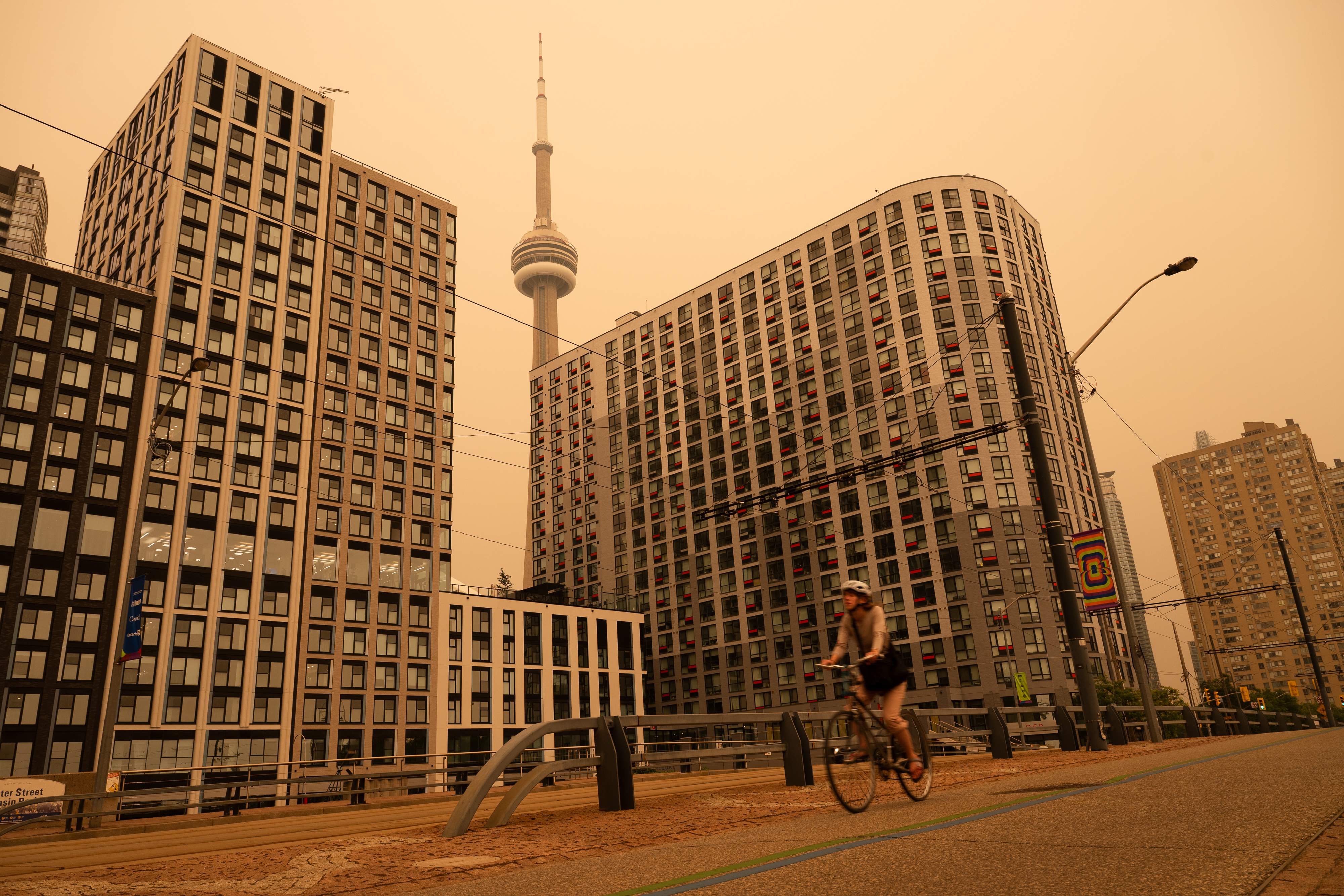
Wildfire smoke still blankets large parts of southern Ontario, including Toronto, and conditions may not improve until Friday morning.
Wildfire smoke still blankets large parts of southern Ontario, including Toronto, and conditions may not improve until Friday morning. Environment Canada’s orange air quality warning continues to be in place Thursday, a day after it was first implemented for the smoke that turned the skies in Canada’s largest city orange. The smoke from the wildfires in northwestern Ontario plummeted Toronto’s air quality to the worst in the world throughout Wednesday morning.
Only Detroit was ahead of Toronto early Thursday morning. The smoke forced the cancellation of several outdoor events Wednesday, including the FIFA Fan Festival watch party in Toronto and the Rock the Park music festival in London. Ontario forest fire officials said Tuesday there were 148 active fires in the northwest region alone, including 69 that were out of control.
The fires have prompted evacuation orders for several communities, including Armstrong, Lac La Croix First Nation, Whitesand First Nation, Gull Bay First Nation and Lac des Mille Lacs First Nation. One fast-moving blaze has damaged and destroyed homes and buildings on Namaygoosisagagun First Nation, also known as Collins First Nation, north of Thunder Bay. Premier Doug Ford has said crews are hard at work fighting the fires, and the province will spare no expense in keeping people safe.
Get breaking National news Environment Canada is advising Canadians to limit time outdoors and prioritize keeping cool inside. “You may experience mild and common symptoms such as eye, nose and throat irritation, headaches or a mild cough. More serious but less common symptoms include wheezing, chest pains or severe cough.
If you think you are having a medical emergency, seek immediate medical assistance,” it said. “People more likely to be impacted by wildfire smoke, including people aged 65 and older, pregnant people, infants and young children, people with an existing illness or chronic health condition, and people who work outdoors, should avoid strenuous activities outdoors and seek medical attention if experiencing symptoms.” The air quality warning follows a heat warning that lifted Wednesday after it was put in place Monday.
Maximum temperatures of 30 to 36 C were expected Wednesday, with humidex values making that feel like 38 to 42 C. Tuesday was the worst day during the heat wave as humidex values made it feel like 38 to 45 C in parts of southern Ontario. — with files from The Canadian Press
- Published
- Jul 16, 2026
- Updated
- Jul 16, 2026
- Source
- Global News
- Category
- Canada
- Read time
- 2 min
Key facts
Why this matters locally
This canada story matters locally because it may affect readers, businesses, commuters, families, or public services in British Columbia.
Local impact
BC Post links this item to British Columbia coverage so readers can follow related city updates, weather, traffic, events, and category news in one place.
Timeline
Source and credit
BC Post may summarize, organize, and add local context for reader clarity. Original reporting remains with the listed publisher.
Related Articles
View all Canada
Port of Vancouver expansion project referred to Canada’s Major Projects Office
Canada
Port of Vancouver expansion project referred to Canada’s Major Projects Office
 Canada
Vaughn Palmer: NDP was asked four years ago to rescue B.C.'s pulp mills. It didn't
Canada
Vaughn Palmer: NDP was asked four years ago to rescue B.C.'s pulp mills. It didn't
 Canada
Vancouver working to avoid ‘the great sigh’ following FIFA World Cup excitement
Canada
Vancouver working to avoid ‘the great sigh’ following FIFA World Cup excitement
 Canada
More areas affected by flooding in Ottawa could be added to disaster aid program, province says
Canada
More areas affected by flooding in Ottawa could be added to disaster aid program, province says


