

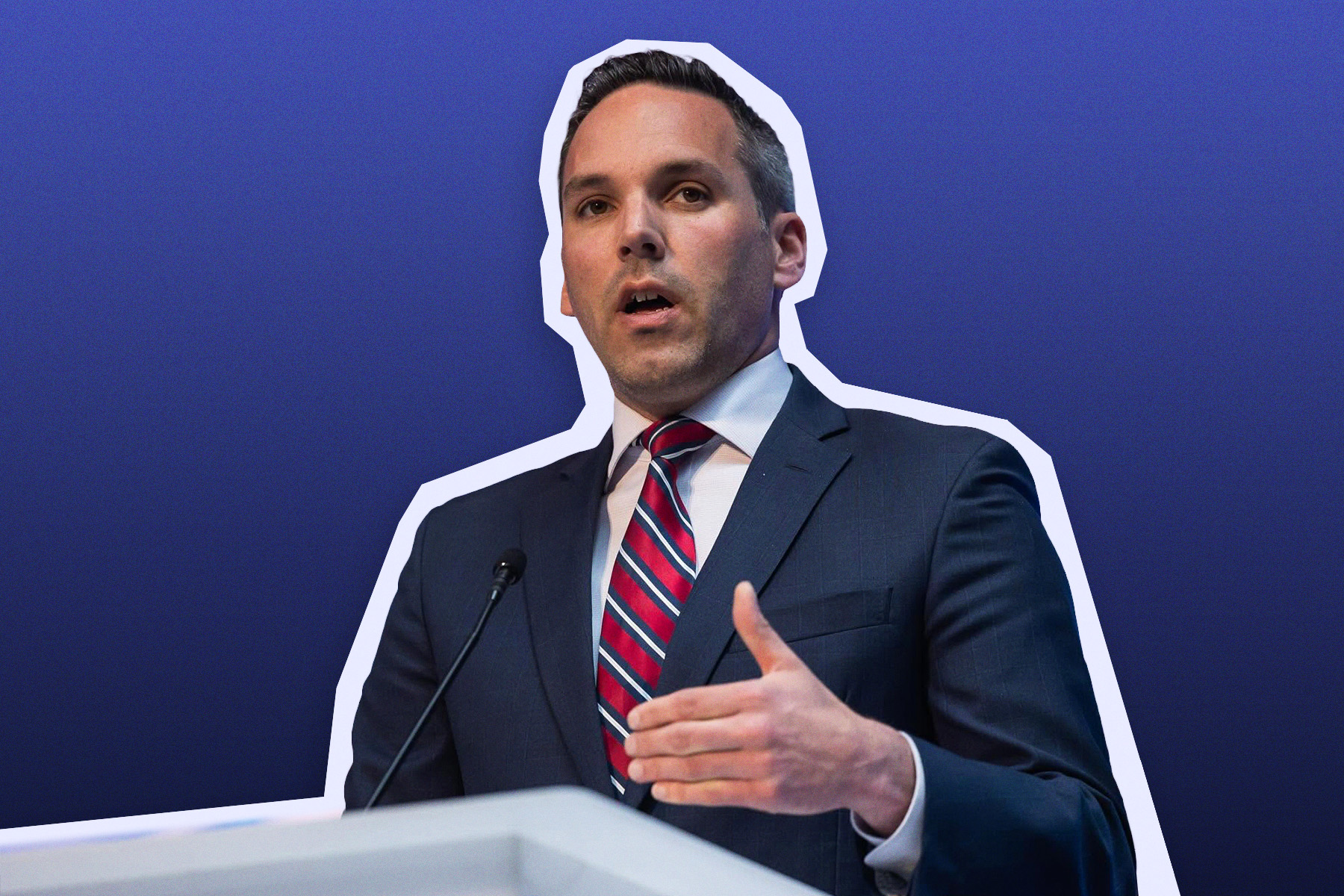
Currie Dixon is turning the North into a battleground for Canada’s resource ambitions The post Yukon’s Premier Wants to Speed Up Mining. Lawsuits Are Already Flying first appeared on The Walrus .
One morning last November, a man giving off “hockey dad” vibes stood in front of me at a busy Whitehorse cafe. Black puffer jacket. Salt-and-pepper fade.
He ordered an Americano, and I recognized his chipper voice instantly. “Congratulations, Currie,” the barista said, and he thanked her so casually they could have been talking about the highlight-reel goal from the night before. Mr. Hockey Dad was Currie Dixon, leader of the right-of-centre Yukon Party who, just the night before, had won the largest majority government in the territory’s history after nearly a decade of Liberal rule.
In Whitehorse, where 34,494 people live, running into an elected official is almost unavoidable. The territory’s entire population—48,135—is roughly 335 times smaller than that of Ontario. The old idea of “six degrees of separation” shrinks here.
It’s more like two or three. Sometimes none at all. Whether or not Yukoners voted for him, there’s probably one thing most like about Dixon: he’s the first premier born in the territory.
Yukoners are used to the revolving door of southerners passing through. Or people confusing Whitehorse for Yellowknife. Or lumping Yukon, the Northwest Territories, and Nunavut into a single “North”—like that lone mug in Tim Hortons’ cross-country souvenir set, decorated with northern lights and dog sleds while the provinces each get a cup of their own.
Dixon’s rise comes at a moment when the national gaze is turning northward—toward Arctic sovereignty, critical minerals, defence spending, and megaprojects. “We were always sort of an afterthought for political leaders in the south,” he tells me. “And now I think that’s changed.”
Dixon is hardly a newcomer. At forty, he’s spent half his life climbing the political ladder. He started as a junior staffer, found himself elected to office right out of graduate school, and entered cabinet from 2011 to 2016.
Dixon then took a three-year hiatus from politics to work for a mining supplies company, before running for—and winning—the Yukon Party leadership in 2020. For the last five years, he served as opposition leader, preparing for this moment. “I’ve seen them all function,” he told me of previous Conservative, Liberal, and New Democratic Party governments.
“I’ve seen the pros and cons of them all and tried to study them carefully.” Those lessons are being put to the test. By February, three months into his term, the new government was already facing three lawsuits from two Yukon First Nations over mining and environmental oversight.
In March, he tabled a budget with a record $82 million deficit. “We’ve reached our debt cap,” he told me. “We can’t borrow or spend anymore.”
Civil servants have been asked for ideas to cut spending, departments are being merged, and “nothing’s off the table”—except, Dixon insists, layoffs. As political pressure and public opposition mount, Dixon remains committed to his campaign promise of overturning the Yukon’s “status quo.” He wants to unlock the potential of the private sector, tapping into a larger push for minerals.
His vision is also one of infrastructure investment beyond Whitehorse, into the small towns, small businesses, and even the iconic highway rest stops the territory was once known for—“the things that I always felt made the Yukon special,” he says. Balancing an aggressive mining agenda with deep-rooted nostalgia for what makes the Yukon the Yukon—namely, intact wilderness—won’t be easy. Playing out here is nothing less than a glimpse at Canada’s future.
Yukon is becoming a testing ground for the collision between First Nations governance, climate politics, and the “elbows up” nationalism driving Prime Minister Mark Carney’s quest to fast-track resource development, consequences be damned. If you had asked ten-year-old Dixon what he wanted to be when he grew up, he would have said “some combination of an NHL player and a country music singer,” he tells me. Politics wasn’t on his radar, but he was exposed to it.
While Dixon’s father was a welder and miner, his mother, Linda, ran for the Yukon Party in the downtown Whitehorse riding in the 1996 general election. She was unsuccessful, but her campaign placed the family inside a political party—broadly centre-right, pro-development, fiscally conservative—that would shape Yukon for the next decade. In 2006, Dixon took a part-time job answering the phone in the office of the governing Yukon Party.
For a twenty-year-old drawn to conservative politics, there were few better places. The party swept to power four years earlier as a practical, no-nonsense champion of ordinary Yukoners—a movement that paired territorial pride with a focus on resource projects. Dixon’s time at the front desk, however, brought him in contact with a conservative politician moving into the height of his influence.
That summer, Stephen Harper, the recently elected prime minister, arrived in Whitehorse to meet with territorial leader Dennis Fentie. Dixon stood in the receiving line. After shaking everyone’s hand, Harper stopped and came back to the junior staffer.
“What happened to your face?” he asked. “I had two black eyes and a broken nose,” laughs Dixon. He’d taken a puck to the face in a hockey tournament.
Meeting Harper was when “the path became clear” for Dixon. He was drawn to Harper’s style: disciplined, managerial. The prime minister avoided grand rhetoric, framing policy debates in pragmatic rather than ideological terms.
These attributes struck Dixon as especially useful in a territory governed very differently from the rest of the country. The Yukon is shaped by treaty relationships and First Nations self-government agreements. In 1993, when Dixon was seven years old, the Council of Yukon First Nations, the government of Canada, and the Yukon government signed the Umbrella Final Agreement.
The UFA designated more than 41,595 square kilometres as settlement land and guaranteed First Nations a say over how land and natural resources would be managed. This made collaboration a practical necessity. A few years later, Dixon went on to pursue his master’s at the University of Northern British Columbia.
At the time, the Yukon was in the middle of one of the biggest transitions in its history. In April 2003, it became the first territory to take control of its land and natural resources from the federal government. With the UFA fundamentally changing the political rules, Dixon “was interested in how that was all going to work out,” says his supervisor, Gary Wilson, a political science professor specializing in Arctic and northern governance.
Using education policy as a case study, Dixon’s research focused on “gaps” between the ideal of fully realized First Nations self-government and the reality on the ground. Those gaps—grey areas where jurisdiction remained unclear—were, he argued, less constitutional dead ends than opportunities ripe for negotiation. It was where trust could be earned.
In the fall of 2011, fresh out of grad school, Dixon ran as the Yukon Party’s candidate for member of the legislative assembly in the Copperbelt North riding. The twenty-five-year-old was considered an underdog. But Dixon told me he was confident going up against the incumbent Liberal Party leader.
As he told the Whitehorse Daily Star, he’d witnessed a demographic shift that favoured him: an uptick of young families. After winning, Dixon told the Star that many of his voters were people he played sports with or went to school with. “I knew I had a shot,” he said.
Shortly after celebrating his twenty-sixth birthday, Dixon became one of the youngest Canadians to serve in territorial or federal cabinet, tasked with two seemingly conflicting portfolios: economic development and environment. Thus began a career trying to balance competing demands from First Nations, conservationists, and industry. The tension has shadowed much of his political life.
It’s something he shares with Harper. Rather than accept limits on oil sands development, Harper abandoned the Kyoto Protocol, the first legally binding climate treaty. Dixon has preached the virtues of practical agreements and trust building, but when forced to choose, he has rarely hidden where his priorities lie.
In 2012, the young cabinet minister would be catapulted into one of the territory’s most contentious environmental debates with First Nations. Since 2006, an independent commission had been working on a regional land-use plan for the Peel River watershed. The watershed, a critical wildlife corridor, spans almost 70,000 square kilometres.
Released in 2011, the plan called for 80 percent of the watershed be protected with some limited development allowed. “Dixon is probably best remembered as being the minister of environment who rejected the final recommended plan approved and endorsed by Yukon First Nations,” says Kate White, today the leader of the opposition for the NDP party. In 2012, the Yukon government vetoed the plan on the premise that it only allowed for around 20 percent of the region for mining and oil and gas development.
A new plan, proposing to open 71 percent of the watershed to industrial development, was approved, despite fierce public opposition. “Nobody expected that,” David Loeks, the commission chair, told the CBC at that time. “When that played out, my jaw and many other people’s jaws collectively dropped.”
The Peel River watershed controversy set off a long legal battle. In 2014, the Na-Cho Nyäk Dun filed a lawsuit against the Yukon government for violating the land-use planning process laid out in the UFA. “Yukon First Nations really pushed back,” says White.
The case eventually wound up before the Supreme Court of Canada. In 2017, the judges unanimously ruled in the favour of First Nations and conservation groups. A revised recommendation plan, setting aside 83 percent of the Peel River watershed for conservation, was signed in 2019.
The memory of the Peel River watershed controversy remains in many Yukoners’ minds. PROTECT THE PEEL bumper stickers may have faded, but they’re still ubiquitous today. In 2021, Dixon, then leader of the Yukon Party, told The Narwhal that land-use planning in the Peel River watershed was something his party “did not get right.”
But it isn’t hard to draw similarities between the Peel River watershed and Dixon’s leadership today. In February, his government passed Bill 5, allowing them to override a new Health Authority Act, an arm’s-length health system that had been co-developed with First Nations over the past decade to centralize care and stop institutional discrimination. The Council of Yukon First Nations condemned the move, saying “partnership cannot be one sided.”
But Dixon insists they had been transparent; his party campaigned on the platform of reassessing the financial feasibility of the new health act and potentially repealing it. The administration of the new act has been costly—$17.2 million over the last three years—and, in the face of a major deficit, Dixon says they have to make tough choices. Dixon acknowledged that this “created issues” with individual First Nations and at the Yukon Forum, the quarterly meeting where the territorial government, First Nations government, and the Council of Yukon First Nations coordinate the territory’s co-governance model.
“We’ve had some difficult conversations with First Nations leadership about that decision,” he says. “We went to them first. We communicated our intention at the Yukon Forum.”
In repealing the act, it appeared Dixon’s government was following a similar path to the Peel River controversy, one that would wind up in court. But on May 8, following a Yukon Forum meeting with First Nations leaders, Dixon diverted course, announcing that his government would work closely with First Nations “to improve the Yukon’s health care system.” Council of Yukon First Nations grand chief Math’ieya Alatini told APTN News that it’s been a “positive reset” for relations.
“That type of humility and respect that was shown at the table goes a long way to establishing and resetting the relationship,” Alatini said. Dixon may have shown humility around the new health act, but he hasn’t wasted any time accelerating mining and energy initiatives—aims that align with Carney’s ambitions for the North. Research shows the Arctic is warming four times faster than the global average.
The consequences are already visible: melting permafrost, floods, wildfires, and increasingly erratic weather. Yet in March, the Yukon government repealed the Clean Energy Act, scrapping greenhouse gas reduction targets that Dixon says were “unrealistic.” His government is instead prioritizing energy supply—eliminating incentives for e-vehicles and e-bikes while providing new rebates for homeowners to install propane, wood, and oil-fired heating systems.
The shift reflects what Dixon sees as the territory’s more immediate problem: keeping the lights on. While summer electricity demand is largely met by hydro, solar, and wind, winter’s cold, dark months still rely heavily on diesel and liquefied natural gas. Last December, when temperatures of forty below held for days and diesel generators broke down, the grid was maxed out and blackouts loomed.
With Yukon’s population projected to grow another 20,000 people by 2045, Dixon is lobbying to connect the territory’s isolated electricity system—“currently an islanded grid”—to BC. For Dixon, there is an even greater incentive: giving mining operations access to reliable, abundant energy. The chief executive officer of the company behind the Casino Mine—a copper-gold open-pit operation 300 kilometres northwest of Whitehorse that would be the largest in Yukon history—told the CBC that approval would be a “catalyst and linchpin” for Ottawa to green light the grid-connect.
But electricity isn’t Dixon’s only hurdle to expanding mining in the Yukon. The territory is still governed by mining laws rooted in the Klondike Gold Rush—legislation so old it predates the recognition of First Nations rights and no longer reflects how modern mines are regulated.
Dixon acknowledges the system for assessing projects, enforcing compliance, and collecting royalties is badly out of date. Under the current regime, the government earns just 37.5 cents on every ounce of gold produced—a royalty set in 1906, when gold sold for about $15 an ounce. Today, an ounce fetches roughly $5,800.
“We’re hopeful that we’ll be able to find a way to engage with First Nations through a process that will lead us to new mineral legislation sometime in 2028,” Dixon says. Reform may still be years away, but Dixon is steamrolling ahead. In March, his government announced it would split the Minerals Resources Branch—the division overseeing the mining sector—into two departments, one focused on major mines and the other on exploration.
The reorganization, it said, would reduce permitting delays. A month later, the Yukon and federal governments approved the Kudz Ze Kayah mine—a proposed zinc, copper, and lead operation south of Ross River on Kaska Dena traditional territory. The decision came despite objections from the Ross River Dena Council, which, according to the CBC, argued the project is in “the wrong place and cannot be allowed to proceed.”
The approval document nevertheless concluded that “consent may not always be achievable.” Other First Nations aren’t waiting around for permits to be issued first. In mid-April, CHON-FM reported that Chief Russell Blackjack of the Little Salmon Carmacks First Nation declared a mining moratorium around Claire Lake, an area the First Nation describes as a “bread basket” for hunting, fishing, and exercising treaty rights.
There’s no shortage of reasons for First Nation governments to question the territory’s regulatory approach. In December, the Na-Cho Nyäk Dun filed a $150 million lawsuit regarding the Eagle Gold Mine disaster, a heap-leach failure that caused a massive landslide of 4 million tonnes of cyanide-contaminated ore into local waterways in June 2024. The lawsuit accuses the Yukon and federal governments of breaching treaty obligations and failing to adequately regulate the gold mine.
Environmental clean-up of the toxic breach is costing the Yukon government upwards of $220 million in loans. The legal battles have widened beyond Eagle Gold. The Tr’ondëk Hwëch’in First Nation has launched two lawsuits.
One alleges ongoing mismanagement of outdated mineral claims staked before the nation’s land-claim agreement and that continue to affect their lands today. The other alleges the Yukon government violated treaty agreements in May 2025 when amending regulations to allow for continued mining on its lands. If Carney’s accelerationist vision of prosperity takes hold, these are conflicts Canada likely to see more often.
Governments will treat consultation and environmental reviews as obstacles rather than safeguards to be respected. For Dixon—a politician who once wrote about the promise of shared authority—the question is whether speed and consensus can coexist or whether one will come at the expense of the other. Dixon indicates he has no intention of easing off.
“I get to effect the kind of change that I’ve been thinking about, studying, and preparing for my entire life,” he tells me. With thanks to the Gordon Foundation for supporting the work of writers from Canada’s North.
- Published
- Jul 15, 2026
- Updated
- Jul 15, 2026
- Source
- Thewalrus Ca News
- Category
- Local News
- Read time
- 12 min
Key facts
Why this matters locally
This local news story matters locally because it may affect readers, businesses, commuters, families, or public services in British Columbia.
Local impact
BC Post links this item to British Columbia coverage so readers can follow related city updates, weather, traffic, events, and category news in one place.
Timeline
Source and credit
BC Post may summarize, organize, and add local context for reader clarity. Original reporting remains with the listed publisher.
Related Articles
View all Local News
Cowichan sports shorts: rugby, hockey, biking
Local News
Cowichan sports shorts: rugby, hockey, biking
 Local News
Cost of B.C. Massey tunnel replacement doubles from previous budget
Local News
Cost of B.C. Massey tunnel replacement doubles from previous budget
 Local News
Lions earn first win by handing Elks their first loss in 36-24 decision
Local News
Lions earn first win by handing Elks their first loss in 36-24 decision
 Local News
Consumer watchdog secures 4 ticketing undertakings during World Cup
Local News
Consumer watchdog secures 4 ticketing undertakings during World Cup
 Local News
Business leader says he hopes Greater Victoria gets fair share of submarine money
Local News
Business leader says he hopes Greater Victoria gets fair share of submarine money
More Local Coverage
Latest news Politics
Powerful pro-life ad featuring boxing legend to air during final World Cup matches
Politics
Powerful pro-life ad featuring boxing legend to air during final World Cup matches
 Top Stories
Yukon minerals work still under review despite federal announcement
Top Stories
Yukon minerals work still under review despite federal announcement