

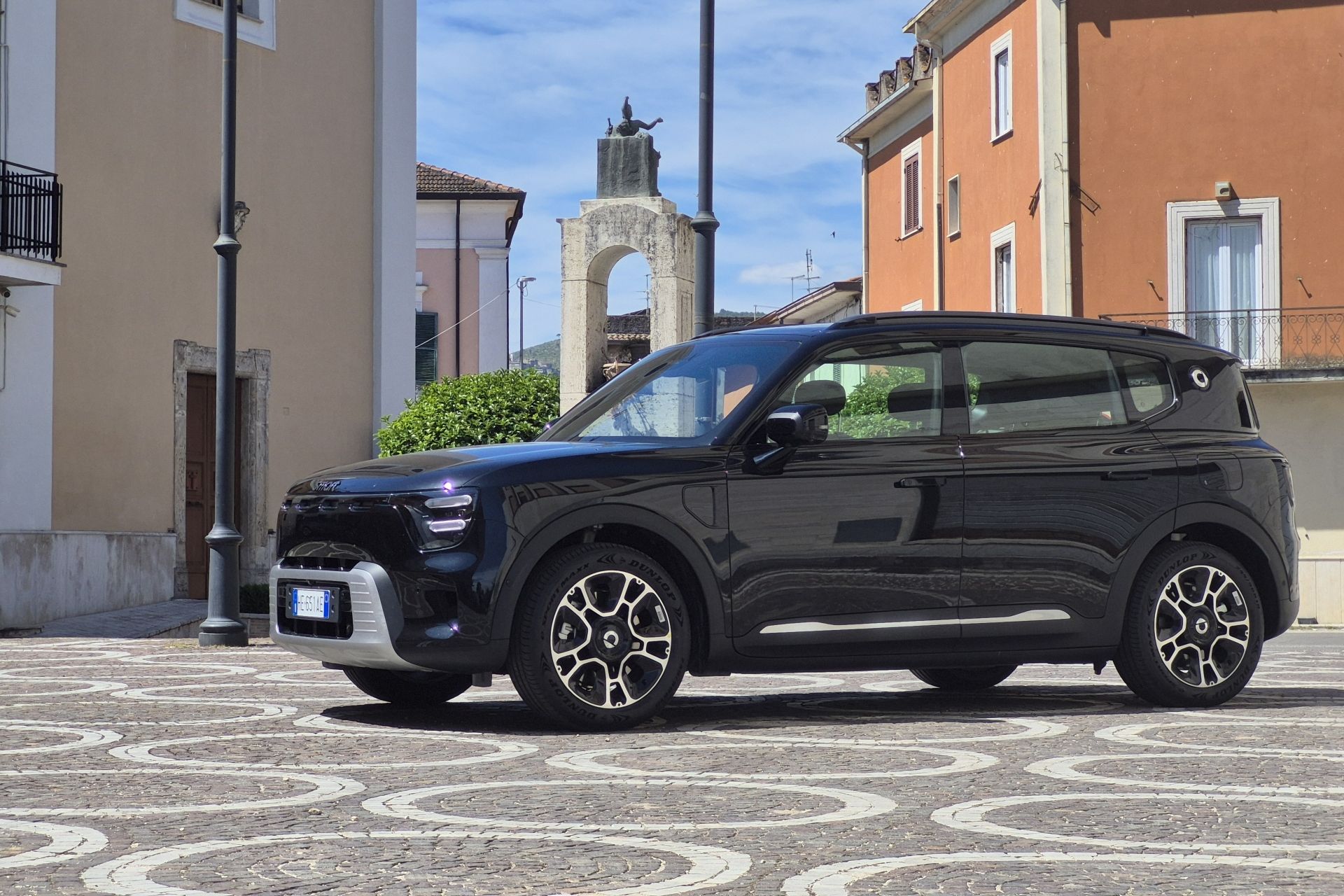
Forget the ForTwo—this new Smart boasts Model-Y-comparable specs, and might even better it in build quality
We’re always being told that good timing is essential. Whether it be a golf swing, a financial investment, or a marriage proposal, getting the timing right is one of the paramount determinants of success of any earthly endeavour, goes the wisdom. What’s less emphasized — hell, mostly ignored — is that being too far ahead of the pack can be as deleterious to your quest as being left behind.
There is not much use when out at the country club, for instance, in un-cocking your wrist too early on a long drive, as it generally ends up in a great big slice into an unfriendly sand trap or treeline far from the direct avenue of attack. And Lord knows that countless geniuses have wasted their fortunes being too far ahead of a technology innovation or an investment curve. It’s no different for cars.
With gasoline touching two bucks a litre in our latest Trump-induced oil crisis, for example, now might well be a good time to introduce a cute, tiny little sprout of a city car to usually-skeptical-of-European-roustabouts Canada. Unfortunately, for Smart Motors — once a huge part of Mercedes-Benz’s plans for the future — it came to Canada in 2004, a year in which there was no invasion of the Middle East, no Saudia Arabian truculence, nor any other artificial supply-side mayhem plaguing gas prices sufficiently to make a tiny little 2.5-metre long 0.8-litre diesel-powered two-seater palatable to a populace raised on Yukons and F-150s.
After an initial spate of curiosity was satiated — the brand sold some 3,000 units in its first year — demand tanked, and Smart eventually turned tail and exited Canada in 2019. Mercedes-Benz vowed it would never return to North America. More’s the pity because as after having spent three days driving around Rome and some of its less-scenic suburbs in the latest Smart, I can tell you that a #5 — yes, there really is car named hashtag-five! — really would be a worthy offering here in the Great White Frozen North.
For one thing, it’s electric. And not just any electric, but a Chinese-built EV. You see, even if Mercedes-Benz retains a half-interest in Smart — and is reputedly responsible for the styling of the brand’s products — the #5 is engineered and built entirely by Geely.
Think Volvo, only smaller. But barely smaller. Unlike Smarts of old, the brand’s current portfolio is not merely a set of automotive miniatures.
In fact, and as you can see from the pictures, it’s sizably larger than a Jeep Renegade, and perhaps better compared to a Jeep Compass, stretching 4,695 millimetres from bumper to bumper and riding on a surprisingly long (not just for a Smart!) 2,900-mm wheelbase. That may not be gargantuan, but the hashtag-five would tower over the last Smart ForTwo I drove.
It’s also roomier inside—vastly roomier. Indeed, for those of us used to the ForTwos of old, it takes a little getting used to a Smart more accommodating than a BMW X3, or maybe even a Mercedes GLC. Five full-sized (some of them McDonald’s-fed, no less) North Americans (and not an insubstantial bit of their belongings) can fit into a #5, a far cry from the two-travellers-and-a-carton-of-cigarettes that more than filled the original.
Leg- and-headroom in the rear are truly generous. Ditto the trunk, which can tuck away 630 litres of cargo with all seats in place; and 1,530L with the rears folded down. And there’s another 72 litres up front, generous for this size of EV.
It’s a sight more luxurious, too. The Pro+ isn’t even the most luxurious of hashtag-fives — actually, it’s second from the bottom rung of the ladder — but its interior is burnished with copious amounts of leather, more than a bit of well-sorted 10.25-inch digital instrument cluster, and an amazingly bright 13-inch OLED infotainment touchscreen. Hell, there’s even a two-Evians-sized fridge in the centre console, a feature you can’t know is essential until you’ve navigated a southern Italian heatwave without the linguistics to ask for either nourishment or refreshment.
Me want! All that said, the #5 can be a little too chatty, its ADAS safety systems pervasively intrusive, the ultimate unwanted “nagivator” forever criticizing your driving. Indeed, I believe there should be a special hell waiting for software engineers who design “soft” speed limits into their safety systems that are difficult to shut down.
Even various interior features end up talking back or querying you incessantly. Indeed, this incessant man-machine dialogue was the only thing that warranted serious complaint about the #5. Considering that the Volvo ES90, also Geely-built, warranted much the same criticism, one has to assume its chromosomal.
Perhaps the Chinese, wary during their first foray into Western markets, are being especially cautious. Or maybe it’s just Italian regulation. But no matter how strikingly large the new Smart may be, that’s not what anyone wants to know about a Chinese-built electric vehicle.
What everyone’s dying to hear is whether battery power from the People’s Republic is the revolution that everyone promises. Is a Chinese electric car really so far ahead of us that resistance is futile? Well, like most questions, the answer is yes and no.
Or, more accurately, yes, but not by as much as one might have predicted. So, for one thing, the Smart #5’s range and energy efficiency are indeed excellent. The Pro+ version is fuelled by a 100-kilowatt-hour battery — not evenly remotely tiny, is it?
— with 94 kWh usable. And in a Range Finder mission pretty much duplicating our testing in Canada — Italy’s A1 autostrada outside of Rome is virtually identical in elevation changes as Ontario’s 407 — it eked out 438 kilometres at a steady 125 kilometres an hour. That’s not half-bad, those 438 klicks far ahead of anything I’ve attained from, say, a Hyundai Ioniq 5.
On the other hand, the Korean sport-ute packs but 77.4 kWH. Even so, the #5’s 21.5-kilowatt-hours-per-100-kilometre energy efficiency is impressively frugal. Fair dinkum to Smart.
On the other hand, a Lucid Gravity, a twice-motored three-row behemoth with 828 horsepower underfoot — my single-motor hashtag-five boast but 335 hp — used but 23.6 kWh/100 km in a similar test. Now, the two are not directly comparable — one is gargantuan while the other is barely mid-sized — but the Lucid’s excellent efficiency implies at least one company can keep up with the EV revolution emanating from the Far East. That said, the #5 does charge impressively fast.
Officially, Smart says its 800-volt nickel-manganese-cobalt batteries — the #5 only uses more traditional-for-Chinese-built-EVs LFP batteries on its entry-level Pro trim — can touch 400 kilowatts while charging. In fact, according to EVKX.net, the hashtag-five can suck up as many as 424 kilowatts. More impressively, that website — which Range Finder uses for all its charging
Source and reference
references — says its charging rate stays above 400 kW all the way from 13% to 23% State of Charge, and averages 275.7 kW all the way from 10% to 80% SoC. Most EVs sold in Canada barely peak at 273 kW, let alone maintain it for the vast majority of their charging cycle. It also means the Smart can fly through that 10% to 80% SoC cycle — the de facto measure for charging quickness — in just 14 minutes. Despite many a grandiose claim being bandied about, as far as I know, that makes the Smart #5 Pro+ faster charging than anything currently offered for sale in Canada. All that said, the one thing the Smart isn’t is cheap. In Italy, it starts at 47,936 euro, and my #5 Pro+’s official MSRP is 52,936 euro, which, on a straight currency-exchanged basis would work out a hefty CDN$85,982. That includes Italy’s IVA value-added tax of 22%; and a 28.8% tariff imposed on all Geely-affiliated EVs...
Read original source- Published
- Jul 15, 2026
- Updated
- Jul 15, 2026
- Source
- Driving
- Category
- Technology
- Read time
- 8 min
Key facts
Why this matters locally
This technology story matters locally because it may affect readers, businesses, commuters, families, or public services in British Columbia.
Local impact
BC Post links this item to British Columbia coverage so readers can follow related city updates, weather, traffic, events, and category news in one place.
Timeline
Source and credit
BC Post may summarize, organize, and add local context for reader clarity. Original reporting remains with the listed publisher.
Related Articles
View all Technology
Transformer-manufacturing company to shut down its Chilliwack facility
Technology
Transformer-manufacturing company to shut down its Chilliwack facility
 Technology
Quebec announces plan to train more aerospace workers as demand surges
Technology
Quebec announces plan to train more aerospace workers as demand surges
 Technology
Apple’s Lawsuit Could Choke OpenAI’s iPhone Rival Before It Even Ships
Technology
Apple’s Lawsuit Could Choke OpenAI’s iPhone Rival Before It Even Ships
 Technology
Spectro Cloud Raises $100 Million Series D to Help Customers Move AI Infrastructure Into Production Across Enterprise, Public Sector, Neocloud and Sovereign Cloud Environments
Technology
Spectro Cloud Raises $100 Million Series D to Help Customers Move AI Infrastructure Into Production Across Enterprise, Public Sector, Neocloud and Sovereign Cloud Environments
 Technology
GO train users could face delays, cancellations due to ‘crew constraints’: Metrolinx
Technology
GO train users could face delays, cancellations due to ‘crew constraints’: Metrolinx
 Technology
Texting a stranger works better to fight loneliness than talking to an AI chatbot
Technology
Texting a stranger works better to fight loneliness than talking to an AI chatbot
More Local Coverage
Latest news Business
AI Market Trends: Q2 2026 Review and Forecast
Business
AI Market Trends: Q2 2026 Review and Forecast
 Politics
Powerful pro-life ad featuring boxing legend to air during final World Cup matches
Politics
Powerful pro-life ad featuring boxing legend to air during final World Cup matches