

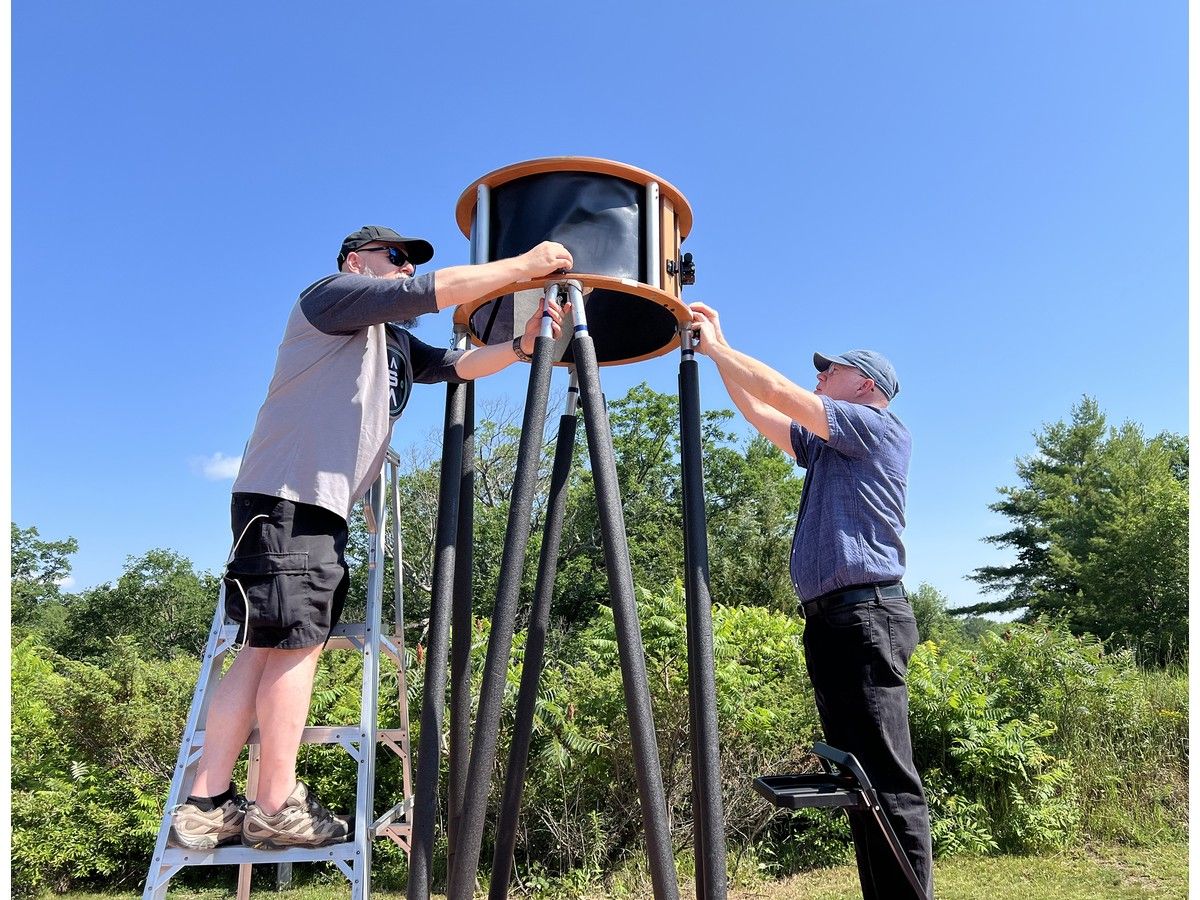
What began as a modest observation platform has expanded significantly over the years.
Visitors to the Lennox and Addington Dark Sky Viewing Area are now seeing farther into the cosmos than ever before thanks to the arrival of a massive telescope once owned by a renowned Canadian amateur astronomer. A 25-inch Obsession Dobsonian telescope donated by the estate of the late Attilla Danko officially debuted Friday at the popular stargazing destination on County Road 41 north of Napanee, marking a significant addition to one of Ontario’s best-known public observation sites. The new installation replaces a 16-inch Sky-Watcher Flextube telescope as the site’s flagship viewing instrument.
Both telescopes will remain on site. For local organizers, the arrival of the instrument represents another milestone in the steady growth of a facility that has become a major astrotourism destination for more than 15 years. “We’re very excited to be able to add this new telescope to our collection,” said Rob Plumley, senior economic development officer with Lennox and Addington County.
Plumley said the donation reflects the reputation the site has built in those one and a half decades. “We’re very fortunate that we were chosen to be the location for this,” he said. “It’s kind of a testament to what we’ve been able to do with dark-sky and stargazing tourism, which has really become something that’s bigger and better than we ever thought it was going to be.”
The telescope originally belonged to Danko, a respected figure in amateur astronomy circles best known as the creator of the Clear Sky Chart forecast system used by astronomers throughout North America. The charts provide detailed sky-condition forecasts tailored specifically to astronomical observing and have become a widely used planning tool among amateur and professional observers alike. Danko was also known for transporting large telescopes to star parties and public outreach events, sharing his love for the cosmos with others.
Joe Gilker, one of the Dark Sky Viewing Area’s volunteer presenters, said he first encountered the telescope about a decade ago when Danko brought it to the North Frontenac Astronomy Park. “I did look into this particular scope about 10 years ago when Danko had it out — and it was really, really impressive,” Gilker said. “I look forward to actually being able to put it to even better use here and letting the public take a good look.”
The telescope’s size is what makes it special. Gilker pointed to the site’s previous primary telescope and recalled a time when it was considered enormous. “We used to consider this our big telescope,” he said.
The difference between the two instruments, however, is considerable. “The new one is a lot more powerful,” Gilker said. “The difference being, that’s a 16-inch mirror (pointing to the older one) and that’s a 25-inch mirror (pointing to the newer model).
So, it has significantly more light-gathering power and, because of that, much higher resolution images.” Unlike refracting telescopes that use lenses, both instruments are Newtonian reflectors — a design developed by Sir Isaac Newton more than 350 years ago. Light enters the telescope, reflects off a large parabolic primary mirror at the base, then bounces to a smaller secondary mirror before reaching the eyepiece.
“The brightness is directly proportional to the size of the primary mirror,” Gilker said. The larger mirror allows observers to collect substantially more light from distant objects, revealing finer details in galaxies, nebulae and star clusters that might otherwise appear faint or invisible. Malcolm Park, president of the Royal Astronomical Society of Canada (RASC), Kingston Centre, called the telescope’s new home a good fit.
“The estate of Attilla Danko was donating his old equipment, looking for places to find maximum usage for it,” Park said. “There was another telescope that he had that was donated in Hamilton, and then the estate approached us in the RASC Kingston Centre looking for interest.” Park said the L&A Dark Sky Viewing Area quickly emerged as the obvious choice.
“Immediately my thought was the best place to put that would be here because they get hundreds of people every night,” Park said. “I don’t know if you know the popularity of this place, but it’s enormous.” The popularity stems from the quality of the night sky itself.
Located roughly 37 kilometres north of Napanee, the Lennox and Addington Dark Sky Viewing Area is recognized as Ontario’s most southerly dedicated dark-sky observation site. The location benefits from relatively low levels of light pollution compared with nearby urban centres. Plumley said the site’s darkness has become increasingly valuable as development expands across much of southern Ontario.
“Really, we’re known as the most southerly dark-sky site in the province,” he said. “The viewing conditions here are very similar to what they were more than 100 years ago.” Preserving that darkness has become a planning priority for local governments.
Plumley said protection of Dark Sky has been incorporated into both Lennox and Addington County’s official plan and planning considerations within Stone Mills Township, where the site is located. “We’re trying to take as many steps as we can to keep the skies as dark as we can,” he said. The county has already worked to minimize potential impacts from new development, including telecommunications infrastructure in the area.
“It’s not a niche tourism opportunity anymore,” Plumley said, citing the facility’s growing popularity. Regular observing nights typically attract between 50 and 100 visitors. Special events, including the site’s laser-guided stargazing tours, can draw 250 to 300 people.
The new telescope made its public debut on Friday for one of those special stargazing events. The dark-sky viewing area traces its origins to a conversation with the late Terence Dickinson, one of Canada’s best-known astronomy
Source and reference
authors and the founder of SkyNews magazine. According to Plumley, Dickinson approached county officials in 2010 and pointed out the unusually dark skies near County Road 41. “He told us if you build a little platform and do a little bit of marketing, you’ll get visitors from urban areas,” Plumley said. “And when someone like that tells you something, you listen.” What began as a modest observation platform has expanded significantly over the years. Improvements include an enlarged viewing area, an accessible ramp, solar-powered electrical service and structures designed to block intrusive light from vehicles. Plumley said the stargazing tours are typically scheduled around darker periods of the lunar cycle. “There’s two weeks a month where stargazing is the best,” he said. “That’s when there’s less than half a moon visible in the sky because the light from the moon can wash out even...
Read original source- Published
- Jul 13, 2026
- Updated
- Jul 13, 2026
- Source
- The Kingston Whig Standard
- Category
- Top
- Read time
- 6 min
Key facts
Why this matters locally
This top story matters locally because it may affect readers, businesses, commuters, families, or public services in British Columbia.
Local impact
BC Post links this item to British Columbia coverage so readers can follow related city updates, weather, traffic, events, and category news in one place.
Timeline
Source and credit
BC Post may summarize, organize, and add local context for reader clarity. Original reporting remains with the listed publisher.
Related Articles
View all Top
Rock the Lake celebrated its ninth year at Prospera Place this past weekend
Top
Rock the Lake celebrated its ninth year at Prospera Place this past weekend
 Top
Million-dollar contract awarded for Surrey Sport & Leisure Complex renos
Top
Million-dollar contract awarded for Surrey Sport & Leisure Complex renos
 Top
Brunswick Creek wildfire grows, leads to air quality warning in east Fraser Valley
Top
Brunswick Creek wildfire grows, leads to air quality warning in east Fraser Valley
 Top
'A sacred place': Delta park to get dedicated ash-scattering site
Top
'A sacred place': Delta park to get dedicated ash-scattering site
 Top
MLA Jordan Kealy to face jury in sexual assault case
Top
MLA Jordan Kealy to face jury in sexual assault case
 Top
BCWS aircraft helping Kamloops firefighters battle grass fire above Shuswap Road
Top
BCWS aircraft helping Kamloops firefighters battle grass fire above Shuswap Road
More Local Coverage
Latest news Business
AI Market Trends: Q2 2026 Review and Forecast
Business
AI Market Trends: Q2 2026 Review and Forecast
 Politics
Powerful pro-life ad featuring boxing legend to air during final World Cup matches
Politics
Powerful pro-life ad featuring boxing legend to air during final World Cup matches
 Local News
Cowichan sports shorts: rugby, hockey, biking
Local News
Cowichan sports shorts: rugby, hockey, biking