

The post agentOS: Run AI Agents in a Secure Linux Sandbox first appeared on Tecmint: Linux Howtos, Tutorials & Guides . I burned through half of my E2B sandbox budget in just two weeks by spinning up containers for AI agents The post agentOS: Run AI Agents in a Secure Linux Sandbox first appeared on Tecmint: Linux Howtos, Tutorials & Guides .
I had been integrating AI coding agents into a few automation scripts on TecMint’s backend. These agents would generate a draft, run a command, check the output, and repeat the process until the task was complete. Since I didn’t want an AI agent running random shell commands directly on my production server, every task needed its own isolated environment.
Like many people, I started with Docker and later switched to a hosted sandbox service when Docker’s startup time became a bottleneck. Everything worked well at first, but eventually both the cost and the startup delay became hard to ignore. A sandbox that takes 400 to 900 milliseconds to start may not seem slow by itself.
However, when an AI agent creates a new sandbox for every task, retry, or small step, that delay quickly adds up. On top of that, I was paying for a full 1 GiB virtual machine even when it was only being used to run a simple two-line shell command. That’s when I came across agentOS, an open-
Source and reference
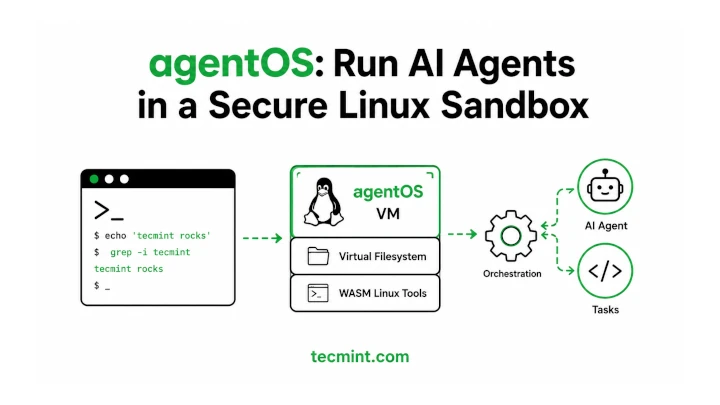
source project from the Rivet team. Before going further, it’s important to understand what agentOS actually is, because its name can be misleading. It is not a command-line tool that you install with a package manager and use like eza or bat . Instead, it is a Node.js library that lets you run an isolated Linux-like virtual machine directly inside your backend application. It includes WebAssembly-based versions of many familiar GNU utilities, such as coreutils , grep , sed , gawk , findutils , tar , gzip , and more. That difference is important, so I’ll walk through exactly how I set it up. What agentOS Actually Does agentOS is an in-process operating system kernel written in Rust and distributed as an npm package. When you call AgentOs.create() in your Node.js application, it creates a virtual Linux-like environment inside your existing process. This environment includes a virtual...
Read original source- Published
- Jul 15, 2026
- Updated
- Jul 16, 2026
- Source
- Tecmint
- Category
- Technology
- Read time
- 10 min
Key facts
Why this matters locally
This technology story matters locally because it may affect readers, businesses, commuters, families, or public services in British Columbia.
Local impact
BC Post links this item to British Columbia coverage so readers can follow related city updates, weather, traffic, events, and category news in one place.
Timeline
Source and credit
BC Post may summarize, organize, and add local context for reader clarity. Original reporting remains with the listed publisher.
Related Articles
View all Technology
Transformer-manufacturing company to shut down its Chilliwack facility
Technology
Transformer-manufacturing company to shut down its Chilliwack facility
 Technology
Quebec announces plan to train more aerospace workers as demand surges
Technology
Quebec announces plan to train more aerospace workers as demand surges
 Technology
Spectro Cloud Raises $100 Million Series D to Help Customers Move AI Infrastructure Into Production Across Enterprise, Public Sector, Neocloud and Sovereign Cloud Environments
Technology
Spectro Cloud Raises $100 Million Series D to Help Customers Move AI Infrastructure Into Production Across Enterprise, Public Sector, Neocloud and Sovereign Cloud Environments
 Technology
Apple’s Lawsuit Could Choke OpenAI’s iPhone Rival Before It Even Ships
Technology
Apple’s Lawsuit Could Choke OpenAI’s iPhone Rival Before It Even Ships
 Technology
GO train users could face delays, cancellations due to ‘crew constraints’: Metrolinx
Technology
GO train users could face delays, cancellations due to ‘crew constraints’: Metrolinx
 Technology
Texting a stranger works better to fight loneliness than talking to an AI chatbot
Technology
Texting a stranger works better to fight loneliness than talking to an AI chatbot
More Local Coverage
Latest news Politics
Powerful pro-life ad featuring boxing legend to air during final World Cup matches
Politics
Powerful pro-life ad featuring boxing legend to air during final World Cup matches
 Business
AI Market Trends: Q2 2026 Review and Forecast
Business
AI Market Trends: Q2 2026 Review and Forecast