

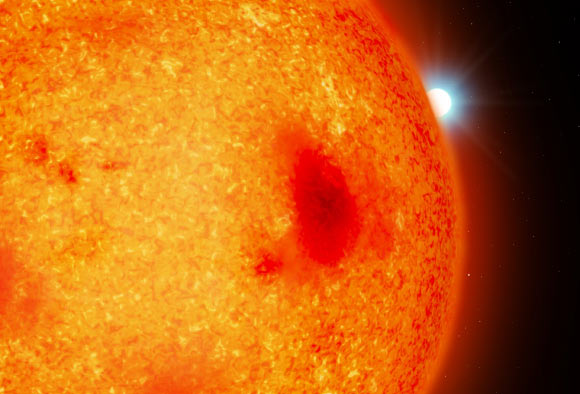
Using near-UV spectroscopic data from the Space Telescope Imaging Spectrograph (STIS) on the NASA/ESA Hubble Space Telescope, astronomers discovered four white dwarfs orbiting nearby red dwarf stars.
Using near-UV spectroscopic data from the Space Telescope Imaging Spectrograph (STIS) on the NASA/ESA Hubble Space Telescope, astronomers discovered four white dwarfs orbiting nearby red dwarf stars. These binary systems are all located within 20 parsecs (65 light-years) of the Sun, and one of the white dwarfs is the ninth closest to our star. Astronomers have performed detailed surveys of the local neighborhood of stars for decades, but white dwarfs like these have been notoriously hard to find.
The four newly-identified systems — G 203-47, GJ 207.1, LHS 1817 and Wolf 1130 — were of interest because they showed a substantial radial wobble, a phenomenon in which a star subtly wobbles backwards and forwards, indicating a massive companion object is orbiting. “Nearby isolated white dwarfs are usually easy to find, but we couldn’t see these four stars directly in visible wavelengths because their red dwarf companions were drowning out their light,” said University of Warwick astronomer Mairi O’Brien. “It’s a reminder that even in our own cosmic neighborhood, we can still find surprises if we look in the right way, at the right wavelengths.”
Using the Hubble/STIS data, the astronomers then obtained detailed observations from the four systems. White dwarfs usually stand out in ultraviolet observations, but red dwarfs complicate things due to their intense flaring that can often mimic a white dwarf signal. The researchers deployed custom calibration techniques to officially confirm the presence of the four white dwarf stars.
One of these systems, G 203-47, has proven particularly enigmatic. Despite being only 25 light-years away, it has taken 27 years after its initial radial wobble observation to find the companion white dwarf. It is now officially the ninth closest white dwarf to the Sun.
G 203-47 is also unusual because its red dwarf rotates once every 100 days but orbits its white dwarf every 14.9 days. Normally, gravitational forces would tidally lock them in sync, like the Moon and Earth, where the same face always points toward each other. Instead, the red dwarf rotates far too slowly for that to happen.
“What’s fascinating is that G 203-47 shouldn’t be rotating this slowly if it formed the same way as similar systems,” said Dr. David Wilson, an astronomer at the University of Colorado Boulder. “This suggests that these binaries have had very different evolutionary histories.” “Some underwent violent, prolonged interactions early on that locked them tidally.”
“Others, like G 203-47, experienced gentler, briefer encounters that left them in this unusual state.” These four new white dwarfs have allowed researchers to update the local white dwarf census within 65 light-years. Crucially, population models had previously predicted roughly four to five closely orbiting white dwarf-red dwarf pairs should exist, and the scientists found exactly four, comparable to the theoretical work.
“Only about 30% of red dwarfs within 20 parsecs have been systematically surveyed for hidden white dwarf companions,” said University of Warwick’s Professor Pier-Emmanuel Tremblay. “We think there could be as many as 9 or 10 additional binary systems in our local stellar environment that we haven’t found yet.” “If we put more targeted effort into observing red dwarfs, perhaps we will find more surprises like this.”
The team’s paper was published today in the Monthly Notices of the Royal Astronomical Society. _____ Mairi W. O’Brien et al. 2026.
Direct detections of white dwarfs in four WD+dM post-common envelope binaries within 20 pc. MNRAS 550 (2): stag1195;
Source and reference
doi: 10.1093/mnras/stag1195
Read original source- Published
- Jul 14, 2026
- Updated
- Jul 14, 2026
- Source
- Sci.news: Breaking Science News
- Category
- Technology
- Read time
- 3 min
Key facts
Why this matters locally
This technology story matters locally because it may affect readers, businesses, commuters, families, or public services in British Columbia.
Local impact
BC Post links this item to British Columbia coverage so readers can follow related city updates, weather, traffic, events, and category news in one place.
Timeline
Source and credit
BC Post may summarize, organize, and add local context for reader clarity. Original reporting remains with the listed publisher.
Related Articles
View all Technology
Transformer-manufacturing company to shut down its Chilliwack facility
Technology
Transformer-manufacturing company to shut down its Chilliwack facility
 Technology
Quebec announces plan to train more aerospace workers as demand surges
Technology
Quebec announces plan to train more aerospace workers as demand surges
 Technology
Apple’s Lawsuit Could Choke OpenAI’s iPhone Rival Before It Even Ships
Technology
Apple’s Lawsuit Could Choke OpenAI’s iPhone Rival Before It Even Ships
 Technology
Texting a stranger works better to fight loneliness than talking to an AI chatbot
Technology
Texting a stranger works better to fight loneliness than talking to an AI chatbot
 Technology
GO train users could face delays, cancellations due to ‘crew constraints’: Metrolinx
Technology
GO train users could face delays, cancellations due to ‘crew constraints’: Metrolinx
More Local Coverage
Latest news Politics
Powerful pro-life ad featuring boxing legend to air during final World Cup matches
Politics
Powerful pro-life ad featuring boxing legend to air during final World Cup matches
 Business
AI Market Trends: Q2 2026 Review and Forecast
Business
AI Market Trends: Q2 2026 Review and Forecast