

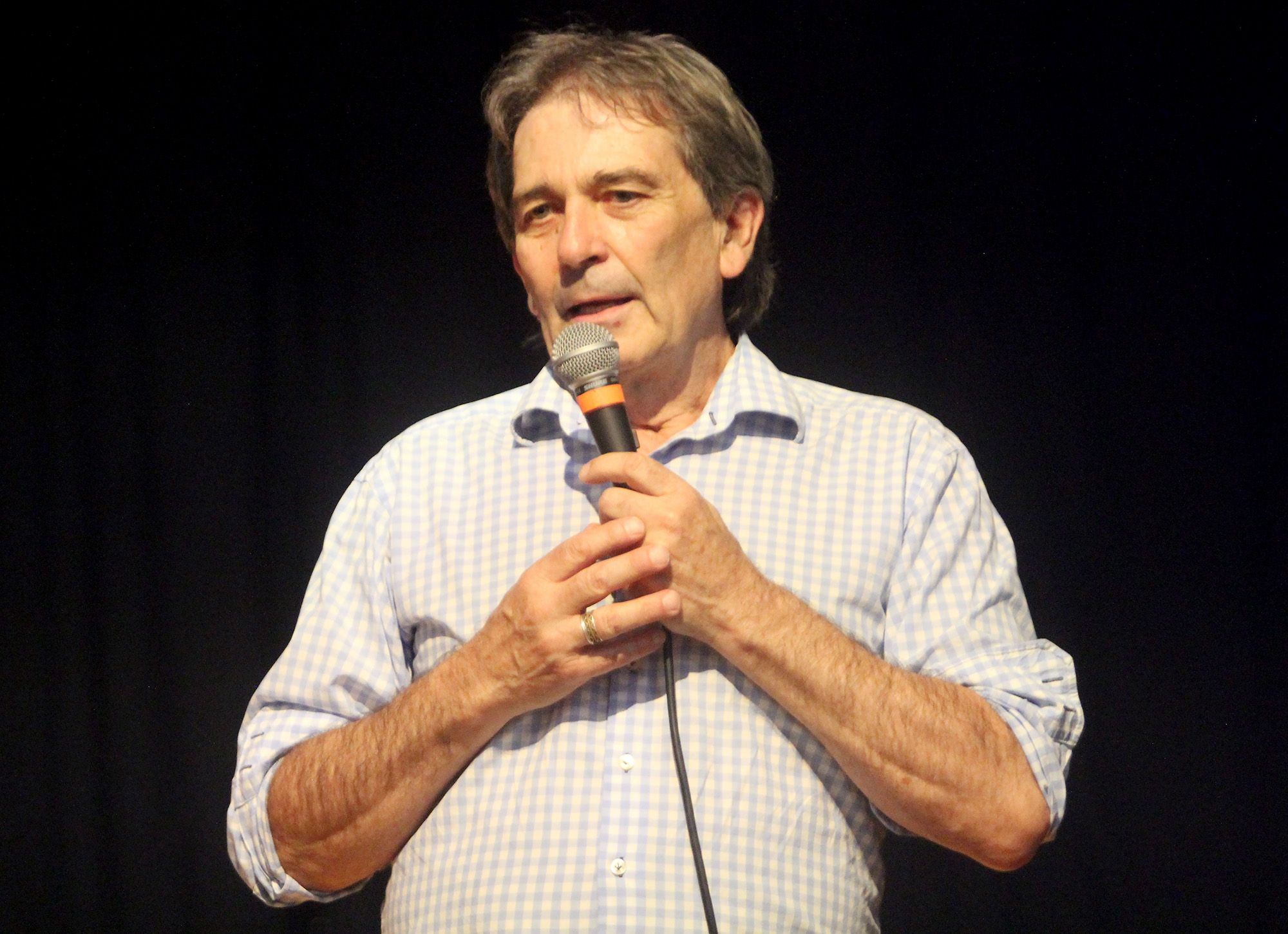
Up to community to take the reins, form committee and start fundraising if this route is desired
Article content The only “realistic” means of healing eastern Algoma’s current health-care crisis is uniting Thessalon and Richards Landing hospitals into one entity, housed in a spanking-new facility. That was the message Wednesday evening to a packed cafeteria at Central Algoma Secondary School when a handful of district doctors unveiled a plan they and regional health-care colleagues across North Shore Health Network contend will help stem a dire situation that is “about to become a disaster.” Recommended Videos The meeting heard that even getting the wheels turning on a modern-purpose building with an efficient user-friendly emergency, inpatient and outpatient departments staffed by “adequate” numbers of physicians, nurse practitioners, clinical care staff, support staff and leadership, would go a long way in creating the positive buzz needed to woo young physicians, many of whom train in Algoma.
Veteran Richards Landing physician Dr. William Crawford said of chief concern is that two of the hospitals’ four doctors – including him – are set to retire soon. “When we go, and if nobody comes, the place can fall apart quite quickly,” said Crawford, adding a “real threat” is that, at some point, both doctors leave Richards Landing, which houses Matthews Memorial Hospital. “After a while the government says, ‘Well, this is getting crazy trying to support this thing that’s not working.
Maybe we’ll close one or both of them,'” Crawford said. “That would lead to a situation which would be much more difficult to recover from. “If we’re going to make a move at all to make an improvement, I think now is the time.”
In an interview with The Sault Star following the meeting, Crawford said he wanted to push ahead with the new hospital concept more than a year ago but was convinced to wait until “other things were ready.”
“I’m not very good at waiting for things and I get frustrated. ‘Let’s just do it,'” he said. “And I don’t want to feel guilty when I leave.”
The Ministry of Health, Crawford told the meeting, appears “a little bit interested” in finding a solution. “But they don’t know what to do,” he added. “They don’t know our situation, what the possibilities are.”
Unhealthy situation Both hospitals, mostly Thessalon, have been plagued for years for frequent, temporary emergency department shutdowns, often when locum doctors can’t be recruited. “Richards Landing does a little better only because local docs step up and work more than they should,” Crawford said. “Locums can be found, but essentially for the last six years or more, it’s been local doctors doing lots more extra work, which is not really sustainable.”
Under the current contract, full-time physicians – there are actually 10.5 approved full-time equivalent MD positions – must provide both primary and emergency care, complicating recruitment. “This is no longer a model that young doctors are thinking about,” said Crawford, for whom it is not unusual to work until midnight and then be called back into service.
“They don’t want to provide all that care. They would like to be a clinic doctor, or an emerg doctor or a hospital doctor. That complicates recruitment.
They have options. There are many places they can go and work.” Dr. Seth Whitley is well aware.
The recent NOSM University graduate and native of St. Joseph Island said that for him to consider settling near home, conditions must be more conducive to family life. “If there’s maybe one or two other doctors, I’m never going to see my kids,” said the married father of four. “What Bill (Crawford) is doing right now is absolutely insane.
It’s not the kind of sacrifice I can make. “If there is nobody else coming, it is not a viable option for me.” However, even a solid indication that a new hospital is in the cards might change that.
“If there is something tangible that is actually happening, that will make a big difference in attracting and attaining people,” he said. Crawford told The Sault Star he understands where Whitley is coming from. “I think it’s wise,” he added.
“That’s not how people live. People like their children.” No time to ‘sit and wait’ The meeting, mostly attended by seniors, heard a dire story about challenges facing hospitals in question, including an increasing population without a primary care provider.
Volumes have been steadily increasing since 2020 to 2024 at both sites (Richards Landing Matthews by 57 per cent and Thessalon by 33 per cent) with further increases 2025. “Those are quite big increases when you think of the small number of people who actually work in these hospitals,” Crawford said. Acuity has increased from 2020 to 2024 at both sites, Richards Landing Matthews by 7.7 per cent and Thessalon by 1.2 per cent.
Crawford said he recognizes problems east of Sault Ste. Marie are not unique; doctor shortages are common practically everywhere, especially in the hinterland. “I don’t think that’s a good reason to sit and wait,” he said.
“So, the main message is that the intention is not to really close down hospitals, but it’s actually to expand both of them. So that you’re creating a proper hospital that provides the service you need.” Dr. Amy Vine, who graduated from NOSM University in 2021 and started working in Thessalon in September 2023, said there have been some “significant investments in primary care over the last few years, pointing to Family Health Teams, a “huge recruitment piece” for her.
This model eliminated many bureaucratic duties. “We don’t really know how to get a new hospital,” Vine said. “We’re just seeing a lot of really big red flags and think that it is time to start pushing.
It’s going to be a slow, long process with a lot of work.” Crawford said a chief challenge will be resistance to “this much” change, given emotional attachment to current sites. “Even though they’re funky old places, people do like them,” Crawford said.
Current RNPGA contracts, introduced in the mid-1990s, require docs to do both clinical and hospital work, and are considered an impediment to recruitment. Dr. Eric Haapala, who has served Algoma District for more than 20 years and was appointed North Shore Health Network chief of staff July 1, said he recognizes fewer young doctors no longer want to multi-task, but added changing the current contract is a political “hot potato” as similar agreements are in place in rural southern Ontario and amendments for one region may mean having to undertake sweeping changes.
Costs for a new facility will also be significant and not all covered by the Ministry of Health. Crawford suggested if the community can raise 10 per cent of capital costs, the government may supply the rest. “Someone said $30 million,” said Crawford of the possible price tag.
“I think that’s pretty low. Probably $60 million. Maybe $100 million.
I don’t know what a hospital costs.” Whipping up $10 million from the region, from Iron Bridge to Echo Bay, “should be possible,” he added. Where is it going to go?
Getting consensus on the location of a new hospital will be the “big stickler.” “Everybody thinks it should be in their backyard,” Crawford said. “It’s kind of the opposite of other things.”
Jody Wildman agreed. “This means that two communities that have a hospital right now, as inadequate as they are, will have to face the fact that they would be giving up that hospital in their community and it would be moving to a central location under this plan,” said Wildman, mayor of the Township of St. Joseph, a small community on St. Joseph Island. “So that’s something we all have to be sure about that that’s what people want to do.”
Wildman – his and other rural Algoma municipalities fundraised for a new Sault Area Hospital, which opened in 2011 – also pointed to possible approval timeframes, which he suggested could be between eight and 10 years. “The government, both politically and bureaucratically, they have to be on side,” he said. Officials must also target current matters, including RNPGA contracts he contends are hurting doctor recruitment.
“Even if everybody in this room was able to convince all their neighbours that we’ve got to do this, that is a long-term process to getting even approval, getting shovels in the ground, getting the whole thing built and all the equipment, staffing and everything and open,” Wildman said. “It’s a long-term process. We’ve got problems today we have to solve.”
A public-driven effort is the “ideal” way to move forward, which will include backing of the NSHN board, which Crawford said should not be a “big stumbling block.” A show of hands of the some 400 there indicated strong support, and meeting attendees were invited to sign an “expression of interest” in joining a steering committee. A website is slated to be up and running soon.
“The purpose of the meeting is to get some public driven initiative so that it’s not coming from the hospital, it’s not coming from politicians, it’s not coming from anywhere except the people,” he added. “‘We want this. We want proper health care, we want our children, grandchildren to have a doctor.
We want proper elder care.'” ‘Community-led effort’ A steering committee of “interested, supportive and capable members” should be struck, and a “boots on the ground” committee formed to provide input and direction related to the facility’s design and operations. Haapala said the idea of uniting these two hospitals has been bandied about for a decade.
“We cannot tell the community what they need,” he said. “The North Shore Health Network can’t do that. It has to be a community-led effort.”
Al Dupuis, Ontario Health Coalition’s Algoma District representative, applauded the new hospital concept. “The people understand the need here, and I think the doctors are making a conscientious effort to address it and get behind it,” he told The Sault Star. The coalition has argued Ontario is falling way short of the national average health-care spend and is, in fact, underspending by about $15 billion.
“We have to put a fire under these guys,” Dupuis said. Wendy Robertson, who summered on St. Joseph Island for 45 years and now has a year-round home there, applauded the concept, but said securing approval might take “closer to” 15 years. “I was really enthused by it,” she said following the meeting.
“The turnout was fantastic.” On X: @JeffreyOugler
- Published
- Jul 16, 2026
- Updated
- Jul 16, 2026
- Source
- The Sault Star
- Category
- Lifestyle
- Read time
- 8 min
Key facts
Why this matters locally
This lifestyle story matters locally because it may affect readers, businesses, commuters, families, or public services in British Columbia.
Local impact
BC Post links this item to British Columbia coverage so readers can follow related city updates, weather, traffic, events, and category news in one place.
Timeline
Source and credit
BC Post may summarize, organize, and add local context for reader clarity. Original reporting remains with the listed publisher.
Related Articles
View all Lifestyle
City of Lethbridge formally agrees to contribute funding for future 32-bed recovery facility
Lifestyle
City of Lethbridge formally agrees to contribute funding for future 32-bed recovery facility
 Lifestyle
Teen hit in crosswalk faces long recovery
Lifestyle
Teen hit in crosswalk faces long recovery
 Lifestyle
PHOTOS: Cyclists in Chilliwack ride in rain to raise funds for multiple sclerosis
Lifestyle
PHOTOS: Cyclists in Chilliwack ride in rain to raise funds for multiple sclerosis
 Lifestyle
Canadian lottery winner thrilled by free plays before noticing much bigger prize
Lifestyle
Canadian lottery winner thrilled by free plays before noticing much bigger prize
 Lifestyle
From overlooked recruit to featured player: Yorkville Christian grad David Douglas Jr. comes home to NIU
Lifestyle
From overlooked recruit to featured player: Yorkville Christian grad David Douglas Jr. comes home to NIU
 Lifestyle
Feds provide $345,000 to expand accessible housing at Community Living Huntsville’s Floral Villa
Lifestyle
Feds provide $345,000 to expand accessible housing at Community Living Huntsville’s Floral Villa
More Local Coverage
Latest news Business
AI Market Trends: Q2 2026 Review and Forecast
Business
AI Market Trends: Q2 2026 Review and Forecast
 Politics
Powerful pro-life ad featuring boxing legend to air during final World Cup matches
Politics
Powerful pro-life ad featuring boxing legend to air during final World Cup matches