

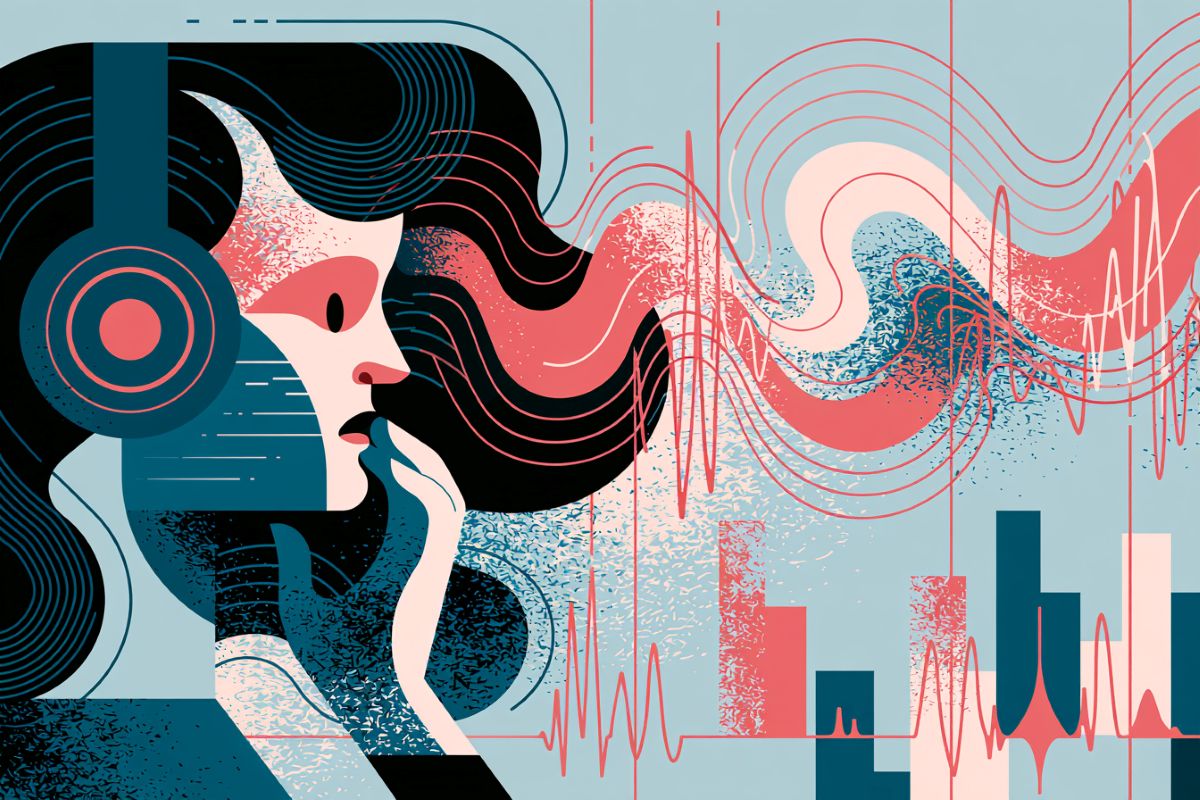
A new study demonstrates that altered aperiodic background signals on high-density 128-channel EEGs correlate with functional communication challenges in autistic youth.
Altered aperiodic background signals serve as an objective biological marker of internal neural noise, predicting real-world functional communication fluency in autistic youth. Credit: Neuroscience News Brain Activity Noise Linked to Autism Communication Summary: Researchers tracked the real-time auditory processing of over 300 children and adolescents. Utilizing high-density electroencephalography (EEG), researchers bypassed standard brain wave cycles to isolate a newer metric called the brain’s “aperiodic” signal.
The empirical data proved that autistic youths experiencing elevated everyday communication challenges possess distinctly altered aperiodic profiles, exposing a state of heightened neural noise that disrupts the brain’s ability to efficiently process human speech. Key Facts Unmasking the Aperiodic Background Signal: For decades, standard EEG analysis focused strictly on rhythmic, periodic brain waves (like alpha, beta, or gamma oscillations). This study deliberately isolated the aperiodic component, the underlying background electrical activity that was long discarded as meaningless static.
This specific signal directly reflects the critical balance between neural excitation and inhibition, which acts as a biological gatekeeper helping the brain filter meaningful information from background clutter. The Neural Noise Inefficiency Matrix: The high-density data science models revealed that autistic participants demonstrated significantly altered aperiodic signal patterns. These variations are consistent with an elevated baseline of neural noise, indicating that the auditory processing centers of the brain must work through a layer of internal static, decreasing the efficiency of real-time speech processing.
Functional Communication vs. Core Language Mechanics: Crucially, higher neural noise metrics did not correlate with basic linguistic mechanics, such as raw vocabulary size or formal grammatical knowledge. Instead, the metric specifically predicted lower scores in everyday functional verbal communication—reflecting a child’s real-world capacity to deploy language fluidly in social and interactive environments.
A Biological Marker, Not a Diagnostic Tool: The UVA research team explicitly stresses that these configurations do not represent a new diagnostic test for autism. Instead, this unique data signature serves as a much-needed objective biological marker (biomarker) that can be tracked longitudinally to monitor natural communication changes or measure how new therapies affect underlying brain circuitry. The Computational Data Science Leap: The extraction of these subtle, low-frequency patterns from massive electrical streams was made possible by advanced computational analytics.
With the human brain generating millions of data points every second, modern data science algorithms allowed researchers to cleanly separate meaningful background signatures from structural noise in ways that were mathematically impossible a few years ago. Cohort Limitations & Future Scalability: While representing a major dataset milestone, the
Source and reference
authors caution that most participants possessed average or above-average verbal skills at baseline. Future replication tracks are actively being engineered to determine if these exact aperiodic noise thresholds extend to minimally verbal autistic individuals, while combining the data with advanced structural neuroimaging. Source: University of Virginia Why do some children with autism communicate more easily than others, even when they hear the same words? Researchers from the University of Virginia believe the answer may lie in the brain’s electrical activity. In a new study published in Scientific Reports, they found that subtle patterns in brain activity while children listened to speech were linked to how well autistic youths communicate in everyday life. The findings offer new clues about the biology behind autism and could one day help researchers objectively measure...
Read original source- Published
- Jul 16, 2026
- Updated
- Jul 16, 2026
- Source
- Neuroscience News
- Category
- Technology
- Read time
- 8 min
Key facts
Why this matters locally
This technology story matters locally because it may affect readers, businesses, commuters, families, or public services in British Columbia.
Local impact
BC Post links this item to British Columbia coverage so readers can follow related city updates, weather, traffic, events, and category news in one place.
Timeline
Source and credit
BC Post may summarize, organize, and add local context for reader clarity. Original reporting remains with the listed publisher.
Related Articles
View all Technology
Transformer-manufacturing company to shut down its Chilliwack facility
Technology
Transformer-manufacturing company to shut down its Chilliwack facility
 Technology
Quebec announces plan to train more aerospace workers as demand surges
Technology
Quebec announces plan to train more aerospace workers as demand surges
 Technology
Apple’s Lawsuit Could Choke OpenAI’s iPhone Rival Before It Even Ships
Technology
Apple’s Lawsuit Could Choke OpenAI’s iPhone Rival Before It Even Ships
 Technology
Texting a stranger works better to fight loneliness than talking to an AI chatbot
Technology
Texting a stranger works better to fight loneliness than talking to an AI chatbot
 Technology
GO train users could face delays, cancellations due to ‘crew constraints’: Metrolinx
Technology
GO train users could face delays, cancellations due to ‘crew constraints’: Metrolinx
More Local Coverage
Latest news Politics
Powerful pro-life ad featuring boxing legend to air during final World Cup matches
Politics
Powerful pro-life ad featuring boxing legend to air during final World Cup matches
 Business
AI Market Trends: Q2 2026 Review and Forecast
Business
AI Market Trends: Q2 2026 Review and Forecast