

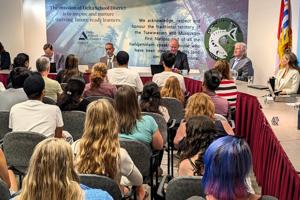
Students from various Delta Youth Advisory Councils (DYAC) presented their annual insights to the board of trustees at the school year’s final board meeting on June 16.
Students from various Delta Youth Advisory Councils (DYAC) presented their annual insights to the board of trustees at the school year’s final board meeting on June 16. Students tackled a range of pressing issues, including academic belonging, racism, cleanliness, and inclusion. However, a presentation from Burnsview Secondary took on a distinctly modern challenge: Artificial Intelligence.
Burnsview is currently working to formulate an AI policy, and it is believed to be the first of its kind for a school in Delta. The student-driven project aims to establish ethical guidelines for technology use by September. Riya Toor a Grade 11 student at Burnsview has been involved with DYAC since Grade 9.
She said the initiative grew out of a simple reality. Students were already using the technology, and the school needed to adapt. “We’ve been working on looking at the uses of AI, why students use it, how they use it, and how we can incorporate it into the school without it being unethical, like cheating,” said Toor.
“How can we use it to improve our education instead of undermining it?” The conversation began when students noticed peers using apps like PhotoMath. The app solves math equations step-by-step.
Other students were turning to chatbots like Google Gemini. They used them for help with assignments over the weekend when teachers were unavailable. However, the school felt the unofficial use of AI could quickly create an equity issue.
Some students who had more access to personal devices or unrestricted internet gained a distinct academic advantage. Others had to rely on school-issued Chromebooks, which previously blocked AI tools. Burnsview administration wanted to level the playing field, so they recently decided to unblock Google AI on school computers for senior classes.
“To make it fair for everyone, so everyone’s using the same AI, and they have the same information,” Toor explained. She noted that the school network also allows the administration to monitor the tools. This helps them guide students in using the software.
The transition has brought up some concerns. Toor noted that relying on AI can sometimes erode the vital connection between students and educators. “I can’t speak for everyone, but I felt like it was getting rid of the connection between teachers and students,” she said.
“Even though the teacher would be right there, the student would be almost too shy or scared to ask a question. They just felt like talking to the AI was easier.” Toor’s friend raised environmental concerns.
She loves to write and worries about the massive amounts of water and energy required to run AI servers. Some students opt to stick to traditional books and dictionaries for their coursework. Toor explained that student learning styles and personal ethical boundaries vary widely.
This makes it challenging to form a concrete set of rules. Burnsview is developing a dedicated AI Committee to tackle this issue. The committee is separate from the general DYAC leadership group and will focus solely on integrating the technology.
In the meantime, teachers have begun holding classroom discussions. The administration also gave the student group a questionnaire about specific, real-world scenarios to help establish clear boundaries. For example, using AI to improve sentence structure with proper citations is generally supported.
Having a chatbot write an entire essay is not. The school aims to have a formal list of guidelines in place by September. This will coincide with the broader rollout of AI access on school Chromebooks.
- Published
- Jul 13, 2026
- Updated
- Jul 13, 2026
- Source
- The Hamilton Spectator
- Category
- Education
- City
- Delta
- Read time
- 3 min
Key facts
Why this matters locally
This education story matters locally because it may affect readers, businesses, commuters, families, or public services in Delta.
Local impact
BC Post links this item to Delta coverage so readers can follow related city updates, weather, traffic, events, and category news in one place.
Timeline
Source and credit
BC Post may summarize, organize, and add local context for reader clarity. Original reporting remains with the listed publisher.
Related Articles
View all Education
Canada extends direct-to-permanent-residence pathway for French-speaking students
Education
Canada extends direct-to-permanent-residence pathway for French-speaking students
 Environment
A powerful movement of healing arrives at Delta’s Discovery Centre
Environment
A powerful movement of healing arrives at Delta’s Discovery Centre
 Top
Delta, B.C. police investigate alleged voyeurism in FedEx staff washroom
Top
Delta, B.C. police investigate alleged voyeurism in FedEx staff washroom
 Business
Delta politicians offer mixed reaction to federal tunnel funding
Business
Delta politicians offer mixed reaction to federal tunnel funding
 Education
Inside Capilano University's first student housing building at its main campus in North Vancouver
Education
Inside Capilano University's first student housing building at its main campus in North Vancouver
 Education
A Vancouver Teen’s Mission to Bring Endometriosis Education to Schools
Education
A Vancouver Teen’s Mission to Bring Endometriosis Education to Schools
More From Delta
View all


More Local Coverage
Latest news Local News
Cowichan sports shorts: rugby, hockey, biking
Local News
Cowichan sports shorts: rugby, hockey, biking
 Top Stories
Yukon minerals work still under review despite federal announcement
Top Stories
Yukon minerals work still under review despite federal announcement