

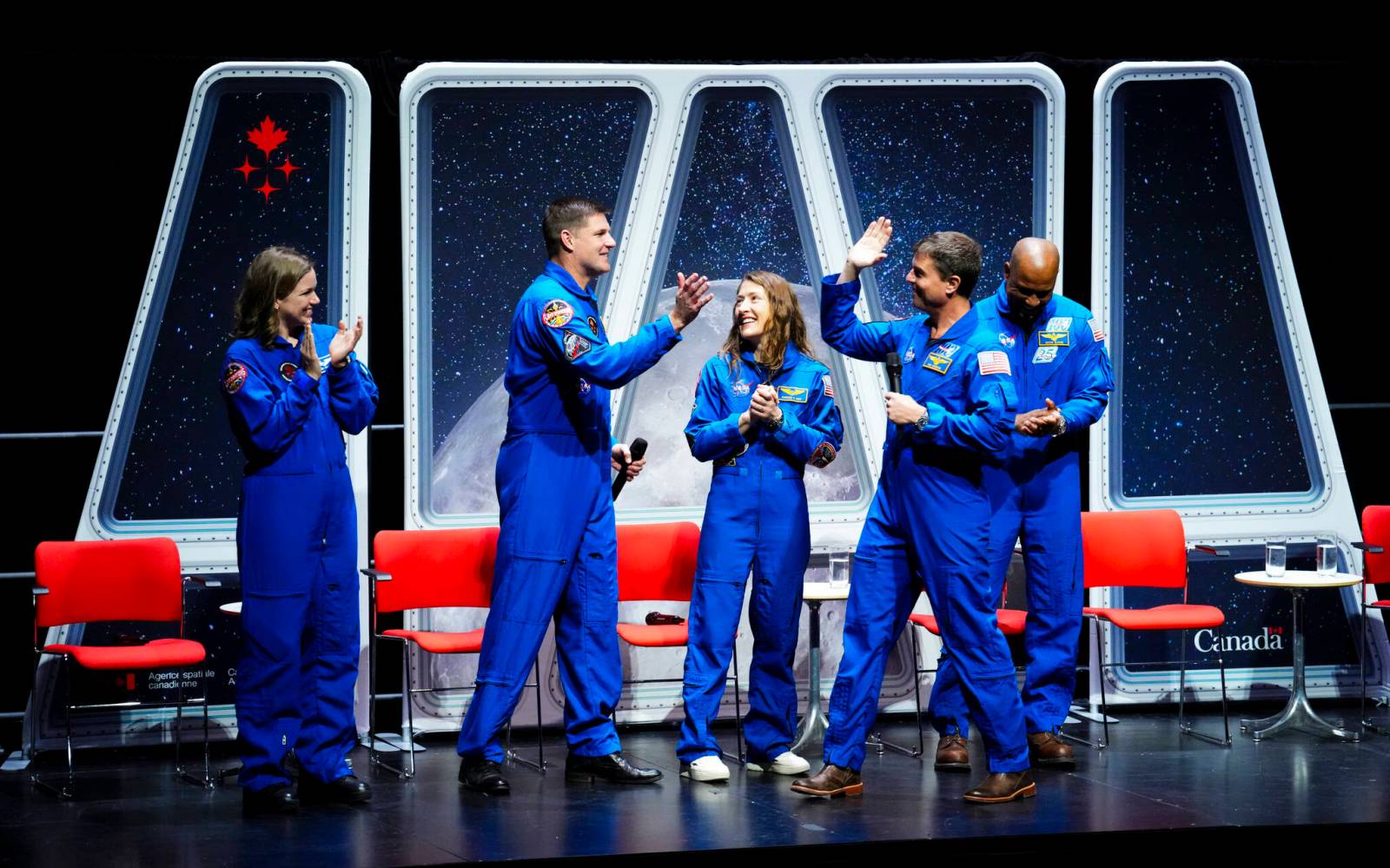
On July 6, 2026, just a few days after helping Canada celebrate its national day, Canadian astronaut and icon Jeremy Hansen announced his retirement from the Canadian Space Agency.
We need your support! Local journalism needs your support! Now, more than ever, we need your support.
or call circulation directly at (204) 727-0527. Your pledge helps to ensure we provide the news that matters most to your community! To continue reading, please subscribe: Add Brandon Sun access to your Free Press subscription for only an additional $1 for the first 4 weeks* On July 6, 2026, just a few days after helping Canada celebrate its national day, Canadian astronaut and icon Jeremy Hansen announced his retirement from the Canadian Space Agency.
As the first Canadian to travel to the moon, Hansen has transformed Canada’s role in human space flight. While his retirement is a loss, Canada will still be playing an important role in the return of humans to the lunar surface. Canadian astronaut Jenni Gibbons has been named lead CAPCOM (capsule communicator) for NASA’s upcoming Artemis III mission.
I am honoured to be part of the Artemis Lunar Surface Science Team. And Canada is also contributing a robotic lunar utility vehicle to the Artemis program. Hansen’s lunar legacy It’s hard to believe, but it is three months since the Artemis II mission ended following a successful splashdown in the Pacific Ocean.
This was the first crewed mission to the moon since Apollo 17 in 1972 and the first crewed flight test of the Space Launch System rocket and Orion spacecraft in deep space. The crew comprised NASA astronauts Reid Wiseman, Victor Glover and Christina Koch, together with Canada’s Hansen. I have had the pleasure of knowing Hansen for 15 years and providing him training in geology in some of the most remote and spectacular parts of the Canadian North.
Hansen served as a mission specialist. This was his first space flight and the culmination of many years of hard work and dedication. From growing up on a farm just outside London, Ont., to becoming an astronaut in 2011, Hansen’s path to the moon was a long one.
Artemis II captured the attention of the world as only astronaut flights can. From the lunar flyby and our generation’s own “Earthset” moment to the tears shed as the crew dedicated a moon crater to Wiseman’s late wife, this mission captured the best of humanity. It showed what can happen when countries work together for a common cause.
Hansen can retire knowing he has helped pave the way for a new generation of explorers to head back to the lunar surface and eventually on to Mars. On a lighter note, the crew also set a new Guinness World Record for the farthest distance humans have ever travelled from Earth. During their lunar flyby, the four astronauts reached a distance of 406,773 kilometres from Earth, surpassing the previous mark set by Apollo 13 in 1970.
They also racked up an astonishing 1.1 million kilometres in 10 days. Significance for Canada For Canada, Artemis II represented one of the most important milestones in the country’s space program. Hansen became the first Canadian to travel to the moon and the first non-American astronaut to participate in a lunar mission.
This partnership with NASA was also a testimony to Canada’s long-term strategy of contributing specialized technology and expertise to international space exploration. As Hansen wrote in his retirement post on X: “Our future depends on a fierce continuation of Canadian innovation and exploration in space. The technological breakthroughs and economic benefits born from this sector are vital for our country and the world.”
Hansen’s flight transformed Canada’s role in human space flight from primarily low-Earth-orbit participation to direct involvement in human exploration beyond Earth’s orbit. Artemis II is a visible demonstration that Canadian researchers, companies, technologies and astronauts can participate directly in the next era of lunar and planetary exploration. Gibbons confirmed for Artemis mission NASA made some major changes to the Artemis program in February.
The next mission, Artemis III, was redesignated from first human lunar landing into a crewed test flight in low-Earth orbit to test rendezvous and docking capabilities with commercial landers. The actual return to the lunar surface has been pushed to the Artemis IV mission. Later, on June 9, 2026, NASA officially named the four crew members who will fly this low-Earth orbit test mission.
While no Canadian astronauts are confirmed for upcoming Artemis missions, Canada will still play a role. Gibbons — the backup for Hansen on Artemis II — has been named lead CAPCOM (capsule communicator) for Artemis III. This is one of the most important roles in mission control and is a testament to the trust that NASA puts in Canadian astronauts.
My role in the science team I am also honoured to be part of the Artemis Lunar Surface Science Team. When we were initially selected, we were known as the Artemis III Geology Team. But with NASA’s recent shakeup of the Artemis program, we will now be the science team for not just Artemis IV, but also Artemis V — the first two missions back to the moon since 1972.
Although these missions are two years away, our science team is constantly busy. With nine candidate landing sites covering thousands of square kilometres on the lunar surface, one of our biggest ongoing responsibilities is deciding on the geology that can be accomplished and the sites that will be most interesting scientifically. We are also busy training to support the astronauts on these historic missions through simulated virtual reality missions.
Kutryk headed to ISS Beyond these confirmed Artemis missions, Canada’s moon plans are in a state of flux. With the cancellation of NASA’s Lunar Gateway space station and Canada’s first-ever rover mission to the moon, there are many uncertainties. A lot is riding on the Lunar Utility Vehicle, Canada’s major robotic contribution to the Artemis program.
However, Canada will not have to wait long for the next Canadian to fly in space. After a long hiatus between David Saint-Jacques’ flight in 2019 and Hansen’s flight earlier this year, it’s only a matter of months before Gibbons’ classmate, Joshua Kutryk, will launch to the International Space Station on Crew 13. This will be another Canadian first to look forward to: Kutryk will be the first Canadian Space Agency astronaut to launch on a Space X Falcon 9 as part of NASA’s Commercial Crew Program.
So, as we say farewell to Hansen, we won’t have long to wait until another Canadian heads to space. » Gordon Osinski is a professor in Earth and planetary science at Western University.
This column was originally published at The Conversation Canada: theconversation.com/ca
- Published
- Jul 13, 2026
- Updated
- Jul 13, 2026
- Source
- Brandonsun
- Category
- Politics
- City
- Mission
- Read time
- 5 min
Key facts
Why this matters locally
This politics story matters locally because it may affect readers, businesses, commuters, families, or public services in Mission.
Local impact
BC Post links this item to Mission coverage so readers can follow related city updates, weather, traffic, events, and category news in one place.
Timeline
Source and credit
BC Post may summarize, organize, and add local context for reader clarity. Original reporting remains with the listed publisher.
Related Articles
View all Politics
Pitt Meadows to host information session for city council candidates
Politics
Pitt Meadows to host information session for city council candidates
 Politics
Funding local governments to speed up delivery of homes
Politics
Funding local governments to speed up delivery of homes
 Crime
Train strikes crashed car at Deroche rail crossing
Crime
Train strikes crashed car at Deroche rail crossing
 Politics
Randhawa slams 2nd ‘questionable’ land purchase by City of Surrey
Politics
Randhawa slams 2nd ‘questionable’ land purchase by City of Surrey
 Business
Earth Angel Worldwide Expands Its Mission Through Music, Education and Environmental Stewardship
Business
Earth Angel Worldwide Expands Its Mission Through Music, Education and Environmental Stewardship
 Politics
Hundreds of enthusiatic supporters attend Surrey Mayor Brenda Locke’s fundarising dinner
Politics
Hundreds of enthusiatic supporters attend Surrey Mayor Brenda Locke’s fundarising dinner
More From Mission
View all Sports
Trump, Infantino give World Cup high praise, calling tournament a success
Sports
Trump, Infantino give World Cup high praise, calling tournament a success
 Politics
One hundred affordable housing units for seniors coming to Sherbrooke
Politics
One hundred affordable housing units for seniors coming to Sherbrooke
 Lifestyle
Historical covers for July 17: Apollo Mission May Tell How Moon, Earth Formed
Lifestyle
Historical covers for July 17: Apollo Mission May Tell How Moon, Earth Formed
 Canada
Saab says pilot training will take place in Canada if Ottawa buys Gripen jets
Canada
Saab says pilot training will take place in Canada if Ottawa buys Gripen jets
More Local Coverage
Latest news Local News
Cowichan sports shorts: rugby, hockey, biking
Local News
Cowichan sports shorts: rugby, hockey, biking
 Top Stories
Yukon minerals work still under review despite federal announcement
Top Stories
Yukon minerals work still under review despite federal announcement