

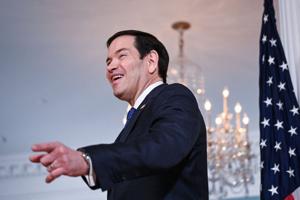
A State Department spokesperson said more than 60 countries had been invited "from various regions, including the Western Hemisphere, Europe, and Asia."
OTTAWA — The Trump administration is hosting a high-level global meeting on combating “political terrorism” in Washington on Thursday, as it tries to rally together allies on its plans to crack down on left-wing movements. But neither the Carney government nor Canada’s national security agencies will say whether they have been invited or plan to attend, or share their views on a campaign that some experts have described as politically motivated and that has reportedly prompted reservations among countries that do not view the issue as a significant threat. Foreign Affairs Minister Anita Anand is not attending the summit being hosted by her counterpart, Secretary of State Marco Rubio, because of prior engagements, according to a spokesperson.
Public Safety Minister Gary Anandasangaree is not making the trip either, his office said. Anand’s office did not respond to repeated requests from the Star this week asking whether other Canadian officials would attend the summit. A State Department spokesperson said more than 60 countries had been invited “from various regions, including the Western Hemisphere, Europe, and Asia.”
That’s a sign Canada is trying to “tread lightly” in the face of pressure from the U.S., which Canada relies on deeply for its security, said experts who spoke to the Star. “I think they’re trying not to say out loud, ‘Thanks, but no thanks,’ given the delicate position we’re in, especially with respect to trade,” said Barbara Perry, the founding director of the Centre on Hate, Bias and Extremism at Ontario Tech University. “I would hope that there is absolutely no interest on the part of any element of the Canadian government to participate in this fiasco.”
The meeting comes as U.S. President Donald Trump’s administration seeks to crack down on what it describes as a rising trend of left-wing extremist violence, with officials focusing on “Antifa,” despite the fact it is not a single, organized group. A White House counterterrorism strategy released in May names “violent left-wing extremists, including anarchists and anti-fascists” as one of three major terror threats alongside “narcoterrorists and transnational gangs” and “legacy Islamist terrorists.” It cites, as an example, “politically motivated killings of Christians and conservatives committed by violent left-wing extremists, including the assassination of Charlie Kirk by a radical who espoused extreme transgender ideologies.”
“In addition to cartels and Islamist terror groups, our national (counterterrorism) activities will also prioritize the rapid identification and neutralization of violent secular political groups whose ideology is anti-American, radically pro-transgender, and anarchist,” the 16-page document notes. A State Department spokesperson recently told the Star part of the work with other countries would include “co-operation to prevent the travel of Antifa-aligned violent actors, protect critical infrastructure, and disrupt financial flows that enable such terrorism.” Phil Gurski, a former Canadian Security Intelligence Service analyst, said the shift in U.S. priorities appears to be politically motivated.
“The most remarkable thing was there was nary a mention of the far-right. It completely disappeared. And if you look at any other sane, informed, justified threat assessment of political violence/terrorism in the United States, I mean the far-right is right up there,” Gurski said of the Americans’ counterterrorism strategy.
“To say that the far-left constitutes a significant national security threat in the United States, that’s complete bulls—t, based on the data that I’ve seen,” Gurski said. “To me, this is one more attempt by the Trump administration to sell this agenda, that you know, there’s nothing to see here, folks from the far-right.” While it might make sense to send a Canadian official to this meeting to understand what’s being discussed, it would not be unusual for Canada to decline the invite because “we haven’t always operated in lockstep with the U.S.,” said Stephanie Carvin, a professor at Carleton University and a former national security analyst for the federal government.
At a March meeting of Western security officials in Ottawa, the U.S. representative urged the other countries to pay more attention to far-left groups, according to a report in the New York Times. The Royal Canadian Mounted Police confirmed to the Star in April it was present at the meeting, but declined to share what was discussed. It also said it “does not investigate movements or ideologies; it investigates threat actors and seeks to prevent and prosecute criminal activity.”
“Based on the messages very publicly signalled out from ... national security organizations, it’s clear to me that we’re not viewing this threat in the same way that the United States is presenting it,” Carvin said. CSIS classifies violent extremism under three main categories: ideological, religious, or politically-motivated. In its most recent annual report, it noted threats were “characterized by a mix of factors, including xenophobia, accelerationism, nihilism, misogyny, and extreme interpretations of religion” — none of which correspond with the White House’s definitions of left-wing extremism.
It also warned that ideologically-motivated extremists are “progressively driven by a range of often seemingly contradictory grievances and personalized narratives from across the traditional left/right ideological spectrum that are often deeply intertwined with conspiracy theories.” Gurski said Canada and the U.S. already share a lot of intelligence, but he’s concerned about Trump officials pressuring Canada to add left-wing groups to its designated terror list. Already, he pointed out, Canada followed suit on the Trump administration’s moves to list Latin American cartels as terror groups, even though they’re typically treated as organized criminal organizations instead.
“If someone commits a criminal act, you can prosecute them for that, but pressuring us to list something like Antifa a terrorist group, just would not fly very well under our legislation as written,” added Carvin.
- Published
- Jul 16, 2026
- Updated
- Jul 16, 2026
- Source
- The Star
- Category
- Politics
- Read time
- 4 min
Key facts
Why this matters locally
This politics story matters locally because it may affect readers, businesses, commuters, families, or public services in British Columbia.
Local impact
BC Post links this item to British Columbia coverage so readers can follow related city updates, weather, traffic, events, and category news in one place.
Timeline
Source and credit
BC Post may summarize, organize, and add local context for reader clarity. Original reporting remains with the listed publisher.
Related Articles
View all Politics
Powerful pro-life ad featuring boxing legend to air during final World Cup matches
Politics
Powerful pro-life ad featuring boxing legend to air during final World Cup matches
 Politics
Vaughn Palmer: David Eby's slow and expensive step toward involuntary care
Politics
Vaughn Palmer: David Eby's slow and expensive step toward involuntary care
 Politics
Pitt Meadows to host information session for city council candidates
Politics
Pitt Meadows to host information session for city council candidates
 Politics
Hundreds of enthusiatic supporters attend Surrey Mayor Brenda Locke’s fundarising dinner
Politics
Hundreds of enthusiatic supporters attend Surrey Mayor Brenda Locke’s fundarising dinner
 Politics
Funding local governments to speed up delivery of homes
Politics
Funding local governments to speed up delivery of homes
 Politics
Randhawa slams 2nd ‘questionable’ land purchase by City of Surrey
Politics
Randhawa slams 2nd ‘questionable’ land purchase by City of Surrey
More Local Coverage
Latest news Business
AI Market Trends: Q2 2026 Review and Forecast
Business
AI Market Trends: Q2 2026 Review and Forecast
 Local News
Cowichan sports shorts: rugby, hockey, biking
Local News
Cowichan sports shorts: rugby, hockey, biking