

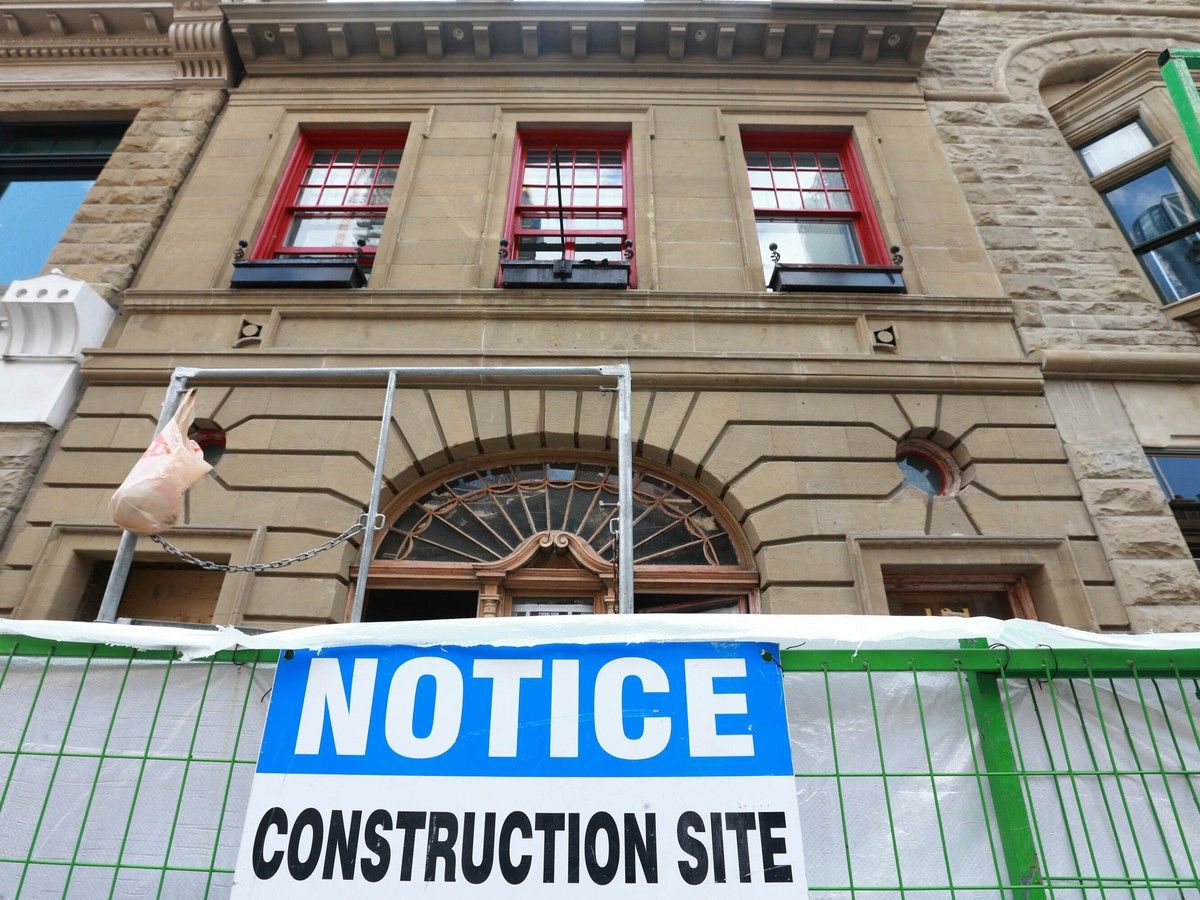
The city introduced the permit relaxations in 2017, but they are set to expire at the end of this year
Development permit relaxations for small businesses in Calgary’s downtown — introduced nine years ago, in a bid to help struggling storefronts following the 2014 oil price crash — could be made permanent. Administration is recommending city council entrench the Centre City Enterprise Area (CCEA), which exempts small businesses from needing development permits for certain renovation or expansion activities, into the city’s land use bylaw. Council’s infrastructure and planning committee will first consider the recommendation Wednesday before it advances to the next regular council meeting later this month.
The city claims the CCEA saves participating businesses in the downtown hundreds of days and hundreds of thousands of dollars they would otherwise need to spend during the permit approval process. “Since its introduction as a pilot initiative, the CCEA has successfully supported economic recovery by reducing regulatory barriers and enabling investment in downtown properties,” the city’s report states. The program was introduced to support small businesses in the downtown and Beltline that were reeling in the wake of the 2014 oil price crash that led to high office vacancy rates and an exodus of their customer base.
It removed or relaxed certain requirements for development approvals in the CCEA boundaries, reducing timelines and costs for building alterations or expansion projects. The aim was to make it easier for downtown tenants and businesses to set up operations, as well as for building owners to accommodate and attract new tenants, according to the city. Change of use applications were excluded from needing a development permit, as were applications for exterior alterations, unless it was for a building on the city’s inventory of historic resources.
Permit requirements were also relaxed for additions less than 1,000 square metres. The city introduced the permit relaxations in 2017, but they are set to expire at the end of this year. The pilot has been extended three times since being introduced, though the regulations haven’t been entrenched in the city’s bylaws permanently.
Since 2023, the program has exempted 577 development permits, according to the city’s cover report. Permit exemptions save applicants anywhere from 60 to 120 or more days, and data from the last three years indicates an average of 192 development permits have been exempted annually, shaving 7,900 days off the permit approval process, the city said. The city says on average, the relaxations saved businesses approximately $500,000, due to reduced architectural, civil and landscape consulting fees, development permit securities and deposits, and other related costs.
A representative with the Canadian Federation of Independent Business (CFIB) said the organization supports any attempt by the city to reduce red tape or streamline permitting processes. “It’s really in the best interests of the city’s small businesses, if it frees up their time to run and expand their business and it reduces the cost of doing business for these entrepreneurs as well,” said Kayode Southwood, a senior policy analyst for the federation’s Alberta branch. “When we look at CFIB survey data from our Calgary members, they tell us that municipal red tape is ranked as the second most harmful issue they experience, next to property taxes . . .
so municipal red tape is a big issue for a lot of businesses, especially on the permitting side of the equation.” Southwood said CFIB believes the city should apply the same principles of the CCEA Calgary-wide. “Instead of just providing an exemption, the city should be taking a broad look at development permit requirements for all businesses across the entire city because there’s certainly red tape in the process,” he added.
“They’ve been running this since 2017 and we think it’s time to broaden the program.” Mayor Jeromy Farkas said the CCEA is a success story in red tape reduction and making the pilot permanent makes sense. “Many third-party business organizations applaud the the red tape reduction that the City of Calgary has implemented as part of that (pilot), and I think committing to that on a go-forward basis, maintaining that perpetually, is really important,” he told reporters.
However, Farkas said he’d be hesitant to expand the program by allowing businesses outside of the current district from accessing the same permit relaxations. “When we think about the needs and the operational demands of the downtown, it’s quite different from, say, a community or suburban context,” he said. “I’d be open to looking at (expanding the eligibility) on a case-by-case basis, but I don’t think the relaxations that are applied for Calgary’s downtown would make sense writ large for the for the rest of the city.”
Asked if the program provides preferential treatment for downtown storefronts compared to other business districts, the area councillor said making sure Calgary’s central business district is vibrant and economically pays dividends across the city. “We need a different approach for downtown than we have in other areas of the city,” said Ward 7 Coun. Myke Atkinson.
“Downtown carries a lot of the tax productivity and there’s a specialized focus that needs to be taken downtown. “We can take some of the learnings from what we find in the downtown approach and apply that to other business districts in our city to make sure we are lifting those areas up, but if you don’t have a strong downtown, businesses across the city suffer as we then have to shift the taxes generated by the commercial base within the downtown to areas elsewhere in the city.”
- Published
- Jul 14, 2026
- Updated
- Jul 14, 2026
- Source
- Calgary Herald
- Category
- Politics
- Read time
- 4 min
Key facts
Why this matters locally
This politics story matters locally because it may affect readers, businesses, commuters, families, or public services in British Columbia.
Local impact
BC Post links this item to British Columbia coverage so readers can follow related city updates, weather, traffic, events, and category news in one place.
Timeline
Source and credit
BC Post may summarize, organize, and add local context for reader clarity. Original reporting remains with the listed publisher.
Related Articles
View all Politics
Powerful pro-life ad featuring boxing legend to air during final World Cup matches
Politics
Powerful pro-life ad featuring boxing legend to air during final World Cup matches
 Politics
Vaughn Palmer: David Eby's slow and expensive step toward involuntary care
Politics
Vaughn Palmer: David Eby's slow and expensive step toward involuntary care
 Politics
Corus rebuts misinformation about future of Global News in Alberta after layoffs
Politics
Corus rebuts misinformation about future of Global News in Alberta after layoffs
 Politics
Pitt Meadows to host information session for city council candidates
Politics
Pitt Meadows to host information session for city council candidates
 Politics
‘No consequences’: East Van woman says she was targeted by hate-motivated assault
Politics
‘No consequences’: East Van woman says she was targeted by hate-motivated assault
 Politics
Traditional Catholic response to Cupich’s suicide distortion
Politics
Traditional Catholic response to Cupich’s suicide distortion
More Local Coverage
Latest news Business
AI Market Trends: Q2 2026 Review and Forecast
Business
AI Market Trends: Q2 2026 Review and Forecast
 Local News
Cowichan sports shorts: rugby, hockey, biking
Local News
Cowichan sports shorts: rugby, hockey, biking