

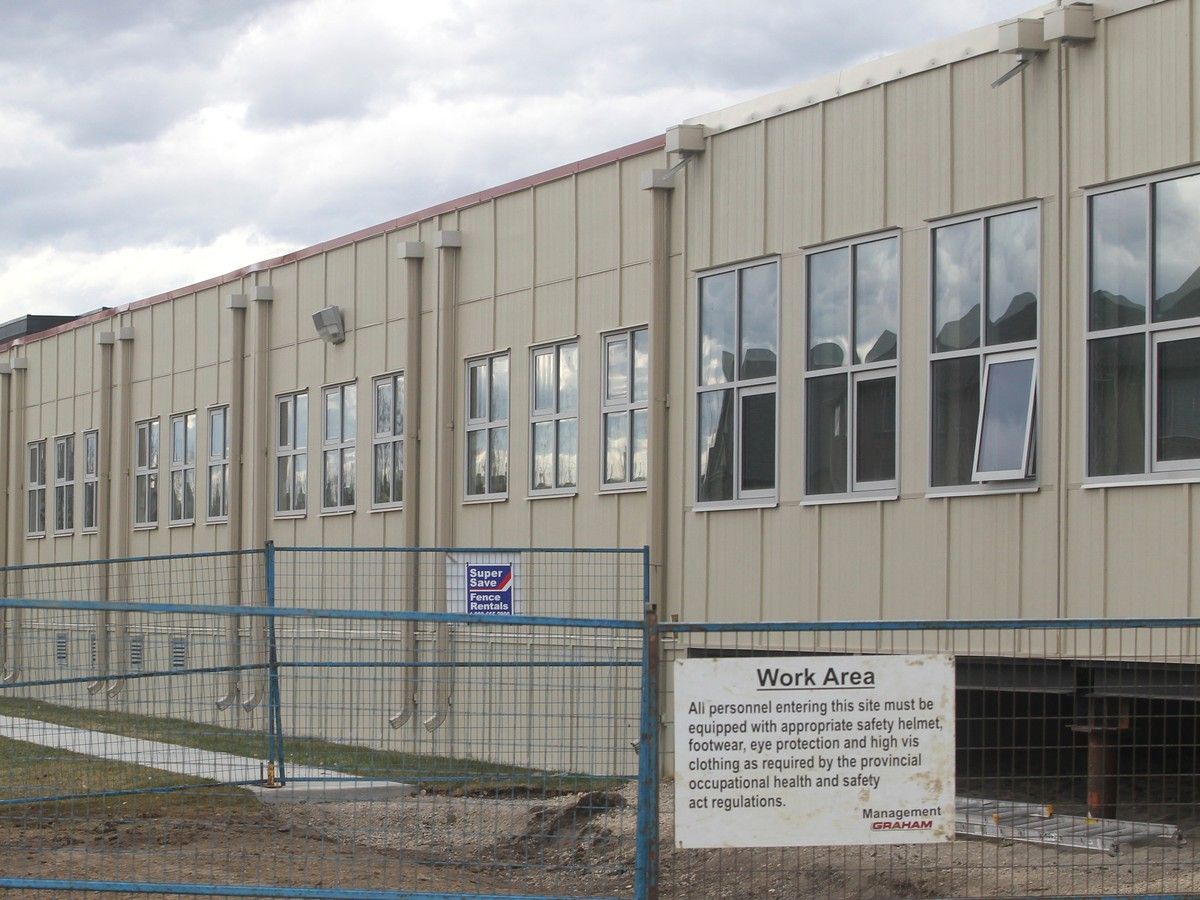
About 160 of CBE's 250 schools are currently above their utilization
Committee supports bylaw changes aiming to remove red tape for portable classroom installation at Calgary schools Proposed tweaks to Calgary’s land use regulations would remove red tape for local school boards to get portable classrooms set up on their campuses faster, city officials argued Wednesday. Administration is proposing amendments to Calgary’s land use bylaw to reduce permitting timelines and streamline the process to install modulars classrooms — an interim measure used to address soaring student enrolment and respond to a space crunch at the majority of Calgary’s schools. Another proposed amendment would exempt development permit requirements for interim uses at vacant or unused schools , allowing those facilities to be used as libraries, recreation centres, daycares, or private or commercial schools for up to two years, as long as the interim use does not require the site to be altered.
While portable classrooms are already a permitted use in Calgary’s land use bylaw, they are subject to prior-to-release conditions requiring additional landscaping, bicycle parking, loading stalls, and pick-up and drop-off stalls before development permits are approved. “School boards are challenged to comply with these rules because sites have limited space, and no additional funding is provided to help school boards meet these requirements,” the city’s report stated. At Wednesday’s infrastructure and planning committee meeting, Arysha Lalach, a planner with the city, said portables play a key role in alleviating student accommodation issues before a new school can be built.
“The city has been seeing a steady increase in the number of portable applications and this coincides with funding from the province,” she told the committee. “School boards strive to complete construction in time for the upcoming school year. However, there are land use bylaw requirements that are difficult to add to existing school sites, and these are consistently relaxed, which ends up extending timelines.”
The proposed relaxations would exempt up to six cumulative portables on a school site from the current requirements for landscaping, bike stalls, loading stalls and pick-up and drop-off stalls, Lalach said, speeding up the process for the city to release the development permit. Although administration consistently relaxes these rules anyway, Lalach said the timeline to advertise bylaw exemptions can risk delaying the installation of modulars before the start of the school year. “I like this approach,” said Ward 12 Coun.
Mike Jamieson. “I see this sort of as red tape reduction, to be able to get portables faster in place and get kids in the schools faster. “I think it’s a great initiative.”
However, other councillors voiced concerns with unintended side-effects, particularly related to mobility and transportation. Ward 2 Coun. Jennifer Wyness argued relaxing the pick-up and drop-off stall requirement could increase vehicular congestion around school sites.
Similarly, removing the bike stall requirement would discourage students from biking to school, argued Ward 7 Coun. Myke Atkinson, who added incentivizing more students to bike to school helps reduce vehicle congestion during pick-up and drop-off times. The proposed removal of pick-up and drop-off stalls may also force parents to drop their kids off further from the school, Atkinson added.
“This is turning on the portables and turning on the capacity, but it isn’t dealing with all the side effects that are coming in,” he said during debate. “We’re trying to encourage more bike and pedestrian traffic . . . but we’re not requiring bike parking.”
But overall, committee members still unanimously supported the recommendations, advancing the proposed bylaw amendments to council’s Sept. 15 public hearing meeting. While nitpicking the recommendations is warranted, Ward 8 Coun. Nathaniel Schmidt said details can be hammered out, and that accelerating portable classroom installation will help address student space pressures.
“Perfect is the enemy of good,” he said. “If we maybe have a couple of things to work out around transportation, biking, whatever it may be, it’s not about pitting those things against one another. “Ultimately, for my own kid, I’d rather her have a place to go to school than for her to have the perfect place to go to school . . .
We can tinker down the road, if tinkering is needed.” In a statement, the Calgary Board of Education said it has a strong relationship with the city when it comes to property, leasing and infrastructure and looks forward to learning more about how the changes could speed up the installation of modular classrooms. “It is our hope this will reduce the time and cost for installation of modular classrooms and facilitate interim uses of school sites,” the spokesperson said in an email.
The spokesperson added that Calgary’s recent rapid population growth has accelerated the need for more school space throughout the city, and modular classrooms are crucial for schools that are operating over their enrolment capacity. About 160 of CBE’s 250 schools are currently above their utilization, while 31 schools are operating as “overflow” facilities. Last April, the Alberta government announced more than $12 million in funding for 46 new modular classrooms across 10 public schools in Calgary.
“Through ongoing collaboration between the CBE, the Ministries of Education and Childcare and Infrastructure, and the City of Calgary, work is already underway to ensure the new modular classrooms are installed and ready for students as soon as possible,” the CBE spokesperson said.
- Published
- Jul 15, 2026
- Updated
- Jul 15, 2026
- Source
- Calgary Herald
- Category
- Politics
- Read time
- 4 min
Key facts
Why this matters locally
This politics story matters locally because it may affect readers, businesses, commuters, families, or public services in British Columbia.
Local impact
BC Post links this item to British Columbia coverage so readers can follow related city updates, weather, traffic, events, and category news in one place.
Timeline
Source and credit
BC Post may summarize, organize, and add local context for reader clarity. Original reporting remains with the listed publisher.
Related Articles
View all Politics
Powerful pro-life ad featuring boxing legend to air during final World Cup matches
Politics
Powerful pro-life ad featuring boxing legend to air during final World Cup matches
 Politics
Vaughn Palmer: David Eby's slow and expensive step toward involuntary care
Politics
Vaughn Palmer: David Eby's slow and expensive step toward involuntary care
 Politics
Corus rebuts misinformation about future of Global News in Alberta after layoffs
Politics
Corus rebuts misinformation about future of Global News in Alberta after layoffs
 Politics
Pitt Meadows to host information session for city council candidates
Politics
Pitt Meadows to host information session for city council candidates
 Politics
Traditional Catholic response to Cupich’s suicide distortion
Politics
Traditional Catholic response to Cupich’s suicide distortion
 Politics
‘No consequences’: East Van woman says she was targeted by hate-motivated assault
Politics
‘No consequences’: East Van woman says she was targeted by hate-motivated assault
More Local Coverage
Latest news Business
AI Market Trends: Q2 2026 Review and Forecast
Business
AI Market Trends: Q2 2026 Review and Forecast
 Local News
Cowichan sports shorts: rugby, hockey, biking
Local News
Cowichan sports shorts: rugby, hockey, biking