

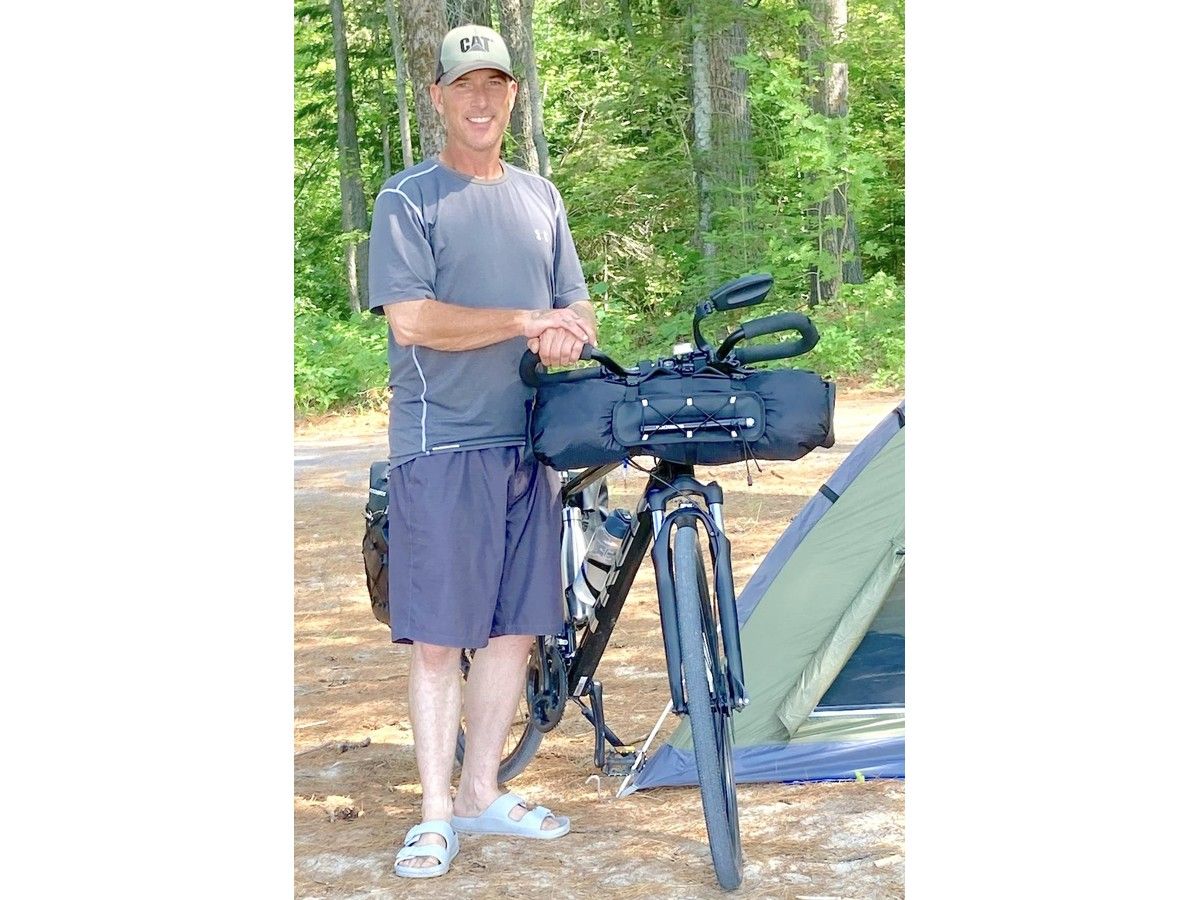
DEEP RIVER — Shade can be hard to come by in the late afternoon at Lamure Beach. In the heat of the day on June 28 I noticed a small tent set up in the trees with a bicycle beside it. I placed our beach blanket on the sand nearby in the same small patch [...]
Article content DEEP RIVER — Shade can be hard to come by in the late afternoon at Lamure Beach. In the heat of the day on June 28 I noticed a small tent set up in the trees with a bicycle beside it. I placed our beach blanket on the sand nearby in the same small patch of shade.
Recommended Videos I heard a few words from the man in the tent talking with someone who had evidently stopped to ask about his set-up. I heard “bicycle-touring,” “across Canada,” and “recovery.” I thought that this sounded like a story I needed to hear, so I approached and asked.
Jason Lavictoire, age 45, has spent the last three summers bicycle-touring Canada as part of his road to recovery from addiction. “When I came to the realization that I had to get clean, I had a problem. Now what?
I’m a high-strung guy. I had to prove to myself that I wasn’t a failure.” He first attempted backpacking in early summer 2023.
He planned a 300 km backpacking trip from his home in Ottawa to just past Kingston. “I lasted two days,” he said. “I felt so worthless, useless.
Walking is so slow and boring. You feel every ounce of pain.” Needing to reassess, Jason went dejectedly back home.
He heard about something called “bike-packing,” or “bike-touring.” “I tried bike-touring about six weeks after the backpacking attempt,” he said. “My first trip was from Ottawa to Hamilton to visit a couple of friends.”
“I had a heavy bike, and cheap (which meant heavy) gear, and no idea how to do this,” he said. He also had no helmet, but don’t tell anyone. “I was at the point of having heat stroke, sunstroke, dehydration,” he said.
“I was new into my recovery so I had no idea how to stop. I was doing the only thing I knew how to do, which was go until you can’t go any further.
This was how I’d treated my life since I was 15 years old, just beating myself up.” “This was when I started to learn the hard way to pay attention,” he went on. “You’re uncomfortable, you’re hurting yourself.
There’s got to be a better way.” “I’d been in active addiction since I was a young guy,” he said. “I didn’t know how to cope.”
He arrived in Hamilton after 8-9 bruising days. He stayed with his friends for a week, and then biked home. “I felt shocked,” he told me.
“This was a big deal because I’d finally accomplished something. It allowed me to be dependent on myself, to make decisions and get results, and to take care of myself.” He also started to see a glimmer of a truth he has later come to accept: you don’t have to be in pain.
Despite his successful first bike-packing attempt, Lavictoire still had a long way to go. “I was still just at the beginning of my recovery. I was still in a dark, dark fog.
I wasn’t finished.” Later the same summer he decided to try biking to Sault Ste. Marie to see his Uncle Mike.
“It’s about 846km from my house to his house,” he explained. About four days into his journey, he arrived in Deep River for the first time and stayed one night at Lamure Beach. He had never heard of Deep River before.
“Deep River in 2023 gave me the first magical moment I’d had,” he said. “The fact that I got to spend a night in such a beautiful place! This view at dusk...” “That night in Deep River was my first time appreciating that I was doing something good and this was a taste of a reward.”
He spent a month with his family in Sault Ste. Marie and in September 2023 started back to Ottawa. He got to North Bay when the temperature abruptly dropped.
He had to pack it in and take a bus home. Not knowing that in order to take his bike home on the bus he needed a bike box, he was shocked when the bus driver refused to take his bike and gear. “I just started bawling my face off,” he said.
“I’d just developed a passion for this and now I had to leave it behind.” Everyone on the bus watched as he cried on the phone to his wife, “They won’t let me bring it home.” However, ultimately this experience taught Lavictoire another valuable lesson: everything works out in the end.
The bus line apologized and Lavictoire was eventually reunited with the bike he’d had to leave tearfully with the girl at the gas station in North Bay. “Over that winter I had to try to go through the wringer of life as a grown-up,” he said. “I tried to learn how to be dependable.”
Lavictoire had burned a lot of bridges during his time as an addict, and many friends and family had cut him off. “I’d made their lives a living hell,” he said. He spent that winter refurbishing his bike and planning another big trip, this time to the east coast.
His goal: Cape Spear, Newfoundland. On May 1, 2024, he set off from Ottawa. “It took 77 days,” he said.
“With each day, I felt like, ‘where have I been my whole life?’” he said. “There were so many places in each province where I had to pull over and cry just because of the beauty. I’d never experienced that, ever.”
“I was still learning coping mechanisms,” he explained. “Sometimes on the highway I’d get these waves of emotion and I had no idea how to deal with it. I’d start bawling on the side of the highway, like a child.
It all came out.” There were many highlights of this tour, like visiting the Anne of Green Gables house on PEI and seeing that the soil really is red. He watched dolphins playing in the wake of the ferry.
Mostly he experienced the kindness and goodness of the people he encountered along the way, people who stopped to check that he was ok, people who fed him, people who took him in. “I was taken aback by the kindness and selflessness,” he said. “I started to have new relationships that I didn’t have to repair,” he said.
“Meeting new people gave me new beginnings.” In the winter of 2024-25 he experimented going back to work. “I needed to see if I could maintain stability,” he said.
“I still hadn’t fully forgiven myself yet. I still had a lot to redeem.” “I was still early enough into recovery that I was edgy,” he explained.
So, on March 1, 2025, Lavictoire left Ottawa again, this time heading to the west coast of Canada. Ontario rewarded him in its usual helpful way, with ice, massive snowfalls, and temperatures around -20. “The hills on the west side of Lake Superior make this side look like a playground,” he said.
Manitoba was a treat. He was so proud to arrive at the border between Ontario and Manitoba, and the weather suddenly changed for the better. He sailed through Manitoba in seven days, riding a tailwind and feeling great.
Saskatchewan delighted him with lots and lots of trains (one of his great loves) but was also the province that made him feel, for the first time really, that maybe what he was doing was dangerous. “What people don’t know about the prairies is there’s no escape from the sun,” he said. “But there’s also no escaping the wind.”
He rode against an extremely strong crosswind that kept pushing him into the highway. He actually rode resting his weight into the wind, “That’s how strong the crosswind was,” he said. “So if the wind ever chose to stop I’d have to overcorrect, and then it would come and shoot me on to the highway.”
In addition to struggling with the elements, Lavictoire started struggling within himself too. “I was getting tired and lonely,” he said. “I was becoming lonelier and lonelier and starting to isolate.
As a guy in recovery, if I start to isolate, that’s very bad.” Even when finally, way, way off in the distance he saw something dark that must be the Rocky Mountains, he still felt demoralized. “When I got to Alberta I felt nothing,” he said.
“I was out of gas and I had nothing left.” “My rest periods were becoming longer, and my motivation to get going was becoming extremely difficult.”
It was 2km before Banff that Lavictoire suddenly decided that enough was enough. He turned his bike around and started back east. He sailed along with the wind – finally, something easy and good!
He had no idea where he was headed, but, “I was flying along,” he said. He allowed himself to accept that he was homesick and it was time to go home. “At this point I was fine!”
he said, amazed. “I wasn’t heartbroken! I was happy to be going home; I was proud of my accomplishment and with my decision.”
By 2026, Lavictoire has become a very different person from the one who started biking in 2023. He has learned to respect himself and to allow himself to be happy. He has also decided not to do any more big tours.
From now on, it will just be short bike-packing trips, like the one he had nearly completed when I met him on the beach. For this one, he planned to be gone for one month. His destination was Sault Ste.
Marie to see his Uncle Mike again, but this time he went through Algonquin Park. He did a few things differently, starting with some training. “This is the first time I’ve trained before going on a tour,” he said.
“I’ll never go on a trip again without training first.” This is also the first time he’s left for a tour feeling full support from the people he loves. “It’s a huge change.
Their support means the world to me,” he said. Arriving back in Deep River this June was an important moment for Lavictoire, as he looked out over the same view he fell in love with three summers ago. “Arriving back here I thought, what a huge difference in the last three years.
Growth, reparations with the people I love. What a massive difference.” For the first time in his adult life, Lavictoire has been overcome with pride – pride in himself!
“It’s all being fixed,” he told me. “I can now love and absorb what life should be.” Hazel Atkins is a Local Journalism Initiative (LJI) reporter working out of the North Renfrew Times.
LJI is funded by the Government of Canada.
- Published
- Jul 16, 2026
- Updated
- Jul 16, 2026
- Source
- Observer
- Category
- Top
- Read time
- 8 min
Key facts
Why this matters locally
This top story matters locally because it may affect readers, businesses, commuters, families, or public services in British Columbia.
Local impact
BC Post links this item to British Columbia coverage so readers can follow related city updates, weather, traffic, events, and category news in one place.
Timeline
Source and credit
BC Post may summarize, organize, and add local context for reader clarity. Original reporting remains with the listed publisher.
Related Articles
View all Top
Rock the Lake celebrated its ninth year at Prospera Place this past weekend
Top
Rock the Lake celebrated its ninth year at Prospera Place this past weekend
 Top
Million-dollar contract awarded for Surrey Sport & Leisure Complex renos
Top
Million-dollar contract awarded for Surrey Sport & Leisure Complex renos
 Top
MLA Jordan Kealy to face jury in sexual assault case
Top
MLA Jordan Kealy to face jury in sexual assault case
 Top
BCWS aircraft helping Kamloops firefighters battle grass fire above Shuswap Road
Top
BCWS aircraft helping Kamloops firefighters battle grass fire above Shuswap Road
 Top
Brunswick Creek wildfire grows, leads to air quality warning in east Fraser Valley
Top
Brunswick Creek wildfire grows, leads to air quality warning in east Fraser Valley
 Top
'A sacred place': Delta park to get dedicated ash-scattering site
Top
'A sacred place': Delta park to get dedicated ash-scattering site
More Local Coverage
Latest news Politics
Powerful pro-life ad featuring boxing legend to air during final World Cup matches
Politics
Powerful pro-life ad featuring boxing legend to air during final World Cup matches
 Business
AI Market Trends: Q2 2026 Review and Forecast
Business
AI Market Trends: Q2 2026 Review and Forecast