

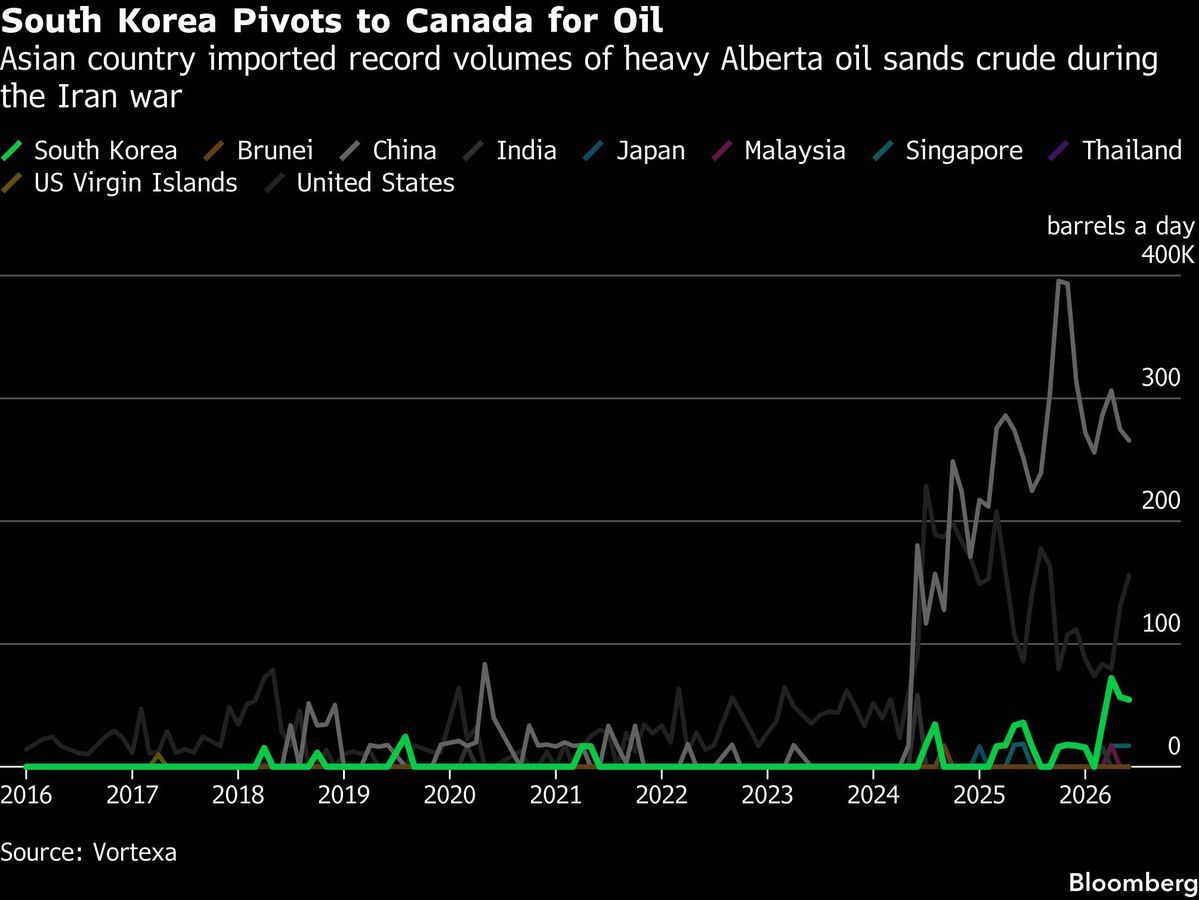
South Korea is soaking up record volumes of Canadian crude oil as the war in Iran forces countries across Asia to look for alternatives to Persian Gulf barrels. It’s a shift that some say will extend beyond the conflict.
(Bloomberg) — South Korea is soaking up record volumes of Canadian crude oil as the war in Iran forces countries across Asia to look for alternatives to Persian Gulf barrels. It’s a shift that some say will extend beyond the conflict. With the conflict disrupting shipping traffic in the Middle East, South Korean imports have risen fourfold to 61,000 barrels a day in the second quarter from 17,000 in the first, Vortexa data show.
The change comes after Alberta and South Korea reached an agreement in April to remove a standard 3% tariff that had been placed on Canadian oil. The ongoing war has left a number of Asian nations looking to forge new trade partnerships. After an interim ceasefire collapsed, US President Donald Trump reinstated a blockade on Iranian exports through the Strait of Hormuz, a critical waterway that handles a fifth of the world’s oil and liquefied natural gas.
The frantic search for alternative fuel supplies means deals are being cut that could reshape trade flows for years to come. Dependence on Canada is likely to last even after hostilities end, according to Celina Hwang, director for North American Crude Oil Markets at S&P Global Energy. South Korean refiners are likely to become more reliant on Canada’s specific type of oil and more hesitant to import oil from the Persian Gulf as the war drags on, she said in an interview.
With the sporadic opening and closing of the strait, refiners face “an issue of trust being broken,” Hwang said. Discussions around boosting Canadian crude shipments to South Korea had started even before the war, she added. In addition to Canadian imports, South Korea has also increased its purchases of US barrels and diversified its supply sources to Latin America.
Japan has also made a dramatic shift away from Middle Eastern crude since the war, relying heavily on the US for oil. Rohit Rathod, an oil market analyst for Vortexa, has a more circumspect view on whether South Korea’s shift toward Canadian crude will wind up being permanent. South Korea used to be “an occasional or very marginal” buyer of Western crude out of Vancouver, he said, cautioning that it could still revert back to buying Iraqi oil in the event the strait reopens.
Before the war started at the end of February, South Korea had relied on Iraq’s Basrah Heavy for most of its dense, high-sulfur crude. Since the conflict started, that supply has been largely replaced by Canadian Cold Lake crude, as well as oil from Mexico.
- Published
- Jul 14, 2026
- Updated
- Jul 14, 2026
- Source
- Financial Post
- Category
- Politics
- Read time
- 2 min
Key facts
Why this matters locally
This politics story matters locally because it may affect readers, businesses, commuters, families, or public services in British Columbia.
Local impact
BC Post links this item to British Columbia coverage so readers can follow related city updates, weather, traffic, events, and category news in one place.
Timeline
Source and credit
BC Post may summarize, organize, and add local context for reader clarity. Original reporting remains with the listed publisher.
Related Articles
View all Politics
Powerful pro-life ad featuring boxing legend to air during final World Cup matches
Politics
Powerful pro-life ad featuring boxing legend to air during final World Cup matches
 Politics
Vaughn Palmer: David Eby's slow and expensive step toward involuntary care
Politics
Vaughn Palmer: David Eby's slow and expensive step toward involuntary care
 Politics
Corus rebuts misinformation about future of Global News in Alberta after layoffs
Politics
Corus rebuts misinformation about future of Global News in Alberta after layoffs
 Politics
Pitt Meadows to host information session for city council candidates
Politics
Pitt Meadows to host information session for city council candidates
 Politics
Traditional Catholic response to Cupich’s suicide distortion
Politics
Traditional Catholic response to Cupich’s suicide distortion
 Politics
‘No consequences’: East Van woman says she was targeted by hate-motivated assault
Politics
‘No consequences’: East Van woman says she was targeted by hate-motivated assault
More Local Coverage
Latest news Business
AI Market Trends: Q2 2026 Review and Forecast
Business
AI Market Trends: Q2 2026 Review and Forecast
 Local News
Cowichan sports shorts: rugby, hockey, biking
Local News
Cowichan sports shorts: rugby, hockey, biking