

WINNIPEG — A middle school student file documenting more than 40 violent outbursts in a single year.
We need your support! Local journalism needs your support! Now, more than ever, we need your support.
or call circulation directly at (204) 727-0527. Your pledge helps to ensure we provide the news that matters most to your community! To continue reading, please subscribe: Add Brandon Sun access to your Free Press subscription for only an additional $1 for the first 4 weeks* WINNIPEG — A middle school student file documenting more than 40 violent outbursts in a single year.
A gun kept under the pillow of a home-care patient who has dementia. A drug-fuelled rage during which a man suffering from a contagious disease spat on and wrapped his hands around the throat of a first responder. These are among the hazards that front-line employees in health care, education and other public-sector positions are navigating when they clock in for a shift.
“The level of workforce violence in Manitoba seems daunting,” said Kevin Rebeck, president of the Manitoba Federation of Labour. “Because it is.” The federation representing 130,000 unionized workers has released a new report outlining what it calls “a long-standing and growing epidemic.”
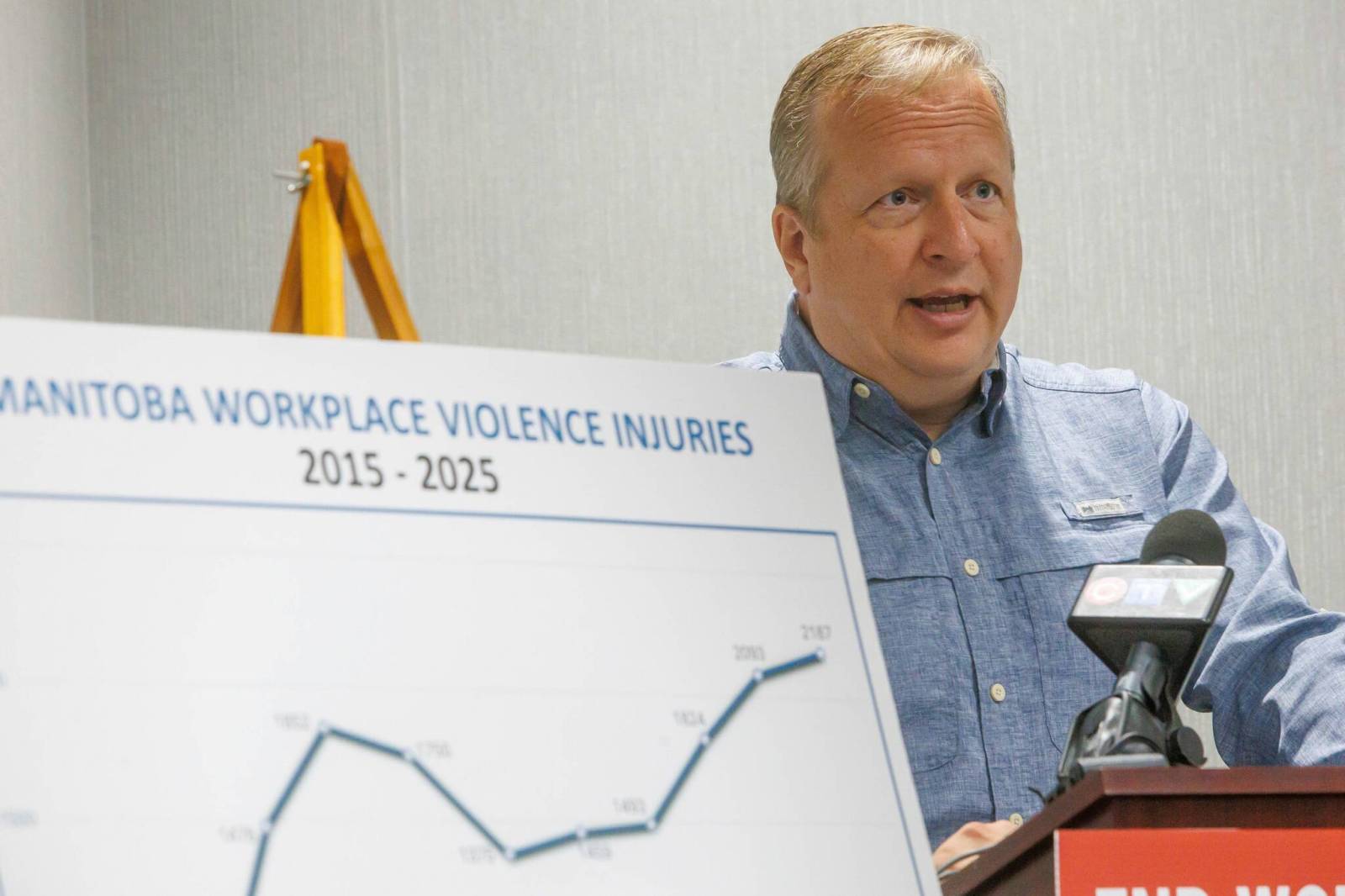
Rebeck shared its contents with reporters and the leaders of its affiliates, including the Manitoba Nurses Union, at Union Centre in downtown Winnipeg on Monday. There was also a chart showing a 240 per cent increase in workplace violence injuries over the last decade. Concerned about the toll this trend is taking on educational assistants, paramedics and others, the federation launched a research project to collect firsthand accounts of violence and analyze public data.
A teacher, one of 38 employees who were interviewed for the report, recalled how a student “threatened to stab me” in a full classroom. The wide-ranging findings highlight concerns about everything from long-term care residents regularly slapping and pulling hair to how covered windows escalate risks in cannabis retail shops. “It is hard to exercise the right to refuse dangerous work when your whole job has dangerous components,” one health-care aide said.
The workers compensation board recorded 2,187 injuries — both physical and psychological — last year. That’s more than triple the amount recorded in 2015. It also represents a 20 per cent increase from just two years prior.
Researcher Karen Naylor called the findings “damning.” Naylor, a labour studies instructor at the University of Manitoba, interviewed members of the federation, with about 30 affiliate unions representing staff in urban and rural communities. Interviewees spoke about violence being increasingly normalized in their workplace and its lasting impact on their well-being.
Naylor said far too often workers reported that their managers either disregarded their complaints or blamed them for their own injuries. This was especially an issue in health care and education, the academic said. Ten occupations represented nearly 80 per cent of all time-loss workplace violence injuries in 2025.
The group includes nurses, social service workers, education assistants, bus drivers, security guards, correctional service officers and early childhood educators. Home support workers, housekeepers and related occupations accounted for more than 14 per cent of all of the time-loss injuries last year. The category with the next highest percentage of time-loss injuries was educational assistants.
Notably, approximately a quarter of the province’s total workforce is not covered by the Workers Compensation Board of Manitoba. These statistics exclude the 17,000 teachers who belong to the Manitoba Teachers’ Society, which recently released its own report warning about a rise in violence in public schools. The federation’s report indicated that women are disproportionately affected by workplace violence.
In the latest available data, from 2024, women accounted for about six in 10 of all time-loss injuries. The report also flagged concerns that violent incidents are often underreported. Rebeck said his team has come up with “common-sense recommendations,” such as enforcing existing legislation, to better protect workers.
The first of 10 identifies the need for a provincial workplace violence prevention strategy. Others include calls to fund safe staffing levels, deploy “highly trained” security personnel and develop a formal training standard. While noting there are regulations requiring workplaces to assess violence hazards, Rebeck said there’s “no evidence” the province has ever undertaken an enforcement campaign.
“If violent hazards are not assessed, it goes without saying they won’t be addressed,” he said. The report acknowledges that many underlying socioeconomic factors, including addictions, mental illness and poverty, contribute to violent incidents. “While it is critical that more resources be directed to supporting those struggling with these issues, employers nonetheless have a legal duty to eliminate or mitigate to the fullest extent possible the hazard of workplace violence,” it said.
Labour Minister Malaya Marcelino was not made available for an interview Monday. Her office issued a statement saying the province is working on “multiple levels” to ensure all Manitobans have access to work environments that are “safe, dignified and respectful.” Marcelino cited the recent adoption of patient-to-staff ratio legislation, new funding for retail theft initiatives and the revival of the advisory council on workplace safety in health.
The province has added eight health and safety officer positions since the 2023 election and two others are imminent. The Manitoba Nurses Union, one of the largest members of the Manitoba Federation of Labour, is prescribing more institutional safety officers, amnesty lockers and weapons detectors in hospitals. Union president Darlene Jackson said new uniformed safety officers have “dropped the temperature” in emergency rooms, but they are being assigned to cover multiple facilities instead of one.
» Winnipeg Free Press
- Published
- Jul 13, 2026
- Updated
- Jul 13, 2026
- Source
- Brandonsun
- Category
- Crime
- Read time
- 4 min
Key facts
Why this matters locally
This crime story matters locally because it may affect readers, businesses, commuters, families, or public services in British Columbia.
Local impact
BC Post links this item to British Columbia coverage so readers can follow related city updates, weather, traffic, events, and category news in one place.
Timeline
Source and credit
BC Post may summarize, organize, and add local context for reader clarity. Original reporting remains with the listed publisher.
Related Articles
View all Crime
Pedestrian struck by bus, critically injured in Surrey
Crime
Pedestrian struck by bus, critically injured in Surrey
 Crime
B.C. seeks forfeiture of alleged gangster’s properties worth more than $6.2 million
Crime
B.C. seeks forfeiture of alleged gangster’s properties worth more than $6.2 million
 Crime
‘N’ driver involved in Abbotsford rollover crash, police say
Crime
‘N’ driver involved in Abbotsford rollover crash, police say
 Crime
A dozen cats are missing after New Westminster apartment fire that displaced roughly 100 residents
Crime
A dozen cats are missing after New Westminster apartment fire that displaced roughly 100 residents
 Crime
Train strikes crashed car at Deroche rail crossing
Crime
Train strikes crashed car at Deroche rail crossing
 Crime
Video shows rescue of lone survivor from deadly B.C. helicopter crash
Crime
Video shows rescue of lone survivor from deadly B.C. helicopter crash
More Local Coverage
Latest news Local News
Cowichan sports shorts: rugby, hockey, biking
Local News
Cowichan sports shorts: rugby, hockey, biking
 Top Stories
Yukon minerals work still under review despite federal announcement
Top Stories
Yukon minerals work still under review despite federal announcement