

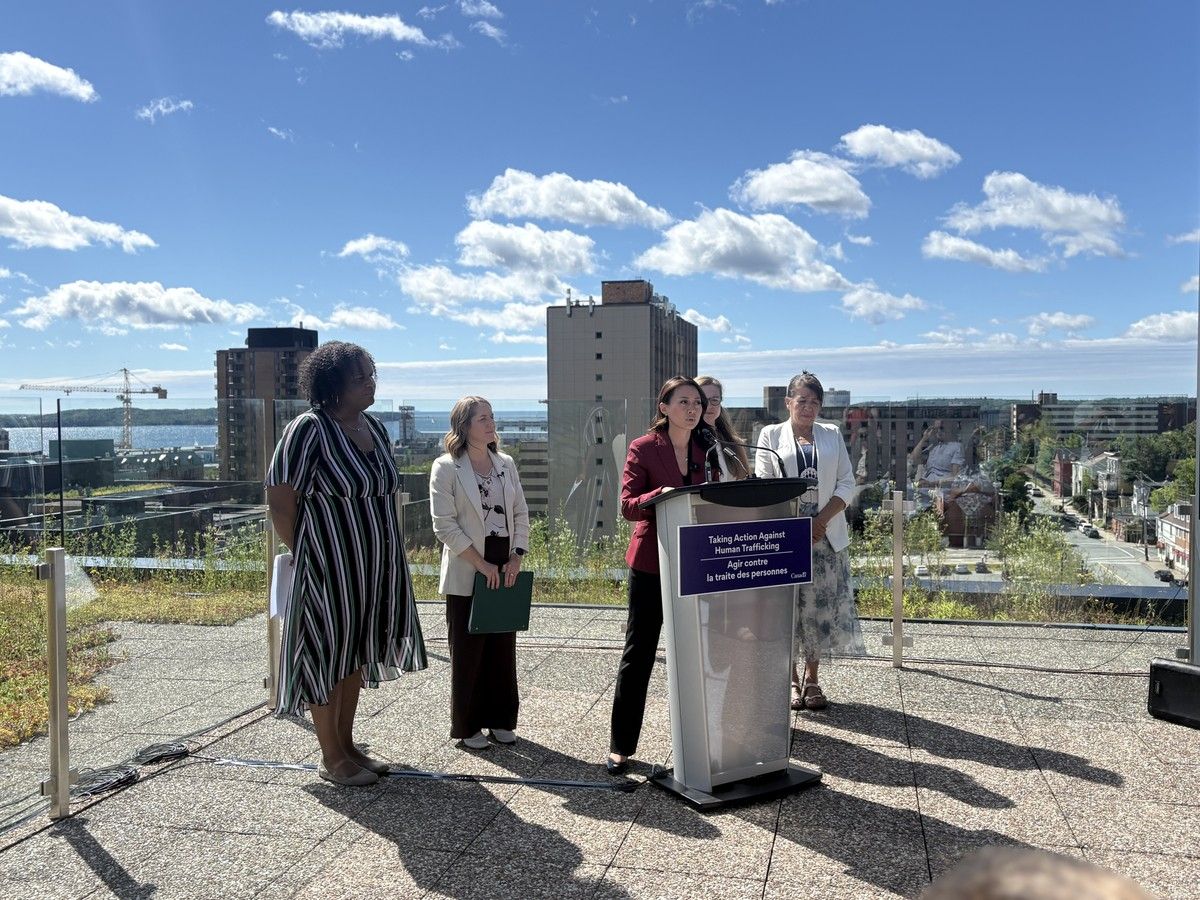
YWCA Halifax and the Nova Scotia Native Women's Association are receiving around $450,000 as part of $1.4 million federal investment to prevent trafficking in Canada.
Two Nova Scotia organizations providing services to victims of gender violence are getting a funding boost from the federal government as part of Canada’s push to end human trafficking and prevent exploitation before it occurs. Federal Women and Gender Equality Minister Rechie Valdez, alongside Shannon Miedema, member of Parliament for Halifax, announced over $1.4 million in funds that will support six organizations throughout the country. According to Statistics Canada, the average annual rate of police-reported instances of human trafficking nationally is 1.2 per 100,000 people.
Nova Scotia’s rate is more than double that, having the highest rate in the country at 4.1, translating to 452 incidents between 2014 and 2024. Around $450,000 will go to YWCA Halifax and the Nova Scotia Native Women’s Association. “When we invest in organizations like these, we are investing in prevention, we are investing in safety, and we are investing in brighter futures for victims and survivors,” Valdez said Friday in Halifax.
YWCA strengthening Nova Scotia’s response YWCA Halifax will be receiving $245,000 to support its CASE 2.0 initiative. CASE, or Co-ordinated Alignment to Support Exit, focuses on growing an approach for Nova Scotia to respond to commercial sexual exploitation of youth and human trafficking. Chief operating officer Danielle Hodges said the funding will expand programming targeted toward prevention and build a system equipped to tackle human trafficking long term.
“The Province of Nova Scotia has recognized intimate partner violence as an epidemic,” Hodges said. “This is not an issue that exists somewhere else. It is happening here in Nova Scotia.”
The funds will also help strengthen the Trafficking and Exploitation Services System, a network that spans the province to improve co-ordination between government, community organizations and partners to improve prevention and support survivors. “Behind every statistic is a person rebuilding their life, a young person finding a safe place to land, a survivor accessing housing and support,” she said. “No single organization can solve this issue alone.
Real change happens when governments, communities, schools, service providers, researchers and survivors come together.” Support for Indigenous women and children Karen Bernard, former vice-president of the native women’s association, said the group will use its $210,450 portion of the fund to continue education aimed at preventing human trafficking from occurring in Indigenous communities. Bernard said Indigenous women are vulnerable to trafficking due to the lasting impacts of colonization, and being able to provide education and awareness is the organization’s strongest defence.
“Our communities know the term, but they don’t understand the depth of it.” Bernard said that while human trafficking may seem to be something that occurs elsewhere, she warned it could happen to anyone in any community. She pointed to her own experience turning a man away who came to ask her on a date, learning years later he had been charged with human trafficking involving women from her community and others.
“Women are vulnerable within our communities. . . . They did entrust him, and they got trapped within that system of human trafficking,” she said. “It is a horrible place to be, and it is so easy to get sucked into that system.”
Frontline organizations and the broader plan Valdez said, “These organizations understand their communities better than anyone else. They know what victims and survivors need because they are the ones . . . every day providing support, building trust and helping people move forward.”
She added that investments in prevention and frontline organizations play an important role in the national strategy to combat sex trafficking through collaboration with law enforcement, educators and other groups that can help with prevention efforts. “That’s the true spirit of what we’re trying to do.”
- Published
- Jul 17, 2026
- Updated
- Jul 17, 2026
- Source
- Pniatlantic
- Category
- Politics
- Read time
- 3 min
Key facts
Why this matters locally
This politics story matters locally because it may affect readers, businesses, commuters, families, or public services in British Columbia.
Local impact
BC Post links this item to British Columbia coverage so readers can follow related city updates, weather, traffic, events, and category news in one place.
Timeline
Source and credit
BC Post may summarize, organize, and add local context for reader clarity. Original reporting remains with the listed publisher.
Related Articles
View all Politics
Powerful pro-life ad featuring boxing legend to air during final World Cup matches
Politics
Powerful pro-life ad featuring boxing legend to air during final World Cup matches
 Politics
Vaughn Palmer: David Eby's slow and expensive step toward involuntary care
Politics
Vaughn Palmer: David Eby's slow and expensive step toward involuntary care
 Politics
Pitt Meadows to host information session for city council candidates
Politics
Pitt Meadows to host information session for city council candidates
 Politics
Hundreds of enthusiatic supporters attend Surrey Mayor Brenda Locke’s fundarising dinner
Politics
Hundreds of enthusiatic supporters attend Surrey Mayor Brenda Locke’s fundarising dinner
 Politics
Funding local governments to speed up delivery of homes
Politics
Funding local governments to speed up delivery of homes
 Politics
Randhawa slams 2nd ‘questionable’ land purchase by City of Surrey
Politics
Randhawa slams 2nd ‘questionable’ land purchase by City of Surrey
More Local Coverage
Latest news Business
AI Market Trends: Q2 2026 Review and Forecast
Business
AI Market Trends: Q2 2026 Review and Forecast
 Local News
Cowichan sports shorts: rugby, hockey, biking
Local News
Cowichan sports shorts: rugby, hockey, biking