


The Quebec Domestic Security Minister (MSI) expanded the ban on open fires as prolonged dry weather has created prime conditions for forest fires.
The Quebec Domestic Security Minister (MSI) expanded the ban on open fires as prolonged dry weather has created prime conditions for forest fires. The ban includes major swaths north of the St. Lawrence River. “Some of these regions are moderate or elevated indicator, but we just expanded teh fire ban because we have a lot of fires in the northern part of the province,” said Quebec forest fire fighting agency (SOPFEU) prevention and communications advisor Isabelle Gariépy.
The ban was expanded on Thursday and will continue until there is rain in the northern part of the province. SOPFEU is monitoring 182 active fires in northern Quebec and six in the southern “intensive protective zone” (IPZ) in the south. Gariépy said that most of the open fires are caused by lightning and that the agency wants to ensure that no extra fires are caused by human actions.
She said the number of fires is about five times the average. “It’s a lot of fires in the northern zone,” she said. SOPFEU says that an average of 80 fires are caused by “smoking articles” in Quebec per year, 60 by campfires and 75 from burned waste.
So far in 2026, 66 fires started as a result of burning trash, 41 from campfires and 24 from smoking articles. Eight were caused by all-terrain vehicles (ATVs). Since the beginning of the fire protection season, 270 wildfires have burned 70,304.4 hectares in the IPZ, while 233 wildfires have burned 266,064.6 hectares in the Northern Zone.
“It’s very important to do our part,” said Gariépy. “Even if in our region we’re not sure, we don’t have any fires, we don’t see the smoke, but these fires are there now. It’s very important to just be sure and respect all of the restrictions we have in the province.”
- Published
- Jul 11, 2026
- Updated
- Jul 11, 2026
- Source
- Ctv News
- Category
- Environment
- Read time
- 1 min
Key facts
Why this matters locally
This environment story matters locally because it may affect readers, businesses, commuters, families, or public services in British Columbia.
Local impact
BC Post links this item to British Columbia coverage so readers can follow related city updates, weather, traffic, events, and category news in one place.
Timeline
Source and credit
BC Post may summarize, organize, and add local context for reader clarity. Original reporting remains with the listed publisher.
Related Articles
View all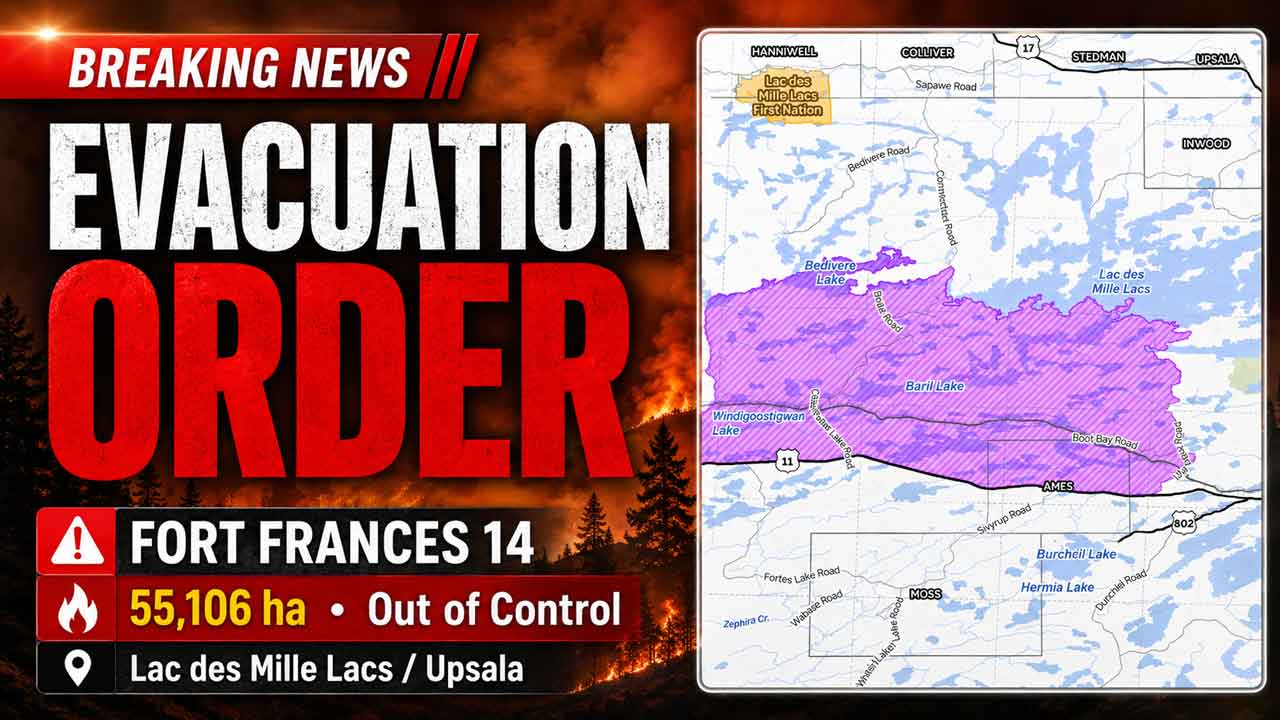 Environment
Updated Evacuation Information for Wildfire Fort Frances 14 (July 17 2026)
Environment
Updated Evacuation Information for Wildfire Fort Frances 14 (July 17 2026)
 Environment
50-hectare wildfire burns between Clearwater and 100 Mile House
Environment
50-hectare wildfire burns between Clearwater and 100 Mile House
 Environment
2 wildfires north of Anahim Lake currently out-of-control
Environment
2 wildfires north of Anahim Lake currently out-of-control
 Environment
A powerful movement of healing arrives at Delta’s Discovery Centre
Environment
A powerful movement of healing arrives at Delta’s Discovery Centre
 Environment
Port Coquitlam mayor launches program that removes graffiti on public property within 48 hours
Environment
Port Coquitlam mayor launches program that removes graffiti on public property within 48 hours
 Environment
'Fending for ourselves' after Manitoba wildfire forces evacuation: O-Pipon-Na-Piwin leaders
Environment
'Fending for ourselves' after Manitoba wildfire forces evacuation: O-Pipon-Na-Piwin leaders
More Local Coverage
Latest news Business
AI Market Trends: Q2 2026 Review and Forecast
Business
AI Market Trends: Q2 2026 Review and Forecast
 Politics
Powerful pro-life ad featuring boxing legend to air during final World Cup matches
Politics
Powerful pro-life ad featuring boxing legend to air during final World Cup matches
 Top
‘Entire city’ asked to help search for missing 11-year-old Parker: Calgary police
Top
‘Entire city’ asked to help search for missing 11-year-old Parker: Calgary police