

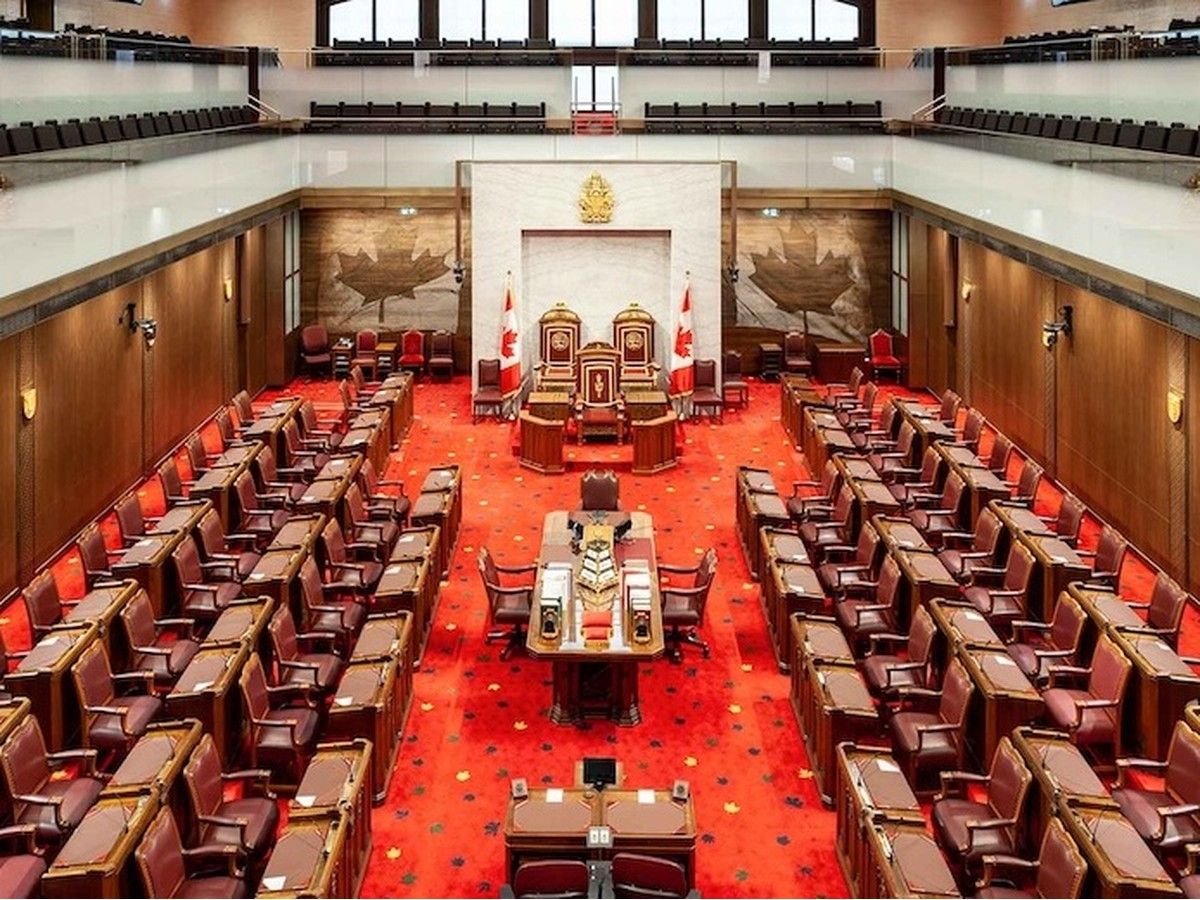
Canada does not need a Senate of experts. It needs a Senate that finally reflects the people it claims to serve
Mark Carney’s recent announcement on Senate appointments marks the most significant shift in Canada’s upper chamber since Justin Trudeau declared it “independent” nearly a decade ago. By eliminating the requirement that Senate appointees be non-partisan and openly seeking candidates with political experience, Carney has quietly acknowledged that the Trudeau experiment did not solve the Senate’s legitimacy problem. It merely disguised it.
And yet Carney has announced that he would again appoint candidates to the “advisory board” who would select Senators. The idea is odious. Who are they to select individuals who would serve in our democratic institutions?
The Senate remains one of Canada’s most peculiar democratic institutions. Its members exercise real legislative power, yet Canadians never vote for them. Since 2017, the Trudeau government attempted to bolster the chamber’s credibility through an “independent” advisory process that emphasized expertise and non-partisanship.
The result, however, was not a democratic Senate but an appointed elite selected through a process ultimately controlled by the prime minister. As I argued recently in a paper prepared for the Fraser Institute, the new model became “an insult to democracy” because it replaced open political accountability with the illusion of neutrality. Carney’s announcement effectively concedes this point.
Political experience, his government now argues, is not a disqualification but an asset. The appointment of former Conservative MP Richard Martel, alongside Liberal strategist Tom Pitfield, illustrates that philosophy in practice. Expertise still matters, but so does political judgment.
Yet changing who gets appointed does nothing to answer the larger democratic question: who should decide? The problem has never been whether senators are partisan or independent. The problem is that Canadians themselves have no meaningful voice in choosing them.
Fortunately, there is a practical solution that avoids the constitutional dead end which has frustrated Senate reform for generations. Rather than elect senators directly or reopen constitutional negotiations — which the Supreme Court has made extraordinarily difficult — the prime minister could voluntarily allocate Senate appointments according to the popular vote in federal elections. The principle is straightforward.
Following each federal election, each province’s Senate vacancies would be distributed proportionally among parties based on their share of the popular vote in that province. A party winning 20 per cent of the vote would receive roughly 20 per cent of available appointments. Party leaders — not the prime minister — would nominate qualified candidates, while the Governor General would continue making appointments on the advice of the prime minister.
The Constitution would remain untouched. Only the political convention governing appointments would change. Such a reform would accomplish several objectives simultaneously.
First, it would finally give meaning to millions of votes that currently disappear under Canada’s first-past-the-post electoral system. Liberal voters in rural Alberta, Conservative voters in downtown Toronto, New Democrats in Atlantic Canada, and Greens across the country would all know that their ballots contribute to representation somewhere in Parliament. Second, a proportionally composed Senate would encourage moderation rather than polarization.
No single party would routinely dominate the upper chamber. Governments would have to negotiate with opposition parties to improve legislation without threatening the supremacy of the elected House of Commons. Far from creating legislative paralysis, such an arrangement could revive Parliament’s deliberative function while preserving responsible government.
Third, proportional appointments would reduce one of the defining weaknesses of Canadian politics: excessive prime ministerial power. Every prime minister inherits the temptation to reward allies and strengthen partisan influence through Senate appointments. Carney’s reforms may broaden the pool of candidates, but they still leave ultimate discretion in the Prime Minister’s Office.
A proportional convention would replace personal patronage with democratic obligation. Critics will argue that this remains an appointed Senate and therefore lacks full democratic legitimacy. They are correct.
But perfection has become the enemy of improvement. Constitutional amendment requiring unanimous provincial consent is simply not politically attainable. Canadians should not abandon meaningful institutional reform because ideal solutions remain impossible.
Indeed, Carney himself appears to recognize that constitutional reality. His government has modified appointment criteria without reopening constitutional negotiations. If conventions can evolve to allow partisan appointments once again, they can also evolve to require appointments that better reflect how Canadians actually vote.
This is the real opportunity presented by Carney’s announcement. Canada does not need a Senate of experts. It needs a Senate that finally reflects the people it claims to serve.
National Post Patrice Dutil’s Prime Ministers and Other “Big Men”: The Recollections of John Lambert Payne will be published in September. He is Professor of Politics and Public Administration at Toronto Metropolitan University.
- Published
- Jul 17, 2026
- Updated
- Jul 17, 2026
- Source
- National Post
- Category
- Politics
- Read time
- 3 min
Key facts
Why this matters locally
This politics story matters locally because it may affect readers, businesses, commuters, families, or public services in British Columbia.
Local impact
BC Post links this item to British Columbia coverage so readers can follow related city updates, weather, traffic, events, and category news in one place.
Timeline
Source and credit
BC Post may summarize, organize, and add local context for reader clarity. Original reporting remains with the listed publisher.
Related Articles
View all Politics
Powerful pro-life ad featuring boxing legend to air during final World Cup matches
Politics
Powerful pro-life ad featuring boxing legend to air during final World Cup matches
 Politics
Vaughn Palmer: David Eby's slow and expensive step toward involuntary care
Politics
Vaughn Palmer: David Eby's slow and expensive step toward involuntary care
 Politics
Corus rebuts misinformation about future of Global News in Alberta after layoffs
Politics
Corus rebuts misinformation about future of Global News in Alberta after layoffs
 Politics
Pitt Meadows to host information session for city council candidates
Politics
Pitt Meadows to host information session for city council candidates
 Politics
Traditional Catholic response to Cupich’s suicide distortion
Politics
Traditional Catholic response to Cupich’s suicide distortion
 Politics
‘No consequences’: East Van woman says she was targeted by hate-motivated assault
Politics
‘No consequences’: East Van woman says she was targeted by hate-motivated assault
More Local Coverage
Latest news Business
AI Market Trends: Q2 2026 Review and Forecast
Business
AI Market Trends: Q2 2026 Review and Forecast
 Local News
Cowichan sports shorts: rugby, hockey, biking
Local News
Cowichan sports shorts: rugby, hockey, biking