

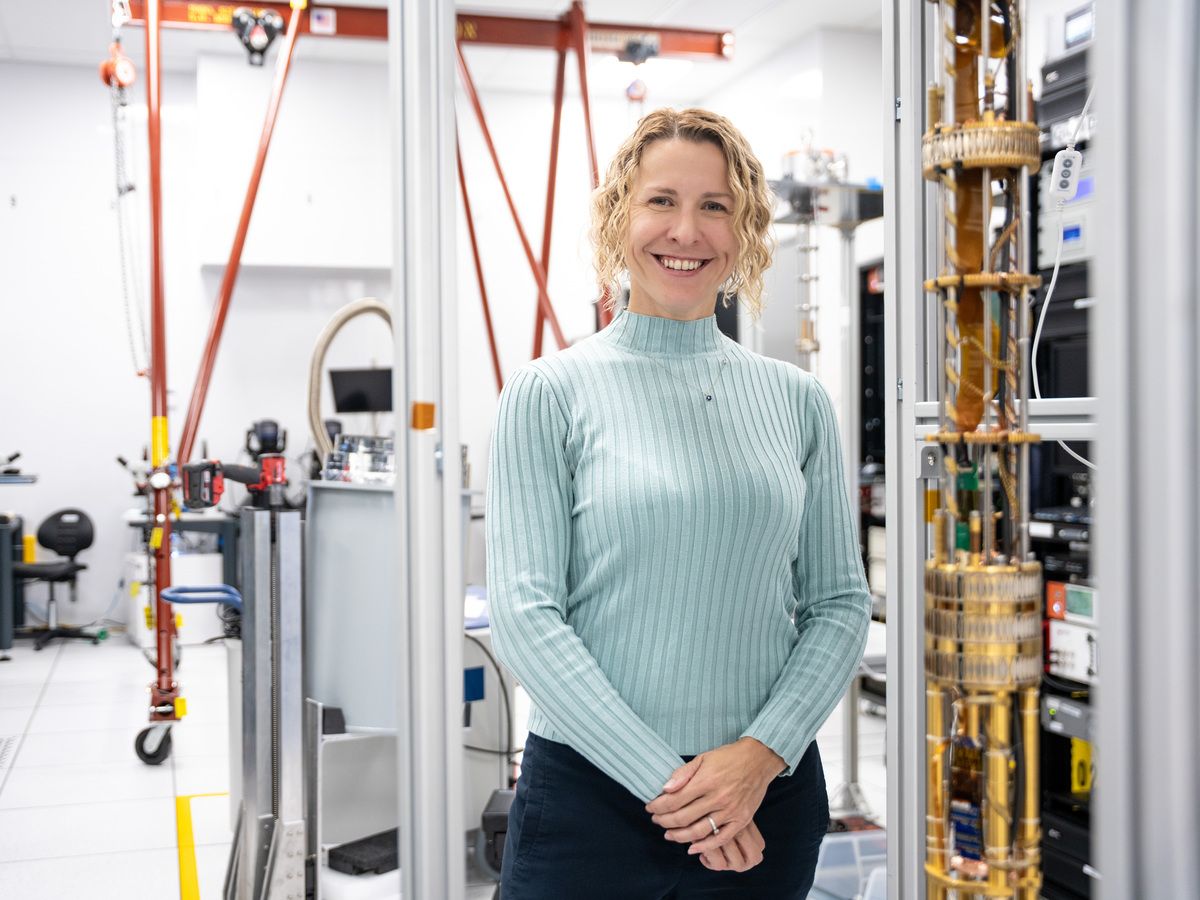
'It’s not yet clear where the quantum Silicon Valley is going to be. It could very well be in Canada'
Coquitlam, B.C.-based quantum computing startup Photonic Inc. has convinced some of Canada’s biggest institutional investors to fork over their cash, but it still needs to prove it can scale its technology in a way that’s useful for businesses and convince companies and governments to pay for its services. More than half of the investors in its US$200-million-plus Series E round that closed in May were Canadian, valuing the company at US$2 billion, which makes it one of the country’s most valuable startups. But Photonic is competing with homegrown rivals alongside global companies to build a large-scale quantum computer that can solve complex problems for industry beyond the scope of traditional computers.
Founder and chief quantum officer Stephanie Simmons said Photonic’s approach, which uses particles of light and quantum physics to network quantum computers together, translates into systems that are cheaper, faster and can scale up easier. (Changed to network to avoid repetition; we use link again below) “We have the ability to take multiple computers, link them together and harness their power.
That is the hardest thing in quantum,” she said. “It’s only been done by a handful of teams around the world and we’re the only commercial organization to have done it.” Photonic plans to use its new funds to hit key milestones, deepen commercial partnerships and grow its team to 200-plus employees from 170 by hiring engineers and other operations staff from within Canada and around the world, chief executive Don Mattrick said.
He said the company has already achieved certain technical milestones and is working on tweaking its systems to become more efficient, user-friendly and applicable for a range of industries and organizations. A key element of Photonic’s strategy is using Microsoft Corp.’s cloud computing platform Azure, which it said will allow it to reach more companies of different sizes that span industries from financial services to pharmaceuticals, cybersecurity, artificial intelligence and defence. “Instead of (companies) having to buy a single quantum computer, they’ll be able to access our quantum computer as a service, Mattrick said.
“I really think about it as a Fortune 1000-plus opportunity, where people around the world will think about their business needs to innovate.” Despite having a business model that relies on a U.S. company and the risks that came with that, he said Microsoft has the ability to work around government needs if, say, Canada ever opts for a digital sovereignty model that requires a Canadian-only cloud. Photonic is also angling for allied governments, particularly the Five Eyes countries, to become anchor customers.
Simmons said government agencies are showing a growing interest and appetite in its tech and that its participation in United States- and Canadian-sponsored quantum computing programs are pathways to potentially scoring procurement contracts. It also opened a $47-million R&D centre in the United Kingdom last year, and Simmons said it is looking into the U.K.’s recently launched procurement program. The company has not publicly disclosed its revenue, but Mattrick said they have reached at least several million dollars.
Many of Photonic’s quantum computing startup peers have gone public in recent months, including Toronto’s Xanadu Quantum Technologies Inc., Finland’s IQM Quantum Computing Oyj and the U.S.’s IonQ Inc. Mattrick declined to discuss its future fundraising plans, but said the company is continuing to evaluate options that could include pathways to go public. Like other Canada-based startup founders, Simmons said it likely would have been easier to build a company in the U.S., but it chose Canada, which offers an abundance of quantum talent and the Canadian brand, a particularly important benefit given quantum’s implications for cybersecurity and cryptography.
Simmons added that Canada has the chance to become the world’s epicentre of quantum computing. “It’s not yet clear where the quantum Silicon Valley is going to be. It could very well be in Canada.”
- Published
- Jul 16, 2026
- Updated
- Jul 16, 2026
- Source
- Financial Post
- Category
- Technology
- Read time
- 3 min
Key facts
Why this matters locally
This technology story matters locally because it may affect readers, businesses, commuters, families, or public services in British Columbia.
Local impact
BC Post links this item to British Columbia coverage so readers can follow related city updates, weather, traffic, events, and category news in one place.
Timeline
Source and credit
BC Post may summarize, organize, and add local context for reader clarity. Original reporting remains with the listed publisher.
Related Articles
View all Technology
Transformer-manufacturing company to shut down its Chilliwack facility
Technology
Transformer-manufacturing company to shut down its Chilliwack facility
 Technology
Asus ROG Strix XG32UQWMS review
Technology
Asus ROG Strix XG32UQWMS review
 Technology
ECT Reprograms Adult Neurons into a Youthful State
Technology
ECT Reprograms Adult Neurons into a Youthful State
 Technology
The Canadian Companies Building AI Infrastructure and Why They Matter
Technology
The Canadian Companies Building AI Infrastructure and Why They Matter
 Technology
Apple’s Lawsuit Could Choke OpenAI’s iPhone Rival Before It Even Ships
Technology
Apple’s Lawsuit Could Choke OpenAI’s iPhone Rival Before It Even Ships
 Technology
Spectro Cloud Raises $100 Million Series D to Help Customers Move AI Infrastructure Into Production Across Enterprise, Public Sector, Neocloud and Sovereign Cloud Environments
Technology
Spectro Cloud Raises $100 Million Series D to Help Customers Move AI Infrastructure Into Production Across Enterprise, Public Sector, Neocloud and Sovereign Cloud Environments
More Local Coverage
Latest news Business
AI Market Trends: Q2 2026 Review and Forecast
Business
AI Market Trends: Q2 2026 Review and Forecast
 Politics
Powerful pro-life ad featuring boxing legend to air during final World Cup matches
Politics
Powerful pro-life ad featuring boxing legend to air during final World Cup matches
 Top
‘Entire city’ asked to help search for missing 11-year-old Parker: Calgary police
Top
‘Entire city’ asked to help search for missing 11-year-old Parker: Calgary police