

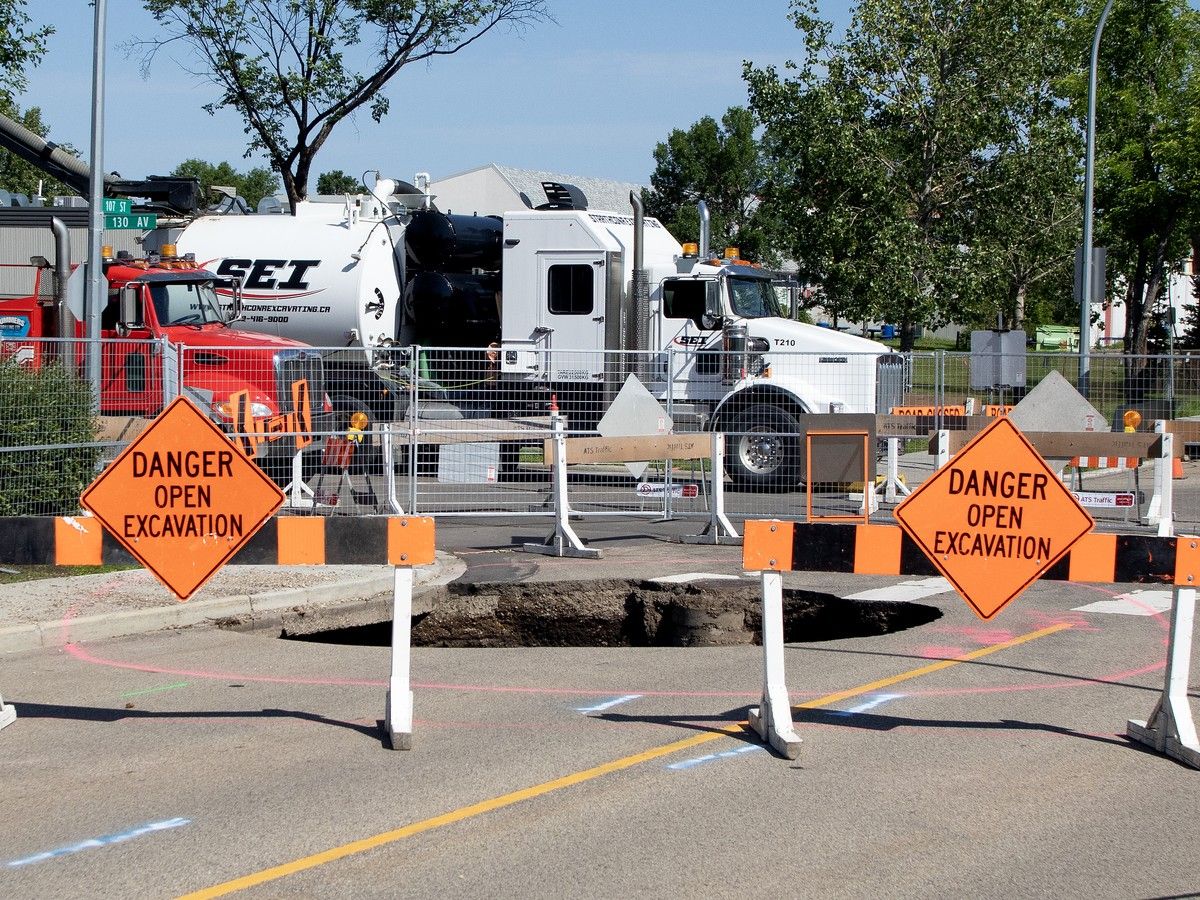
As large sinkhole appears in Edmonton, we ask: What are the risks because of the heavy rains?
The Lauderdale sinkhole is growing. The hole, which was barricaded by Epcor workers Saturday, is estimated to be more than nine meters deep. It’s located in the Lauderdale neighbourhood, close to 130 Avenue and 107 Street.
“While the portion of affected roadway has grown in size, we’ve continued to monitor the location as we advanced a repair strategy,” said Epcor spokesperson Laura Ehrkamp. Repairs will begin this week. Work will begin on a large pipe that transports flow to the Gold Bar Wastewater Treatment Plant.
First step is to reroute these flows so service remains reliable for customers, and allows workers to be safe as they work below ground to make repairs. “While the timeline is not yet known, we will continue updating the community and appreciate their ongoing support,” said Ehrkamp. “We do not yet have a specific cause, but know it’s often a combination of factors such as soil erosion and ground saturation can contribute to subsidences.
Given the rainfall across the region this past month, weather likely played a role in this issue.” But how big of a role? Alireza Bayat, the Senior Engineering Research Chair at the University of Alberta, said that if we think Edmonton is going to be like Florida when it comes to the formation of massive sinkholes, we should give our heads a shake.
He said Edmonton doesn’t have the “dissolving soil” that is seen in Florida. “We don’t have that kind of soil,” said Bayat. “It’s always it’s about the pipe, and there is a pipe, defective pipe.
That’s where the problem starts.” He said that the heavy rains Edmonton has received in the late spring and the early days of summer would play a role, but they’re the final drops. They weren’t the catalyst.
He said sinkholes in Edmonton are almost always caused by faulty pipes under the ground. The water starts to leak from the pipe, and it starts to erode the soil near it. “It always starts with a defective sewer pipe,” said Bayat.
“So essentially, based on what I’m seeing, there is a sewer pipe underneath that location, and normally these pipes basically have a crack or a failed joint. And, through that defect, water starts slowly washing the surrounding soil into the pipe. And then soil is eroding around the pipe, and it starts to create an empty space.
“So it’s not just it happened that day due to storm. It is a defective pipe. It is eroding soil, and then the storm is just the last straw.
So the ground was already undermined. The heavy rain and rushing water were the final push. The rain didn’t dig the soil; it just finished it off.”
While the appearances of sinkholes aren’t everyday occurrences in Edmonton, they’re also not unheard of. In 2018, a five-storey-deep sinkhole was discovered under Allendale Road. In October of 2020, a 23-metre-deep sinkhole was discovered near 61 Avenue and 109 Street.
You can also support our journalism by becoming a digital subscriber. Subscribers gain unlimited access to The Edmonton Journal, Edmonton Sun, National Post, and 13 other Canadian news sites. The Edmonton
Source and reference
Journal | The Edmonton Sun
Read original source- Published
- Jul 14, 2026
- Updated
- Jul 14, 2026
- Source
- Edmonton Journal
- Category
- Environment
- Read time
- 2 min
Key facts
Why this matters locally
This environment story matters locally because it may affect readers, businesses, commuters, families, or public services in British Columbia.
Local impact
BC Post links this item to British Columbia coverage so readers can follow related city updates, weather, traffic, events, and category news in one place.
Timeline
Source and credit
BC Post may summarize, organize, and add local context for reader clarity. Original reporting remains with the listed publisher.
Related Articles
View all Environment
50-hectare wildfire burns between Clearwater and 100 Mile House
Environment
50-hectare wildfire burns between Clearwater and 100 Mile House
 Environment
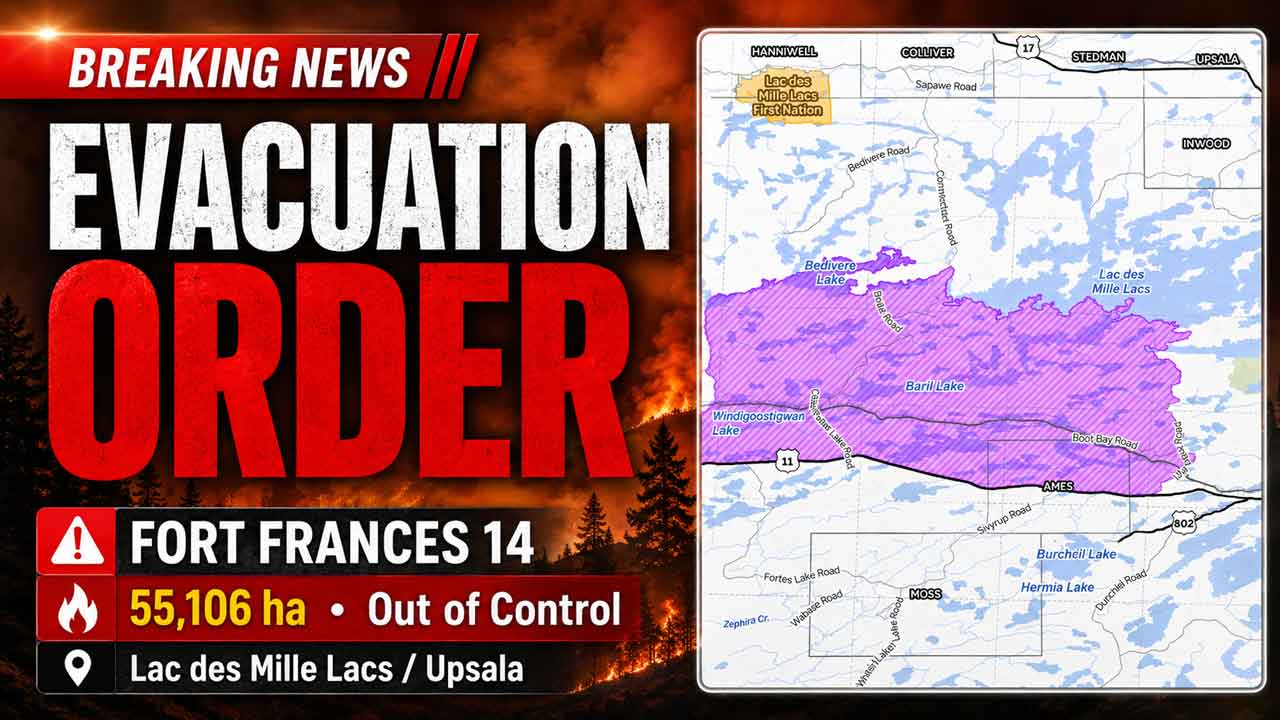
Updated Evacuation Information for Wildfire Fort Frances 14 (July 17 2026)
Environment
Updated Evacuation Information for Wildfire Fort Frances 14 (July 17 2026)
 Environment
A powerful movement of healing arrives at Delta’s Discovery Centre
Environment
A powerful movement of healing arrives at Delta’s Discovery Centre
 Environment
EU Excludes Soybean Seed from Deforestation Rules
Environment
EU Excludes Soybean Seed from Deforestation Rules
 Environment
Metro Vancouver issues air quality warning as wildfire smoke drifts in
Environment
Metro Vancouver issues air quality warning as wildfire smoke drifts in
 Environment
Vancouver forecast in 'sweet spot' but hot temperatures on the way
Environment
Vancouver forecast in 'sweet spot' but hot temperatures on the way
More Local Coverage
Latest news Business
AI Market Trends: Q2 2026 Review and Forecast
Business
AI Market Trends: Q2 2026 Review and Forecast
 Politics
Powerful pro-life ad featuring boxing legend to air during final World Cup matches
Politics
Powerful pro-life ad featuring boxing legend to air during final World Cup matches