

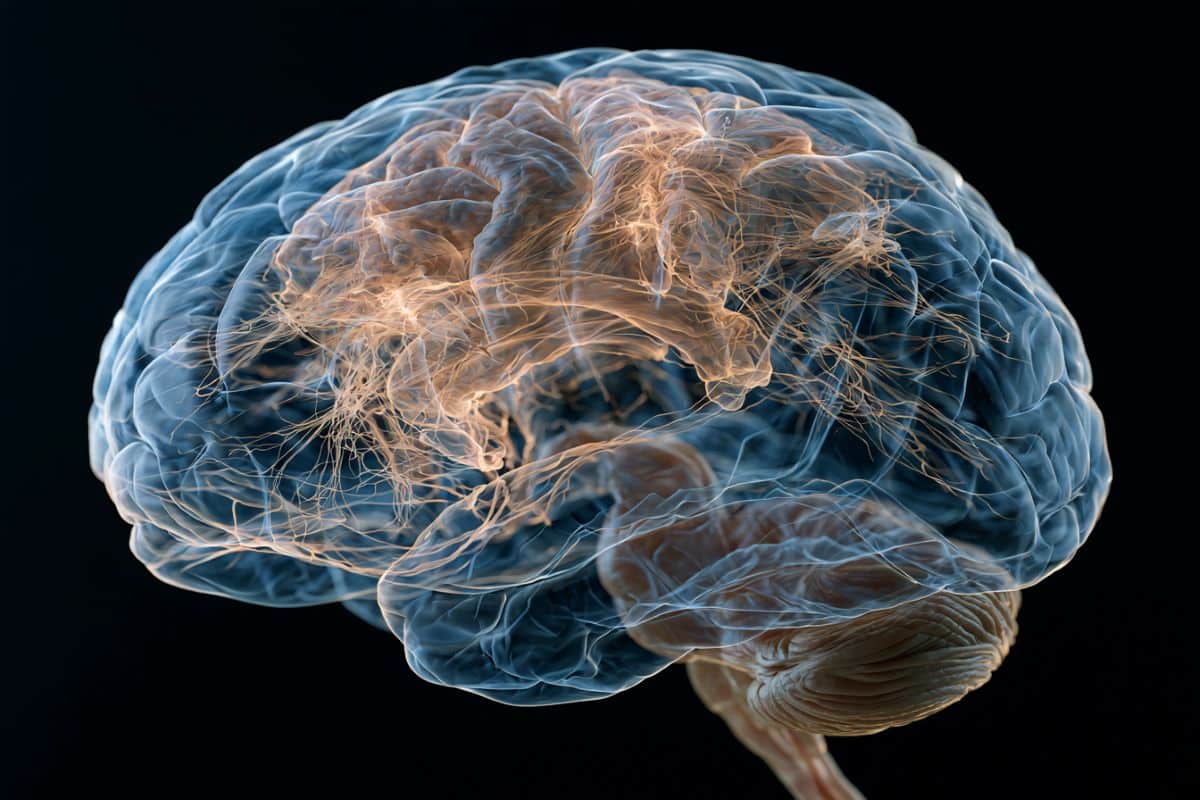
Cognitive and behavioral symptoms in Progressive Supranuclear Palsy (PSP) are driven by the remote circuit disruption of a shared frontoparietal architecture called the "PSP-tau network."
Summary: Utilizing an advanced, home-grown PET radiotracer, the team mapped tau deposits in 37 PSP patients and combined this structural data with functional connectivity coordinates from 100 healthy control brains. The empirical data unmasked a shared, remote network architecture dubbed the “PSP-tau network.” The study confirms that deep, local tau clusters impair high-level cognition by sending disruptive, echo-like signals along healthy neural pathways to disable distant, clear areas of the cerebral cortex.
Key Facts The Remote Network Hypothesis Validated: The study demonstrates that the clinical symptoms of neurodegenerative disease are not solely dictated by where a toxic protein aggregates locally. Instead, localized protein buildup can travel through, or electronically disrupt, distant cortical regions along established neural highways. The “PSP-Tau Network” Discovered: While the precise, local footprint of tau buildup varied from patient to patient, connectomic tracking unmasked that all affected subcortical zones were functionally hardwired to a shared set of distant cortical structures.
This common, vulnerable circuit comprises the prefrontal cortex, anterior cingulate cortex, anterior insula, and parietal cortex—the precise control hubs that govern executive function, attention, working memory, and behavioral inhibition. The Mechanistic Decoupling of Symptoms: The QST data revealed a clear division in how symptoms develop: Motor Deficits (Local): The raw volume of tau pooled locally within deep subcortical movement centers (like the midbrain, caudate, and putamen) accurately predicted eye movement paralysis and physical stiffness, but showed no link to mental decline. Cognitive Deficits (Remote): The statistical strength of the connection between those deep tau deposits and the distant PSP-tau network directly predicted the severity of a patient’s frontal cognitive impairment.
Solving Clinical Heterogeneity: This circuit-based model elegantly explains a long-standing mystery in neurology: why patients with highly diverse or asymmetrical patterns of visible brain pathology often manifest identical clinical symptoms. They develop identical deficits because their unique localized lesions happen to intercept the same shared network. Extending to Alzheimer’s and Frontotemporal Dementias: Dr. Toshiyuki Hirabayashi notes that this structural shift carries massive, sweeping implications for broader dementia research.
Because tau accumulation is a core feature of Alzheimer’s disease and frontotemporal lobar degeneration, deploying functional connectome mapping will allow scientists to map symptom-specific circuits across multiple distinct neurodegenerative conditions. A New Horizon for Precision Therapeutics: Shifting neuroscience away from evaluating “isolated spots of damage” paves the way for advanced network-based precision medicine. Future clinical interventions can focus on protecting circuit integrity, predicting precise symptom timelines before they physically manifest, and tailoring personalized neuromodulation therapies.
Source and reference
Source: QST Researchers at Japan’s National Institutes for Quantum Science and Technology (QST) have found that tau buildup in progressive supranuclear palsy (PSP) may affect brain networks involved in thinking and behaviour. The findings suggest that symptoms may arise not only from where tau builds up in the brain, but also from how those affected areas are connected to distant brain regions. The study was published online on July 10, 2026, in Science Advances. PSP is a rare neurodegenerative disease caused by the abnormal accumulation of tau, a protein associated with several forms of dementia. The disease often leads to falls, problems with eye movement, stiffness, and cognitive or behavioral symptoms such as reduced attention and difficulty controlling emotions. A long-standing question in PSP is why patients develop cognitive symptoms even when tau is concentrated mainly in...
Read original source- Published
- Jul 17, 2026
- Updated
- Jul 17, 2026
- Source
- Neuroscience News
- Category
- Technology
- Read time
- 8 min
Key facts
Why this matters locally
This technology story matters locally because it may affect readers, businesses, commuters, families, or public services in British Columbia.
Local impact
BC Post links this item to British Columbia coverage so readers can follow related city updates, weather, traffic, events, and category news in one place.
Timeline
Source and credit
BC Post may summarize, organize, and add local context for reader clarity. Original reporting remains with the listed publisher.
Related Articles
View all Technology
Transformer-manufacturing company to shut down its Chilliwack facility
Technology
Transformer-manufacturing company to shut down its Chilliwack facility
 Technology
Quebec announces plan to train more aerospace workers as demand surges
Technology
Quebec announces plan to train more aerospace workers as demand surges
 Technology
Apple’s Lawsuit Could Choke OpenAI’s iPhone Rival Before It Even Ships
Technology
Apple’s Lawsuit Could Choke OpenAI’s iPhone Rival Before It Even Ships
 Technology
Texting a stranger works better to fight loneliness than talking to an AI chatbot
Technology
Texting a stranger works better to fight loneliness than talking to an AI chatbot
 Technology
GO train users could face delays, cancellations due to ‘crew constraints’: Metrolinx
Technology
GO train users could face delays, cancellations due to ‘crew constraints’: Metrolinx
More Local Coverage
Latest news Politics
Powerful pro-life ad featuring boxing legend to air during final World Cup matches
Politics
Powerful pro-life ad featuring boxing legend to air during final World Cup matches
 Business
AI Market Trends: Q2 2026 Review and Forecast
Business
AI Market Trends: Q2 2026 Review and Forecast