

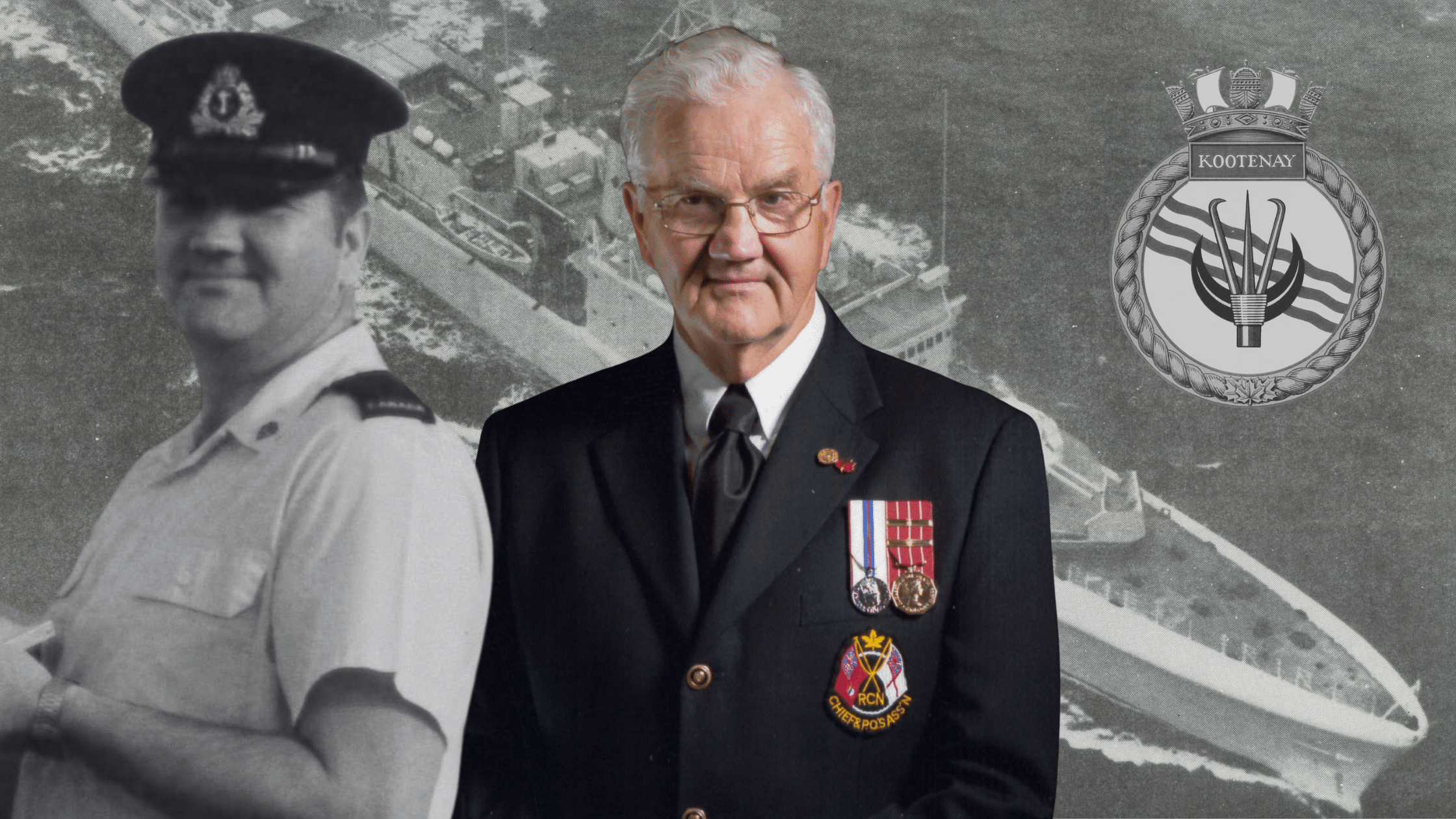
Archana Cini, Lookout Newspaper. “There’s a lot of pride in doing your job properly. That was always the standard.” – William (Bill) McIntyre At 82 years old, William (Bill) McIntyre The post The Life of Royal Canadian Navy Veteran William (Bill) McIntyre appeared first on Pacific Navy News .
Archana Cini, Lookout Newspaper. “There’s a lot of pride in doing your job properly. That was always the standard.”
– William (Bill) McIntyre At 82 years old, William (Bill) McIntyre speaks about the Royal Canadian Navy (RCN) with a clarity that suggests the sea never fully left him. Now attending the Veterans Health Centre day program at the Veterans Memorial Lodge, a Broadmead Care Home, McIntyre carries with him 32 years of service and an RCN career full of purpose.
Bill grew up on a farm in Prince Edward Island (P.E.I.) as one of seven siblings in a rural household. Life there was shaped by early mornings, physical work, and the rhythm of a large, busy family. His father both farmed and fished, as did his brothers, but Bill was looking for something different.
That difference came early, in July 1965, when he enlisted in the RCN at 19 years old. “I didn’t like farming very much,” said Bill plainly. “The navy was a good way of making a living, and I liked the work.”
What began as a decision to leave farm life behind as a young adult then slowly became a career that would span more than three decades. Almost immediately, Bill entered an apprenticeship program in marine engineering, a structured but demanding path that would define the rest of his working life. “It wasn’t just a short course,” he recalled.
“You went to school for years — machine shop, steam equipment, diesels — all of it.” From auxiliary machinery and boiler room certification to engine room qualifications and eventually charge tickets, Bill worked his way through each stage without pause. By the time he completed his training, which took him through both land and sea, he had built a technical foundation that made him a vital part of every vessel he served on.
In 1965, Bill found himself aboard, at the time, His Majesty’s Canadian Ship (HMCS) Saskatchewan on the East Coast training route. Not long after, he was posted to Canadian Forces Base (CFB) Halifax, beginning a long stretch of service that would include both East and West Coast assignments and eventually a posting in Ottawa. Like many in the engineering trades, Bill moved frequently, adapting to new crews, ships, and demands.
“I went wherever I was posted,” he said. “That’s just how it was.” His career included time aboard several minesweepers, destroyers, and support vessels, including His Majesty’s Canadian (HMC) Ships Kootenay and Provider.
To Bill, one of his most memorable postings was aboard a minesweeper he served aboard for a year and a half. “It was really busy,” said Bill. “A lot of work, a lot of responsibility.
But I liked it.” Life at sea was defined by routine and readiness with engine checks, maintenance cycles, and the constant expectation that something might need fixing at any moment. On smaller vessels especially, the workload was intense.
“You’re looking after everything, and there’s not many of you doing it,” shared Bill. During one of his postings in the North Sea, Bill recalls a significant gearbox failure while the vessel was alongside in Plymouth with a breakdown serious enough to take the ship out of regular operations for nearly a month. The crew was reorganized into shifts as engineers and technicians worked continuously to diagnose and repair the system, rotating through demanding schedules that kept the ship in a constant state of partial readiness.
What stood out to Bill wasn’t just the scale of the repair, but the persistence it required: long days in the engine spaces and problem-solving under pressure for over three weeks. “You just worked through it,” he said, reflecting on the period. “Different shifts, different hours...
you did what had to be done until it was fixed.” The experience, like many at sea, underscored the unpredictability of naval engineering work, where a single mechanical failure could ripple through an entire crew’s routine and demand huge collective effort to bring a ship back to operability. Beyond Canada’s coasts, Bill’s service took him through much of the globe.
He travelled to Europe, Australia, New Zealand, and the Caribbean, sometimes on naval duty, sometimes through later travel. “I’ve been lucky that way,” he said. “Seen a lot of the world.”
After 32 years in uniform, Bill retired in 1995, leaving behind a career that had shaped most of his adult life. Looking back, he doesn’t dwell on rank or accolades, but on the work itself. “I liked what I did,” he said simply.
“That’s very important.” When asked what makes a good sailor, Bill’s answer was immediate: “You’ve got to do your job. That’s it.
The ship depends on it!” Today, Bill reflects on a life spent largely at sea with a sense of quiet satisfaction. While ships may have changed and systems may have modernized, the core of his service remains the same: showing up, doing the work, and keeping things running when it mattered most.
This story is brought to you in partnership with Broadmead Care, a registered charity and non-profit care provider supporting veterans through long term care and programs that honour their life history, support their abilities, and maintain their dignity. To learn more, call 250-658-0311 or visit broadmeadcare.com The post The Life of Royal Canadian Navy Veteran William (Bill) McIntyre appeared first on Pacific Navy News .
- Published
- Jul 13, 2026
- Updated
- Jul 13, 2026
- Source
- Pacific Navy News
- Category
- Lifestyle
- Read time
- 4 min
Key facts
Why this matters locally
This lifestyle story matters locally because it may affect readers, businesses, commuters, families, or public services in British Columbia.
Local impact
BC Post links this item to British Columbia coverage so readers can follow related city updates, weather, traffic, events, and category news in one place.
Timeline
Source and credit
BC Post may summarize, organize, and add local context for reader clarity. Original reporting remains with the listed publisher.
Related Articles
View all Lifestyle
Teen hit in crosswalk faces long recovery
Lifestyle
Teen hit in crosswalk faces long recovery
 Lifestyle
PHOTOS: Cyclists in Chilliwack ride in rain to raise funds for multiple sclerosis
Lifestyle
PHOTOS: Cyclists in Chilliwack ride in rain to raise funds for multiple sclerosis
 Lifestyle
Feds provide $345,000 to expand accessible housing at Community Living Huntsville’s Floral Villa
Lifestyle
Feds provide $345,000 to expand accessible housing at Community Living Huntsville’s Floral Villa
 Lifestyle
From overlooked recruit to featured player: Yorkville Christian grad David Douglas Jr. comes home to NIU
Lifestyle
From overlooked recruit to featured player: Yorkville Christian grad David Douglas Jr. comes home to NIU
 Lifestyle
City of Lethbridge formally agrees to contribute funding for future 32-bed recovery facility
Lifestyle
City of Lethbridge formally agrees to contribute funding for future 32-bed recovery facility
 Lifestyle
Former Nova Scotia premier John Hamm dies at 88
Lifestyle
Former Nova Scotia premier John Hamm dies at 88
More Local Coverage
Latest news Politics
Powerful pro-life ad featuring boxing legend to air during final World Cup matches
Politics
Powerful pro-life ad featuring boxing legend to air during final World Cup matches
 Business
AI Market Trends: Q2 2026 Review and Forecast
Business
AI Market Trends: Q2 2026 Review and Forecast