

"Missiles are being launched at the joint force every single day in [Operation] Epic Fury."
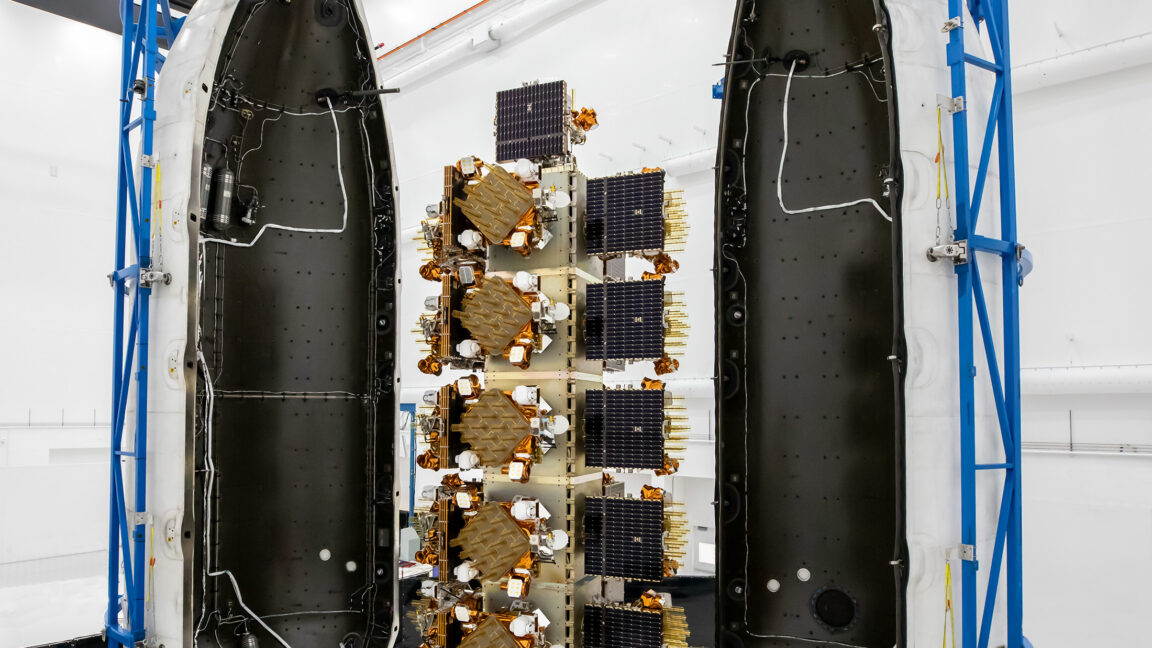
The Space Development Agency was established in 2019 to help speed up the deployment of US military space systems by sidestepping the Pentagon’s traditional sluggish bureaucracy. Seven years later, SDA is finally launching its first batches of operational satellites, just as the Pentagon plans to shutter the semi-autonomous agency and fold it back into the Space Force’s procurement pipeline, newly reorganized under several program acquisition executives in a bid to streamline weapons buying. SDA’s fate is not a surprise, and lawmakers in both houses of Congress have backed the agency’s closure in drafts of this year’s National Defense Authorization Act.
The Space Development Agency’s primary mission has been to develop a constellation of several hundred missile warning and data relay satellites in low-Earth orbit designed to detect, track, and target ballistic and hypersonic missiles. The military calls the constellation the Proliferated Warfighter Space Architecture (PWSA). The Pentagon currently has a small fleet of legacy missile warning satellites in much higher geosynchronous orbits.
These satellites are expensive and vulnerable to attack, and their distance from Earth makes them less sensitive to smaller, dimmer missiles. The idea was to rapidly procure, develop, and field new generations, or tranches, of tracking and data “transport” satellites every two years. SDA’s strategy was to cast a wide net across the US space industry, using satellites and sensors developed by many companies.
Launches of SDA’s new satellites were supposed to occur at a cadence of about once per month. Rough waters Much of SDA’s mission will continue under a different banner within the US Space Force. The missile-warning and data-relay satellites will eventually be part of the Pentagon’s planned Golden Dome missile shield, one of the Trump administration’s top priorities for the Space Force.
- Published
- Jul 17, 2026
- Updated
- Jul 17, 2026
- Source
- Ars Technica
- Category
- Technology
- Read time
- 1 min
Key facts
Why this matters locally
This technology story matters locally because it may affect readers, businesses, commuters, families, or public services in British Columbia.
Local impact
BC Post links this item to British Columbia coverage so readers can follow related city updates, weather, traffic, events, and category news in one place.
Timeline
Source and credit
BC Post may summarize, organize, and add local context for reader clarity. Original reporting remains with the listed publisher.
Related Articles
View all Technology
Transformer-manufacturing company to shut down its Chilliwack facility
Technology
Transformer-manufacturing company to shut down its Chilliwack facility
 Technology
Quebec announces plan to train more aerospace workers as demand surges
Technology
Quebec announces plan to train more aerospace workers as demand surges
 Technology
Apple’s Lawsuit Could Choke OpenAI’s iPhone Rival Before It Even Ships
Technology
Apple’s Lawsuit Could Choke OpenAI’s iPhone Rival Before It Even Ships
 Technology
Texting a stranger works better to fight loneliness than talking to an AI chatbot
Technology
Texting a stranger works better to fight loneliness than talking to an AI chatbot
 Technology
GO train users could face delays, cancellations due to ‘crew constraints’: Metrolinx
Technology
GO train users could face delays, cancellations due to ‘crew constraints’: Metrolinx
More Local Coverage
Latest news Politics
Powerful pro-life ad featuring boxing legend to air during final World Cup matches
Politics
Powerful pro-life ad featuring boxing legend to air during final World Cup matches
 Business
AI Market Trends: Q2 2026 Review and Forecast
Business
AI Market Trends: Q2 2026 Review and Forecast