

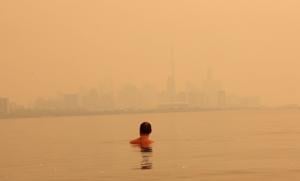
The city had the worst air quality in the world on Wednesday, prompting health warnings and event cancellations. About 200 wildfires are burning in northwestern Ontario where First Nations communities have been ordered evacuated as smoke plumes stretch south across...
Toronto was blanketed under an eerie orange sky Wednesday as a thick, choking cover of smoke from hundreds of wildfires in northern Ontario pushed the city’s air quality to worst in the world, prompting health warnings and event cancellations. Air quality warnings from Environment Canada stretched from Thunder Bay east to Kingston and south to London. Evacuation orders have been issued for several First Nations communities in northwestern Ontario.
Prime Minister Mark Carney said in a social media post Wednesday night that his government was “in close contact with provincial, municipal and Indigenous partners and stands ready to provide any additional support as needed.” “Thousands of people have been forced to evacuate their communities, not knowing if their homes will survive,” Carney said, thanking firefighters, first responders and local leaders for their work. A video posted online showed orange flames engulfing a stalled CN train near Armstrong, about 250 kilometres north of Thunder Bay, with crew members trapped inside before they were evacuated.
Smoke plumes stretched south across the U.S.-Canada border, prompting health warnings in New York state and through the U.S. Northeast and Midwest. Mayor Zohran Mamdani told residents of New York City that “air quality has reached unhealthy levels in parts of NYC due to smoke from Canadian wildfires,” in a social media post as the city overtook Toronto for the world’s worst air quality Wednesday night. Thousands of visitors were told to evacuate a remote Minnesota wilderness area accessible only by boat due to wildfires burning in the state.
Minnesota Gov. Tim Waltz thanked Premier Doug Ford and “our Canadian allies” after two groups of American YMCA campers were rescued from the fires near the U.S. Canada border. Ford replied, “That’s what neighbours are for.” In Toronto, outdoor events were cancelled, including World Cup watch parties for Argentina’s 2-1 semifinal match win over England at FIFA Fan Festival, Nathan Phillips Square and the University of Toronto.
The city closed its outdoor pools and children’s wading pools. “Is this the apocalypse now? What’s going on here?” said Pat Kehs, a tourist in Toronto from Washington, D.C., as he awoke Wednesday and looked out of his hotel window.
“This morning it was like a war zone,” he said, adding he was surprised to see conditions change so fast after enjoying sunny, blue skies for the past few days. “In a clear atmosphere, shorter wavelengths like blue light gets scattered in all directions, making the sky look blue,” she explained in a social media video. But during wildfires, when larger particles like pollution, smoke and ash enter the air, the shorter colour wavelengths are filtered out, and colours like red and orange come through.
“When wildfire smoke is present, the filtering is even stronger, and you can get a deep red or even a blood orange sky,” Singh said. “If the smoke is especially thick, the sun can be appeared dimmed or even blotted out.” By Wednesday evening, Toronto had dropped from first to fifth most polluted major city in the world, according to IQAir.
But Environment Canada warned that air quality would continue to pose a high risk before potentially improving by Friday morning. The weather agency’s heat warning for Toronto ended Wednesday evening as the temperature downtown dropped to 24.8 C. The city saw a new heat record set Tuesday when temperatures hit a sweltering 37.3 C, beating the single-day July 14 record of 36.8 C in 1995.
Toronto’s all-time temperature record of 40.6 C was set over a multiple-day heat wave in July 1936. Temperatures are forecast to slowly continue dropping, with 29 C expected on Thursday, 28 C on Friday, and a chance of rain with 28 C on Saturday. Around 200 wildfires are burning in northwestern Ontario, according to the latest information from the provincial government, prompting the evacuation of communities across the region, including Armstrong, Lac La Croix First Nation, Collins First Nation, Whitesand First Nation, Gull Bay First Nation and Lac des
Mille Lacs First Nation. In the online video showing the stalled CN train surrounded by flames near Armstrong, someone can be heard saying the fire could overtake them. “OK, y’all need to hurry up here, like seriously, we’re encased in flame now.”
CN Rail’s media adviser Michelle Hannan verified the video in a statement to the Star and said the crew was safely evacuated from the area. High-risk days like Wednesday are anomalies in Canada, but there is evidence that they are becoming more common, said Rebecca Saari, Canada Research Chair in global change, atmosphere and health, and associate professor at the University of Waterloo. “We expect them to become less rare,” she said.
“A lot of that is just climate change.” Saari said climate change increases the likelihood of wildfires as higher temperatures lead to hotter, drier conditions. Whether these kinds of events become a new normal in the summer “depends on whether we reduce emissions that cause air pollution and that cause climate change,” she said.
“If we do meet our climate goals, then we can expect to avoid a lot of these risks.” While there are acute, short-term effects associated with wildfires, there is a “bigger public health concern” of prolonged or repeated exposures to poor air quality, Saari said. Air pollution is already associated with 17,000 premature deaths every year and more than $140 billion of economic damage in Canada annually — and that burden could increase if air quality worsens, she added.
How-Sen Chong, an organizer with the Toronto Environmental Alliance, said different levels of governments need to come together to fight climate change. “The unfortunate reality is that this extreme weather and wildfire smoke is not natural,” Chong said. “It is man-made.
It is a result of decades of burning natural gas, gasoline, coal, burning garbage.” “If we want to make sure that the number of extreme weather events, of heat days and wildfire events, doesn’t increase exponentially, we need to stop burning things for energy,” he said. With files from The Canadian Press and The Associated Press
- Published
- Jul 15, 2026
- Updated
- Jul 15, 2026
- Source
- The Star
- Category
- Environment
- Read time
- 5 min
Key facts
Why this matters locally
This environment story matters locally because it may affect readers, businesses, commuters, families, or public services in British Columbia.
Local impact
BC Post links this item to British Columbia coverage so readers can follow related city updates, weather, traffic, events, and category news in one place.
Timeline
Source and credit
BC Post may summarize, organize, and add local context for reader clarity. Original reporting remains with the listed publisher.
Related Articles
View all Environment
A powerful movement of healing arrives at Delta’s Discovery Centre
Environment
A powerful movement of healing arrives at Delta’s Discovery Centre
 Environment
Metro Vancouver issues air quality warning as wildfire smoke drifts in
Environment
Metro Vancouver issues air quality warning as wildfire smoke drifts in
 Environment
Vancouver forecast in 'sweet spot' but hot temperatures on the way
Environment
Vancouver forecast in 'sweet spot' but hot temperatures on the way
 Environment
Mark Carney's new climate doctrine
Environment
Mark Carney's new climate doctrine
 Environment
EU Excludes Soybean Seed from Deforestation Rules
Environment
EU Excludes Soybean Seed from Deforestation Rules
 Environment
Spanish Mountain Gold Reports 69.20 Metres of 0.74 g/t Gold and 77.85 Metres of 0.70 g/t Gold as Part of Its Feasibility Study Drill Program
Environment
Spanish Mountain Gold Reports 69.20 Metres of 0.74 g/t Gold and 77.85 Metres of 0.70 g/t Gold as Part of Its Feasibility Study Drill Program
More Local Coverage
Latest news Politics
Powerful pro-life ad featuring boxing legend to air during final World Cup matches
Politics
Powerful pro-life ad featuring boxing legend to air during final World Cup matches
 Business
AI Market Trends: Q2 2026 Review and Forecast
Business
AI Market Trends: Q2 2026 Review and Forecast