

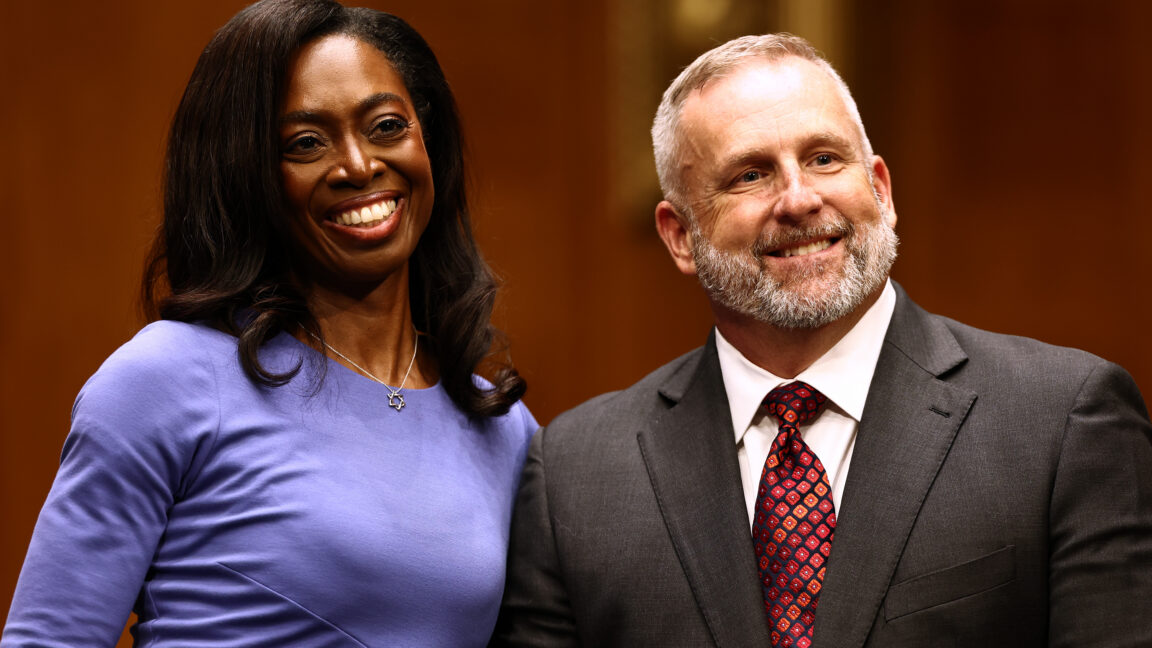
Both nominees flailed in their own unique ways as senators sought answers.
Two nominees for high-profile health roles in the Trump administration faced scrutiny from the Senate health committee Wednesday—and both crashed and burned in their own special ways. The Senate Committee on Health, Education, Labor and Pensions (HELP) scrutinized Erica Schwartz, the nominee for director of the Centers for Disease Control and Prevention, and Sean Kaufman, up for the role of Assistant Secretary for Preparedness and Response. Schwartz’s assignment Public health experts were “cautiously optimistic” about Schwartz’s nomination.
She is well respected and holds views in line with evidence-based medicine, including being supportive of vaccinations—in contrast to anti-vaccine Health Secretary Robert F. Kennedy Jr., whom she will serve under. She is also highly qualified for the role, with a medical degree, a master’s degree in public health, and a law degree. She’s had a long career as a Navy Officer, and previously held the roles of Chief Medical Officer for the US Coast Guard and deputy surgeon general in the first Trump administration.
With her credentials checking all the boxes and then some, the obvious question looming over her confirmation was whether she would stand firm against Kennedy’s well-documented anti-vaccine agenda and political interference. Kennedy notoriously fired the last highly qualified Senate-confirmed CDC director, Susan Monarez, for refusing to rubber-stamp vaccine recommendations from a CDC advisory panel he had stacked with anti-vaccine allies. Although Monarez only held the job for 29 days, lawmakers—as well as scientists, doctors, and health experts—praised her integrity and commitment to science and evidence-based policy.
Schwartz’s assignment going into the hearing was abundantly clear: assure senators she was equally principled and would stand up to Kennedy. Kaufman’s assignment Kaufman, on the other hand, went into the hearing with a less-than-rosy image that he needed to overcome. He is up for the role of leading the Administration for Strategic Preparedness and Response (ASPR), which is responsible for ensuring the US is poised to swiftly respond to the next pandemic, bioterror threat, or other emergency.
That preparedness includes having quick access to or the development of vaccines, tests, and treatments.
- Published
- Jul 16, 2026
- Updated
- Jul 16, 2026
- Source
- Ars Technica
- Category
- Technology
- Read time
- 2 min
Key facts
Why this matters locally
This technology story matters locally because it may affect readers, businesses, commuters, families, or public services in British Columbia.
Local impact
BC Post links this item to British Columbia coverage so readers can follow related city updates, weather, traffic, events, and category news in one place.
Timeline
Source and credit
BC Post may summarize, organize, and add local context for reader clarity. Original reporting remains with the listed publisher.
Related Articles
View all Technology
Transformer-manufacturing company to shut down its Chilliwack facility
Technology
Transformer-manufacturing company to shut down its Chilliwack facility
 Technology
Quebec announces plan to train more aerospace workers as demand surges
Technology
Quebec announces plan to train more aerospace workers as demand surges
 Technology
Spectro Cloud Raises $100 Million Series D to Help Customers Move AI Infrastructure Into Production Across Enterprise, Public Sector, Neocloud and Sovereign Cloud Environments
Technology
Spectro Cloud Raises $100 Million Series D to Help Customers Move AI Infrastructure Into Production Across Enterprise, Public Sector, Neocloud and Sovereign Cloud Environments
 Technology
Apple’s Lawsuit Could Choke OpenAI’s iPhone Rival Before It Even Ships
Technology
Apple’s Lawsuit Could Choke OpenAI’s iPhone Rival Before It Even Ships
 Technology
GO train users could face delays, cancellations due to ‘crew constraints’: Metrolinx
Technology
GO train users could face delays, cancellations due to ‘crew constraints’: Metrolinx
 Technology
Texting a stranger works better to fight loneliness than talking to an AI chatbot
Technology
Texting a stranger works better to fight loneliness than talking to an AI chatbot
More Local Coverage
Latest news Business
AI Market Trends: Q2 2026 Review and Forecast
Business
AI Market Trends: Q2 2026 Review and Forecast
 Politics
Powerful pro-life ad featuring boxing legend to air during final World Cup matches
Politics
Powerful pro-life ad featuring boxing legend to air during final World Cup matches