

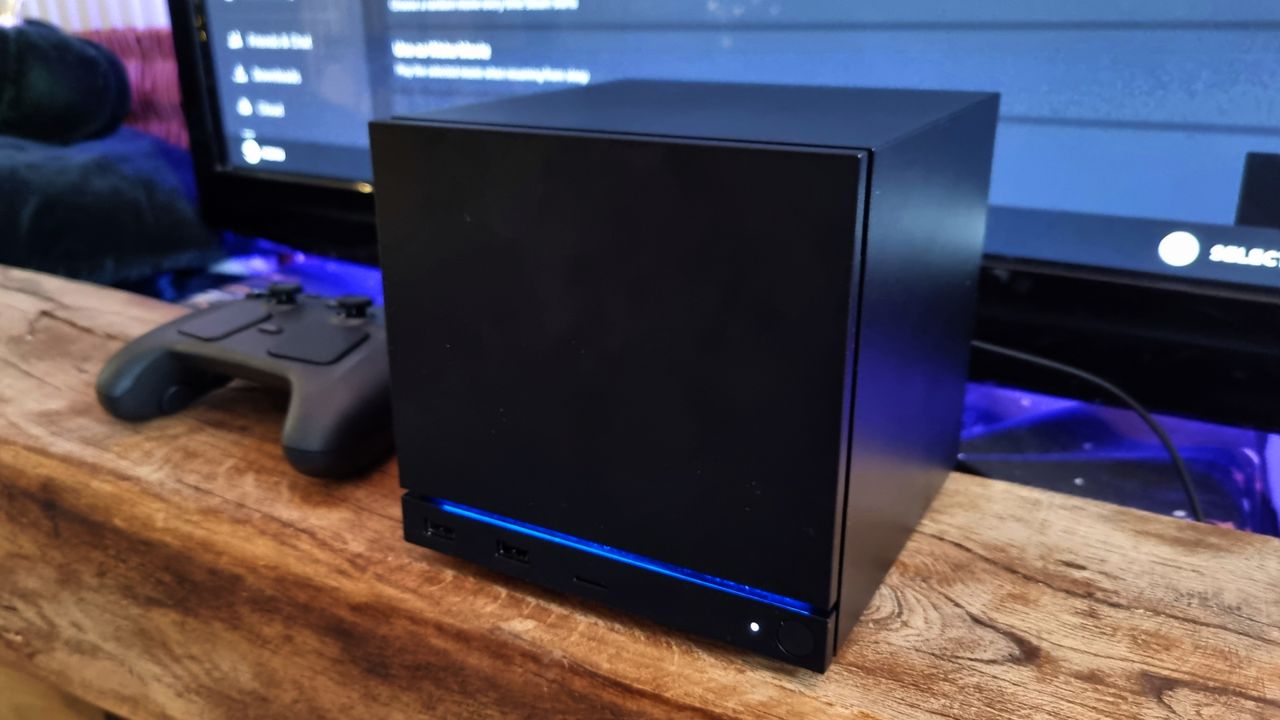
Anyone can make a better Steam machine, and that's how Valve likes it.
The living room PC is a certified thing now, and not just for those of us with extra long HDMI cables. The Steam Machine is "out" for the dozens of people who've picked up the $1,000 cube, but before that, folks were already making their own living room machines that run SteamOS. Anyone can make a Steam Machine, which is exactly how Valve likes it.
That's one reason it priced its GabeCube roughly at cost (which has skyrocketed thanks to the AI-driven memory crisis), and why it has no interest in making games exclusively for its Linux-based devices. "We want it to still be viable for other hardware manufacturers to offer things like the Steam Machine either with higher performance or a different feature set," Valve engineer Yazan Aldehayyat recently told Bloomberg's Jason Schreier in an interview. Valve is capable of selling its hardware at a loss to boost its adoption, but its goal is to grow the PC platform as a whole by maintaining an open spirit.
"We look at it from a long-term perspective,” Valve engineer Loup Griffais told Bloomberg. "Someone that is creating one of those PCs might actually create some meaningful innovation that is really important for things to come on PC that becomes so universal and brings the experience forward by that much that now the experience is better for everyone and then people might buy more games." To that end, Valve also sees no need to fight the 'exclusives' war that Sony and Microsoft have recently recommitted to.
"We're much more interested in having the whole PC catalog as our 'launch exclusive,'" Giraffes said. "Restricting where people can play a game I don't think is a great model, at least for us." Keep up to date with the most important stories and the best deals, as picked by the PC Gamer team.
I had to check to make sure, but even the Steam Deck's free pack-in game, Aperture Desk Job, doesn't require the device to play it (just a controller). While Valve's hardware is good, it's the freely available SteamOS, with its console-like interface and relative ease of use, that has truly legitimized the category. Last year, we scored a Lenovo Legion Go handheld that runs SteamOS instead of Windows higher than the Steam Deck itself—an example of Valve embracing other companies making a better Steam machine.
But it's also the savvy business call for Valve, whose marketplace dominance and sizable 30% cut from all sales on the platform (with some exceptions) means it shares in the profits no matter what. Morgan has been writing for PC Gamer since 2018, first as a freelancer and currently as a staff writer. He has also appeared on Polygon, Kotaku, Fanbyte, and PCGamesN. Before freelancing, he spent most of high school and all of college writing at small gaming sites that didn't pay him.
He's very happy to have a real job now. Morgan is a beat writer following the latest and greatest shooters and the communities that play them. He also writes general news, reviews, features, the occasional guide, and bad jokes in Slack.
Twist his arm, and he'll even write about a boring strategy game. Please don't, though. You must confirm your public display name before commenting Please logout and then login again, you will then be prompted to enter your display name.
- Published
- Jul 17, 2026
- Updated
- Jul 17, 2026
- Source
- Pc Gamer
- Category
- Technology
- Read time
- 3 min
Key facts
Why this matters locally
This technology story matters locally because it may affect readers, businesses, commuters, families, or public services in British Columbia.
Local impact
BC Post links this item to British Columbia coverage so readers can follow related city updates, weather, traffic, events, and category news in one place.
Timeline
Source and credit
BC Post may summarize, organize, and add local context for reader clarity. Original reporting remains with the listed publisher.
Related Articles
View all Technology
Transformer-manufacturing company to shut down its Chilliwack facility
Technology
Transformer-manufacturing company to shut down its Chilliwack facility
 Technology
Quebec announces plan to train more aerospace workers as demand surges
Technology
Quebec announces plan to train more aerospace workers as demand surges
 Technology
Spectro Cloud Raises $100 Million Series D to Help Customers Move AI Infrastructure Into Production Across Enterprise, Public Sector, Neocloud and Sovereign Cloud Environments
Technology
Spectro Cloud Raises $100 Million Series D to Help Customers Move AI Infrastructure Into Production Across Enterprise, Public Sector, Neocloud and Sovereign Cloud Environments
 Technology
Apple’s Lawsuit Could Choke OpenAI’s iPhone Rival Before It Even Ships
Technology
Apple’s Lawsuit Could Choke OpenAI’s iPhone Rival Before It Even Ships
 Technology
GO train users could face delays, cancellations due to ‘crew constraints’: Metrolinx
Technology
GO train users could face delays, cancellations due to ‘crew constraints’: Metrolinx
 Technology
Texting a stranger works better to fight loneliness than talking to an AI chatbot
Technology
Texting a stranger works better to fight loneliness than talking to an AI chatbot
More Local Coverage
Latest news Business
AI Market Trends: Q2 2026 Review and Forecast
Business
AI Market Trends: Q2 2026 Review and Forecast
 Politics
Powerful pro-life ad featuring boxing legend to air during final World Cup matches
Politics
Powerful pro-life ad featuring boxing legend to air during final World Cup matches