

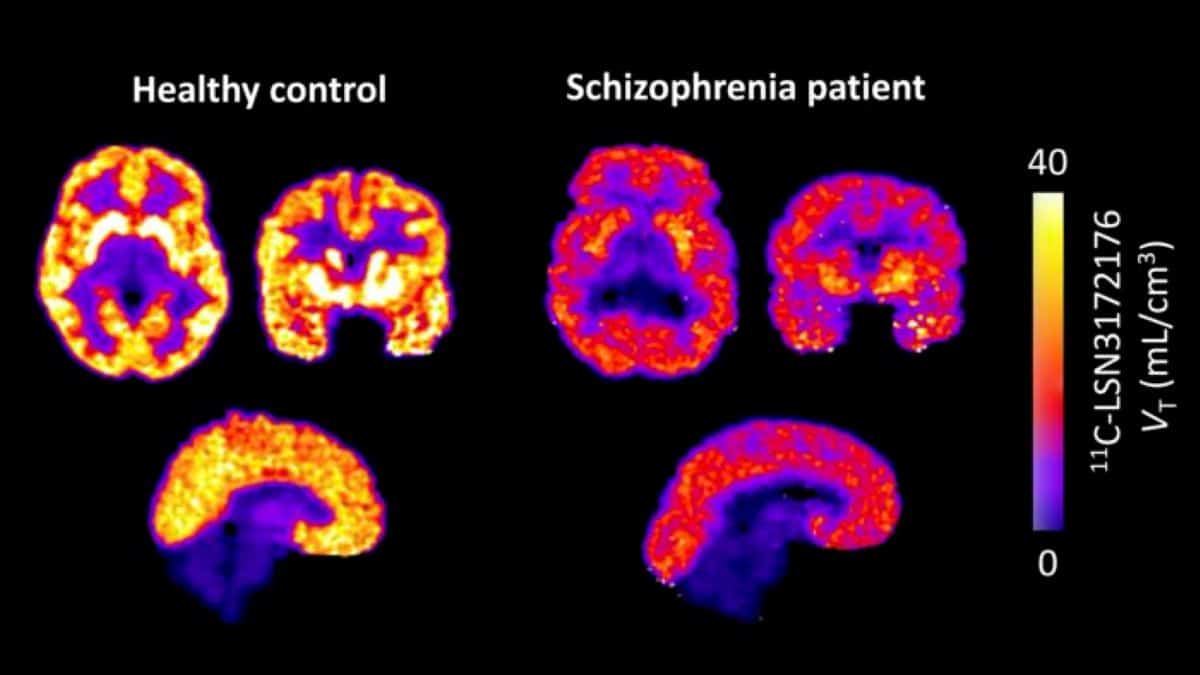
A new study utilizes a novel PET radiotracer to provide the first in vivo evidence of widespread muscarinic acetylcholine M1 receptor deficits in living schizophrenia patients.
Summary: Researchers delivered the world’s first in vivo (in a living organism) evidence of widespread muscarinic acetylcholine M1 receptor deficits in schizophrenia. Utilizing a pioneering, highly selective PET radiotracer, the researchers discovered that living schizophrenia patients exhibit a striking 13% to 19% reduction in M1 receptor availability across multiple core cognitive regions of the brain. The discovery validates a major shift toward non-dopaminergic precision treatments.
Key Facts The M1 Muscarinic Deficit Discovered: The high-resolution PET imaging revealed that patients diagnosed with schizophrenia experience a significant 13% to 19% drop in functional M1 receptor availability across widespread cortical and subcortical regions compared to completely healthy control peers. Direct Alignment with Cognitive Deficits: Crucially, the scarcity of M1 receptors was much more strongly linked to objective measures of cognitive impairment than to the severity of positive psychotic symptoms. This reveals that M1 dysfunction is a primary biological driver behind the memory, learning, and executive processing challenges that heavily disrupt daily life.
Bypassing the Postmortem Limitation: For decades, neurobiology was trapped because nearly all evidence connecting acetylcholine to schizophrenia came from postmortem tissue samples. This left it entirely unclear if the deficits were present during life or simply caused by decades of heavy medication use. This study provides the definitive in vivo baseline confirmation.
Validating Next-Gen Non-Dopaminergic Drugs: The study arrives at an extraordinary historical turning point in psychiatry. The findings provide immediate biological reinforcement for newly approved therapies like xanomeline–trospium (COBENFYTM), the first antipsychotic medication approved in over 70 years that treats schizophrenia through a non-dopaminergic, muscarinic mechanism. Strengthening Precision Psychiatry Pathways: While this trial did not actively track medication responses, Dr. Rajiv Radhakrishnan notes that M1 receptor PET scans could eventually be used as a precision diagnostic tool to identify distinct biological subgroups of patients, allowing doctors to match individuals to targeted treatments.
A New Focus on G-Protein-Coupled Receptors: The data cements M1 receptors, which are widely distributed G-protein-coupled receptors crucial for synaptic plasticity, as an essential target for modern psychiatric drug development and diagnostic focus.
Source and reference
Source: Elsevier A groundbreaking study using positron emission tomography (PET) imaging has found that patients with schizophrenia had significantly lower muscarinic acetylcholine M1 receptor availability (~13% to 19%) across multiple brain regions compared with healthy individuals. Reductions in M1 receptors affect several brain regions involved in cognition, learning, memory, and executive function. The findings in Biological Psychiatry, published by Elsevier, provide the first in vivo evidence supporting widespread M1 receptor deficits in schizophrenia. Schizophrenia is a serious mental disorder that is heterogeneous in its expression and biology. For many years, abnormalities in the brain’s muscarinic acetylcholine system, particularly the M1 receptor, have been implicated in the pathophysiology of schizophrenia. However, nearly all of the evidence came from postmortem studies...
Read original source- Published
- Jul 16, 2026
- Updated
- Jul 16, 2026
- Source
- Neuroscience News
- Category
- Technology
- Read time
- 7 min
Key facts
Why this matters locally
This technology story matters locally because it may affect readers, businesses, commuters, families, or public services in British Columbia.
Local impact
BC Post links this item to British Columbia coverage so readers can follow related city updates, weather, traffic, events, and category news in one place.
Timeline
Source and credit
BC Post may summarize, organize, and add local context for reader clarity. Original reporting remains with the listed publisher.
Related Articles
View all Technology
Transformer-manufacturing company to shut down its Chilliwack facility
Technology
Transformer-manufacturing company to shut down its Chilliwack facility
 Technology
Quebec announces plan to train more aerospace workers as demand surges
Technology
Quebec announces plan to train more aerospace workers as demand surges
 Technology
Spectro Cloud Raises $100 Million Series D to Help Customers Move AI Infrastructure Into Production Across Enterprise, Public Sector, Neocloud and Sovereign Cloud Environments
Technology
Spectro Cloud Raises $100 Million Series D to Help Customers Move AI Infrastructure Into Production Across Enterprise, Public Sector, Neocloud and Sovereign Cloud Environments
 Technology
Apple’s Lawsuit Could Choke OpenAI’s iPhone Rival Before It Even Ships
Technology
Apple’s Lawsuit Could Choke OpenAI’s iPhone Rival Before It Even Ships
 Technology
GO train users could face delays, cancellations due to ‘crew constraints’: Metrolinx
Technology
GO train users could face delays, cancellations due to ‘crew constraints’: Metrolinx
 Technology
Texting a stranger works better to fight loneliness than talking to an AI chatbot
Technology
Texting a stranger works better to fight loneliness than talking to an AI chatbot
More Local Coverage
Latest news Business
AI Market Trends: Q2 2026 Review and Forecast
Business
AI Market Trends: Q2 2026 Review and Forecast
 Politics
Powerful pro-life ad featuring boxing legend to air during final World Cup matches
Politics
Powerful pro-life ad featuring boxing legend to air during final World Cup matches