


Forest fires in northwestern Ontario are spreading across Ontario, Quebec and the United States
Article content Wildfires in Northern Ontario grew so wide and fierce that they turned skies across the province a smoky shade of orange, while a CN Rail train could be seen travelling through a burning, hellish landscape. “This could potentially overtake us here, this has gotten a little scary,” says an engineer in a video taken inside the train while it was stopped on the tracks, which was shared by Ontario MPP Sol Mamakwa. “We’re encased in flames now.”
Recommended Videos CN later responded with a statement on the incident, saying it was “aware of a video showing a CN train travelling through an area affected by wildfire near Armstrong.” “We can confirm that the crew members shown in the video are safe and were evacuated from the area,” it added. “Rail operations near Armstrong have been temporarily suspended due to wildfire activity.”
The union representing rail workers said the train shouldn’t have been forced to travel in those conditions. “We are relieved that nobody was hurt,” said Paul Boucher, president of the Teamsters Canada Rail Conference, in a statement. “But make no mistake, this incident should never have happened.
CN should never have sent a train down those lines. The company knows exactly how bad the situation is in that region. That fire has been raging for five weeks.”
Further south, Canadians in Toronto, Montreal and beyond awoke Wednesday morning to a sky that looked more like a day on Mars than Earth, accompanied at times by an acrid smell of burnt wood. It was much the same in Sudbury. Smoke covered the iconic Superstack, and Sudburians could not only see the smoke, but smell and breathe it, too.
Here’s what to know about the smoke and whether it’s safe to go outside. What’s the situation in Sudbury? Environment Canada issued an air quality warning for the region on Wednesday.
The Air Quality Index was expected to top 10 – or very high risk on Wednesday, meaning people should avoid strenuous activities outdoors, especially children and the elderly. Environment Canada said conditions should improve by Thursday. Why is the sky orange?
It all has to do with wildfires that are burning to the north, with the prevailing winds driving the smoke south. “What’s with this apocalyptic colour in the air?” says Greg Evans, a professor of chemical engineering and applied chemistry at the University of Toronto. “That’s because the particles (of smoke) in the air are scattering out the blue light, so we see reddish light.”
He adds: “That’s very similar to what we would see at dusk when the sun is setting. But now it’s occurring throughout the day.” How bad is the smoke?
The worst. Wednesday morning at 7 a.m., the global monitoring organization IQAir listed Toronto as having the worst air quality of any city on the planet. Its Air Quality Index (AQI) of 184 is defined as unhealthy for everyone, and especially anyone with existing health problems.
Second on the list was Kinshasa, Congo, at 167, followed by Delhi, Dubai and Jerusalem. The next Canadian city on the list was Montreal in 30th place with an AQI of 72. Canada uses the Air Quality Health Index (AQHI) to measure the health risks of pollution.
The Ontario government listed a forecast of “10+” on the 10-point scale for Toronto on Wednesday, which it says amounts to “very high risk.” How long will it last? The Ontario website listed a forecast of 9 AQHI for Toronto on Thursday.
Evans says there may be relief Friday there due to shifting winds and rain that could wash some of the smoke out of the air. “And then there’s the actual fires themselves in northwestern Ontario,” he says. “Difficult to say whether or not those are going to remain the same, expand, or hopefully get abated by the firefighters up there.
But as long as the wildfires are burning, the smoke is going somewhere.” That includes down into the United States, where already cities like Boston and New York have noticed the strange colour in the sky this week. Last summer, six members of Congress went so far as to send a letter of complaint to Canada’s embassy.
There are 838 active wildfires across the country, according to the Canadian Interagency Forest Fire Centre, and almost 2 million forest hectares have burned this year to date. What can people do? “It’s about limiting your exposure to it,” says Madeleine Orr, a professor of kinesiology and physical education at U of T. “It’s all about prevention.”
She adds: “Most people are probably fine to sit on the porch and go for a short walk. What we’re looking at here is two things: exposure time and the amount of pollutant content you get into your lungs.” Masks can help with the second variable, she says: “And an N95 will meaningfully reduce the exposure.
But that’s not to say that you can do that and then go work your intense landscaping job all day. It’s not a ‘fix everything.’ It might extend your exposure a little bit.”
Evans adds that if you have central air conditioning you should run the fan continuously, even without the cooling function, since it will allow whatever filters the system has to treat the smoky air as it comes into your house. “This is the first time to my recollection that we’ve had a one-two punch of both extreme heat and wildfires impact Toronto,” Evans says, adding that for anyone without air conditioning, it presents a difficult choice: Do I keep the windows closed against the smoke, or open them for “fresh air” that isn’t really fresh?
What about exercise? Give it a break, says Orr. “And the reason for that is that when you are exercising, you are bypassing your nasal filtration system ... and breathing through your mouth, and that means that you’re getting all of the polluted air ... straight down to your lungs, and then it has an easier shot of getting into your bloodstream.
That’s where we’re going to see some issues as well, so no hard physical activity today would be my advice.” That advice is even more important for the very young, the elderly, anyone with health issues and pregnant women. “I just had a baby a month ago,” Orr says.
“I hate to pick on pregnant women, telling what they should and shouldn’t do, but in fire-impacted parts of Canada right now, when women are delivering their babies at the end of fire season, the placentas look like the lungs of an 80-year-old smoker. So, if you’re pregnant, do consider that you would be in the high-risk group.” – with files from The Sudbury Star Bluesky: @sudburystar.bsky.social X: @SudburyStar
- Published
- Jul 15, 2026
- Updated
- Jul 15, 2026
- Source
- Thesudburystar
- Category
- Environment
- Read time
- 5 min
Key facts
Why this matters locally
This environment story matters locally because it may affect readers, businesses, commuters, families, or public services in British Columbia.
Local impact
BC Post links this item to British Columbia coverage so readers can follow related city updates, weather, traffic, events, and category news in one place.
Timeline
Source and credit
BC Post may summarize, organize, and add local context for reader clarity. Original reporting remains with the listed publisher.
Related Articles
View all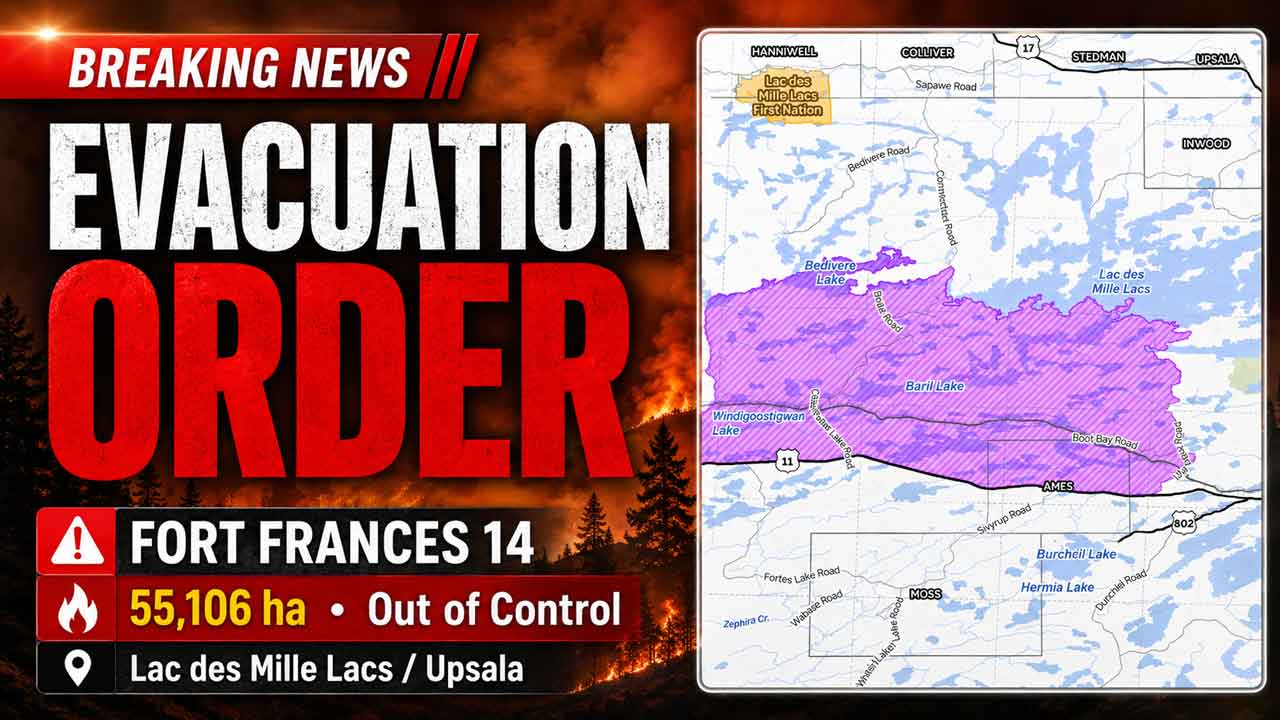 Environment
Updated Evacuation Information for Wildfire Fort Frances 14 (July 17 2026)
Environment
Updated Evacuation Information for Wildfire Fort Frances 14 (July 17 2026)
 Environment
50-hectare wildfire burns between Clearwater and 100 Mile House
Environment
50-hectare wildfire burns between Clearwater and 100 Mile House
 Environment
A powerful movement of healing arrives at Delta’s Discovery Centre
Environment
A powerful movement of healing arrives at Delta’s Discovery Centre
 Environment
2 wildfires north of Anahim Lake currently out-of-control
Environment
2 wildfires north of Anahim Lake currently out-of-control
 Environment
Port Coquitlam mayor launches program that removes graffiti on public property within 48 hours
Environment
Port Coquitlam mayor launches program that removes graffiti on public property within 48 hours
 Environment
'Fending for ourselves' after Manitoba wildfire forces evacuation: O-Pipon-Na-Piwin leaders
Environment
'Fending for ourselves' after Manitoba wildfire forces evacuation: O-Pipon-Na-Piwin leaders
More Local Coverage
Latest news Business
AI Market Trends: Q2 2026 Review and Forecast
Business
AI Market Trends: Q2 2026 Review and Forecast
 Politics
Powerful pro-life ad featuring boxing legend to air during final World Cup matches
Politics
Powerful pro-life ad featuring boxing legend to air during final World Cup matches
 Local News
Cowichan sports shorts: rugby, hockey, biking
Local News
Cowichan sports shorts: rugby, hockey, biking