

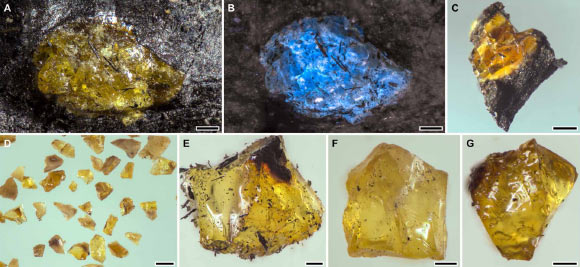
Paleontologists in China have discovered what they say is the earliest confirmed pieces of amber ever found, a fossilized resin roughly 385 million years old (Middle Devonian epoch) that predates the previous record-holder by about 65 million years.
Paleontologists in China have discovered what they say is the earliest confirmed pieces of amber ever found, a fossilized resin roughly 385 million years old (Middle Devonian epoch) that predates the previous record-holder by about 65 million years. The discovery also suggests that resin production evolved in plants well before seed plants existed. “Amber, specifically fossilized resin, is thought to be one of the ancient exudates of seed plants,” said Dr. Cihang Luo, a researcher with the Nanjing Institute of Geology and Palaeontology at the Chinese Academy of Sciences and the Senckenberg Research Institute and Natural History Museum, and colleagues.
“Seed plants usually secrete resin through specialized secretory tissues of plant surfaces or, on a larger scale, via their internal secretory systems associated with bark and wood.” “These resins, which are complex mixtures of primarily terpenoid and/or phenolic compounds, help plants recover from various biotic and abiotic injuries, including those from pests, microbial pathogens, and wildfires.” “Secreted resin hardens and transforms into amber during diagenetic and catagenetic processes, under elevated temperatures and pressures.”
“The viscous resin sometimes traps organisms, which are subsequently preserved as fossil inclusions within amber, providing critical information on the evolution of terrestrial ecosystems.” In their research, Dr. Luo and co-
Source and reference
authors analyzed about 10 kg of coal collected from a coal seam in the Hujiersite Formation near Hoxtolgay in China’s Xinjiang region. Using ultraviolet light, they located small clusters of amber embedded within the coal and ultimately extracted 241 tiny pieces — most measuring just 0.1 to 0.5 mm across — by hand under a microscope. Most of the amber is translucent to opaque and ranges from pale yellow to dark brown. Some pieces contain bubbles, and the fossils fluoresce bright blue under ultraviolet light. The amber-bearing layer in the Hujiersite Formation is Middle Devonian, approximately 385 million years old. Until now, the oldest definitively verified amber came from the Late Carboniferous, about 320 million years ago. “Although amber is a unique repository of environmental, diagenetic, and biological data, its occurrence is not continuous through Earth history,” the...
Read original source- Published
- Jul 17, 2026
- Updated
- Jul 17, 2026
- Source
- Sci.news: Breaking Science News
- Category
- Technology
- Read time
- 4 min
Key facts
Why this matters locally
This technology story matters locally because it may affect readers, businesses, commuters, families, or public services in British Columbia.
Local impact
BC Post links this item to British Columbia coverage so readers can follow related city updates, weather, traffic, events, and category news in one place.
Timeline
Source and credit
BC Post may summarize, organize, and add local context for reader clarity. Original reporting remains with the listed publisher.
Related Articles
View all Technology
Transformer-manufacturing company to shut down its Chilliwack facility
Technology
Transformer-manufacturing company to shut down its Chilliwack facility
 Technology
Quebec announces plan to train more aerospace workers as demand surges
Technology
Quebec announces plan to train more aerospace workers as demand surges
 Technology
Apple’s Lawsuit Could Choke OpenAI’s iPhone Rival Before It Even Ships
Technology
Apple’s Lawsuit Could Choke OpenAI’s iPhone Rival Before It Even Ships
 Technology
Texting a stranger works better to fight loneliness than talking to an AI chatbot
Technology
Texting a stranger works better to fight loneliness than talking to an AI chatbot
 Technology
GO train users could face delays, cancellations due to ‘crew constraints’: Metrolinx
Technology
GO train users could face delays, cancellations due to ‘crew constraints’: Metrolinx
More Local Coverage
Latest news Politics
Powerful pro-life ad featuring boxing legend to air during final World Cup matches
Politics
Powerful pro-life ad featuring boxing legend to air during final World Cup matches
 Business
AI Market Trends: Q2 2026 Review and Forecast
Business
AI Market Trends: Q2 2026 Review and Forecast