

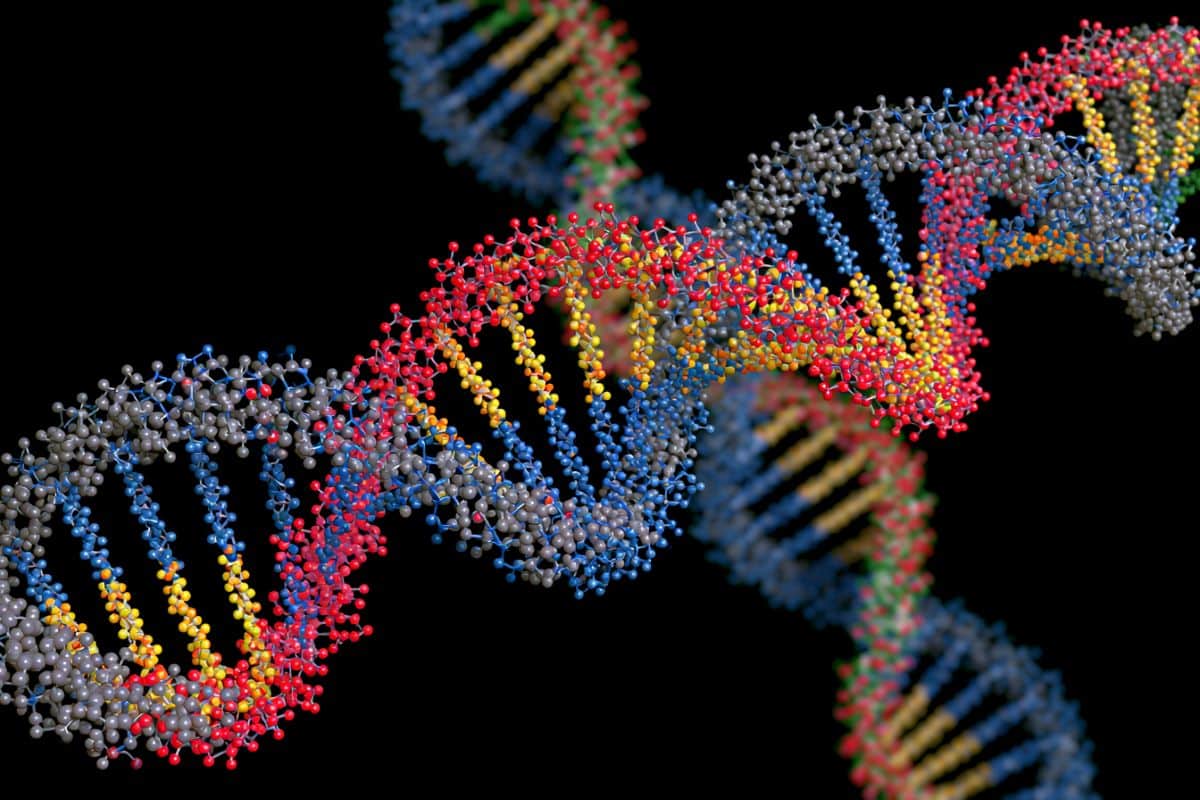
A new study introduces BINND, a deep learning model designed to predict complex, non-complementary DNA-DNA binding interactions.
The deep learning model BINND can accurately map hypercomplex, non-complementary DNA-DNA binding behaviors, overcoming a primary scaling bottleneck for molecular data storage. Credit: Neuroscience News Summary: Researchers developed and trained a novel deep learning model named BINND (Binding and Interaction Neural Network for DNA). Powered by an unprecedented dataset of 144 million sequence pairs, BINND predicts complex DNA-DNA binding affinity with outstanding accuracy, outperforming the previous state-of-the-art models and establishing a vital tool to scale up DNA-based computing and data retrieval.
Key Facts The Hyperconnectivity Barrier Broken: Traditional models treat DNA binding as a simple, isolated “Yes/No” interaction. BINND is specifically engineered to handle “hyperconnected” networks—predicting how multiple different strands of DNA interact with one another simultaneously, mimicking the crowded environment of a living cell or a complex DNA computer. Empirical Data Overestimation Avoided: Rather than extrapolating predictions from basic biophysical or thermodynamic formulas (which struggle to account for non-linear molecular behaviors), the team built a physical library of 144 million sequence pairs to train BINND directly on empirical, real-world binding events.
High Predictive Accuracy: In proof-of-concept testing, the BINND deep learning model achieved 83.5% accuracy in predicting binding behaviors, outperforming current state-of-the-art models by a minimum of 10%. Asymmetrical Safe Failures: When the AI model did make an error, it demonstrated a predictable safety bias: it tended to predict that two DNA strands would not bind when they actually did, rather than falsely claiming a non-existent bind would occur. This helps researchers avoid catastrophic background interference (crosstalk) in molecular diagnostics.
The Matrix Demonstration: To showcase BINND’s practical utility, the team constructed an interactive database mapping the cross-binding relationships of ninety-six 20-character DNA sequences against twenty-six other 20-character sequences, establishing a reliable “address book” for storing and retrieving molecular data. Unlocking Scalable DNA Computing: Storing vast archives of human data inside microscopic DNA molecules requires rapid, error-free physical data retrieval.
By providing a reliable roadmap of exactly which DNA strands will stick together, BINND solves a fundamental scaling challenge, paving the way for molecular hard drives capable of storing petabytes of data in a single droplet.
Source and reference
Source: North Carolina State University Researchers have demonstrated a novel AI model that can predict which DNA molecules bind with which other DNA molecules. Providing a more thorough understanding of these hypercomplex binding relationships has utility in applications ranging from biomedical diagnostic tools to DNA computing. “We often think about binding as a very simple relationship – Molecule A binds to Molecule B,” says Albert Keung, co-corresponding author of the study and an associate professor of chemical and biomolecular engineering at North Carolina State University. “But in biological systems, it’s far from simple. Molecule A may bind to dozens of other molecules, to varying degrees. “Capturing that hypercomplexity is a significant challenge, but it is critical if we want to better understand natural genetic systems,” says Keung, who is the Goodnight Distinguished...
Read original source- Published
- Jul 14, 2026
- Updated
- Jul 14, 2026
- Source
- Neuroscience News
- Category
- Technology
- Read time
- 7 min
Key facts
Why this matters locally
This technology story matters locally because it may affect readers, businesses, commuters, families, or public services in British Columbia.
Local impact
BC Post links this item to British Columbia coverage so readers can follow related city updates, weather, traffic, events, and category news in one place.
Timeline
Source and credit
BC Post may summarize, organize, and add local context for reader clarity. Original reporting remains with the listed publisher.
Related Articles
View all Technology
Transformer-manufacturing company to shut down its Chilliwack facility
Technology
Transformer-manufacturing company to shut down its Chilliwack facility
 Technology
Spectro Cloud Raises $100 Million Series D to Help Customers Move AI Infrastructure Into Production Across Enterprise, Public Sector, Neocloud and Sovereign Cloud Environments
Technology
Spectro Cloud Raises $100 Million Series D to Help Customers Move AI Infrastructure Into Production Across Enterprise, Public Sector, Neocloud and Sovereign Cloud Environments
 Technology
Quebec announces plan to train more aerospace workers as demand surges
Technology
Quebec announces plan to train more aerospace workers as demand surges
 Technology
Apple’s Lawsuit Could Choke OpenAI’s iPhone Rival Before It Even Ships
Technology
Apple’s Lawsuit Could Choke OpenAI’s iPhone Rival Before It Even Ships
 Technology
ECT Reprograms Adult Neurons into a Youthful State
Technology
ECT Reprograms Adult Neurons into a Youthful State
 Technology
GO train users could face delays, cancellations due to ‘crew constraints’: Metrolinx
Technology
GO train users could face delays, cancellations due to ‘crew constraints’: Metrolinx
More Local Coverage
Latest news Business
AI Market Trends: Q2 2026 Review and Forecast
Business
AI Market Trends: Q2 2026 Review and Forecast
 Politics
Powerful pro-life ad featuring boxing legend to air during final World Cup matches
Politics
Powerful pro-life ad featuring boxing legend to air during final World Cup matches